How Do Cats Show Submission? Vet Reviewed Behavior Explained


In this article
Like dogs, cats exhibit submissive behaviors, but how they demonstrate these differs from the often less-subtle manner of canines. For example, felines change the position of their ears or tail, crouch their body, or expose their belly. Essentially, they show submission with all the elegance and subtlety that characterizes them so well. Read on to learn more about what submission means in cat language!

What Does Submission Mean in Cats?
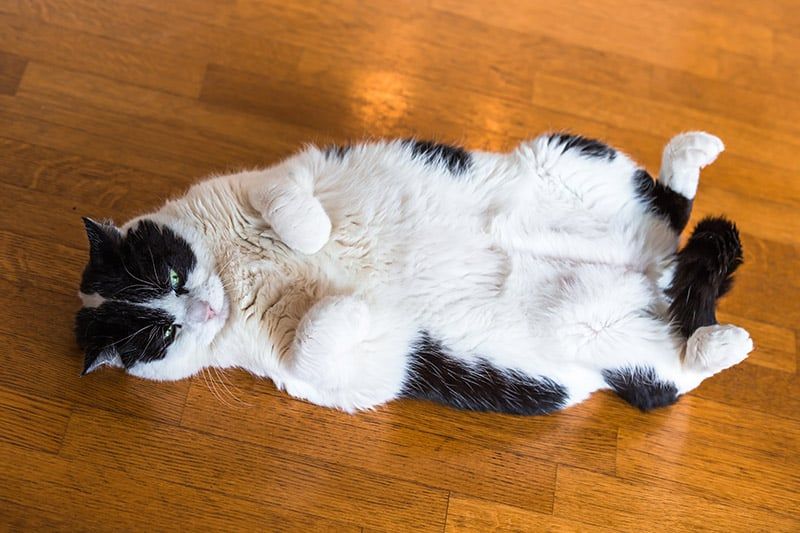
Subordinate behavior has been widely described in many carnivorous species, such as wolves. However, it is relatively rare among felines due to their more solitary nature. That said, the lion, the cheetah, and the domestic cat all tend to group together and have complex social structures. Interestingly, biologists and other researchers who have looked at the social relationships of these felids have noticed both aggressive and submissive behaviors. In an established group of cats, the lower-ranking cats (the subordinates) show that they “respect” the dominant ones by using subtle signals instead of fighting. When encountering a dominant cat, a subordinate cat might look away, lower their ears, turn their head, or lean back. In more intense situations, the subordinate cat may flatten their ears, lower and curl their tail to the side, turn their head, and crouch their whole body. In extreme cases, the submissive cat may roll over and show their vulnerable belly as a sign of submission. Therefore, submissive behaviors in cats include:
- Low, crouched body posture
- Flattened ears
- Vocalizations (meowing or purring)
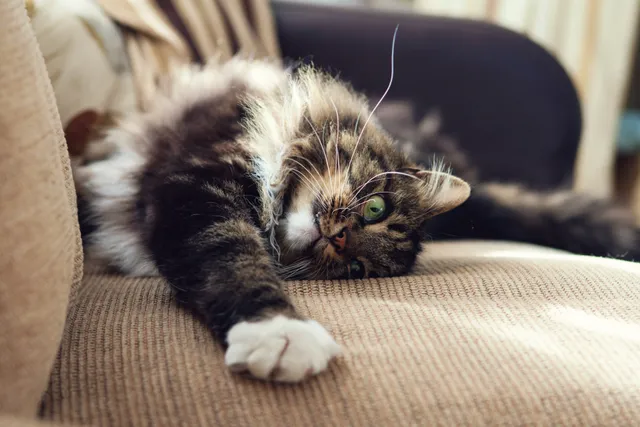
- Rolling posture (rolling on the back with splayed legs and belly exposed)
- Tucked tail

Is There a Difference Between Showing Submission and Showing Affection?
Yes, there is a difference between showing submission and showing affection, with submission generally being considered a sign of respect.
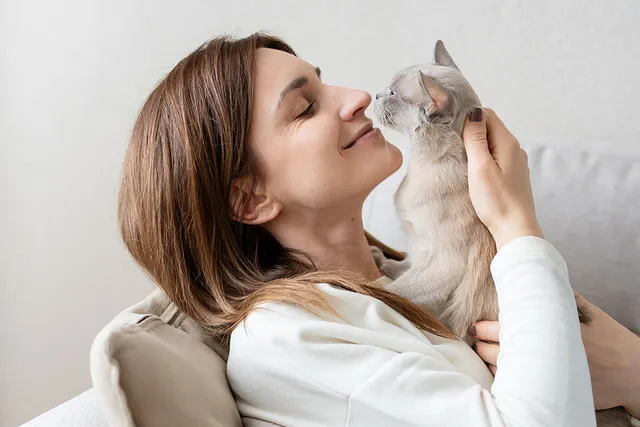
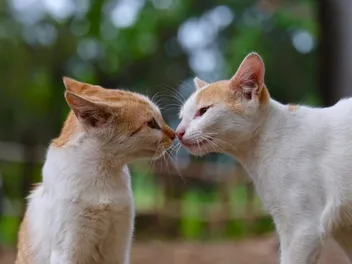
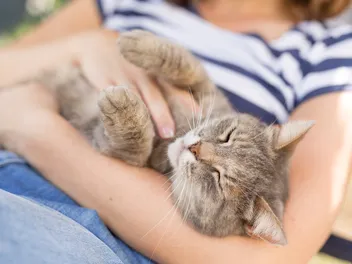
Common signs of affection in cats include slow blinking, headbutting, kneading (also known as “making biscuits”), purring, and for cats allowed outdoors, bringing you little “presents,” such as dead birds or rodents. Conversely, showing their belly can be a sign of both affection and submission. Your cat is demonstrating how much they trust you.
Should You Train Your Cat to Show Submission?
While some cats may naturally be submissive, others may not, and this is entirely normal. So, instead of trying to make your cat more submissive, it's best to focus on creating a calm, less stressful environment for them. Also, never force your cat to submit, as it can lead to anxiety and fear. Positive reinforcement can be used to encourage desirable behaviors while respecting your cat's individuality.
Building trust and a positive relationship with your feline pal is often more effective than trying to change their natural behaviors. However, if you have concerns about your pet's behavior, it’s best to seek advice from a vet for proper guidance.
What Does Dominance Mean for Cats?
The American Veterinary Society of Animal Behavior defines dominance in animals as a “relationship between two or more individuals that is established by force, aggression, and submission in order to gain priority access to resources.” However, dominance in domestic cats can be a confusing topic, as a few studies have shown that these small felines don’t always demonstrate “explicit hierarchies,” even in feral groups.
That said, some cats can sometimes show signs of aggression toward their owners or other pets, which can be perceived as a form of social dominance. For example, if your cat blocks the path to the stairs by sprawling on the steps and snapping at anyone trying to pass, this is potentially a form of status-induced aggression. According to the experts at Cornell Feline Health Center, the best way to combat this type of behavior is to ignore your cat completely. Any form of attention, including play and food rewards, only reinforces this behavior.
Final Thoughts
Cats use subtle signals to show their submission. These involve lowering their ears slightly or flattening them, curling their tail against the thigh, crouching their body, rolling over, or exposing their belly. These signs can be seen in an established group of cats, but they are not so easy to spot. Among their owners, the signs of submission can sometimes be confused with those of affection, but these are subtle differences. In any case, cats should not show aggression toward their humans or other pets in the home, so it is essential to seek advice from your veterinary team if your cat is overly aggressive.
Also see:
Do Cats Think We Are Cats, Only Bigger? How Felines Perceive Us
Do Cats Make Friends With Other Cats? Feline Social Behavior Explained
How to Show Dominance to a Cat: 10 Tips for Becoming More Assertive
Featured Image Credit: Benny Marty, Shutterstock
Expert cat care, straight to your inbox
News, insights, and useful advice, delivered to you.

No spam — unsubscribe anytime.
By signing up, you agree to our Terms & Conditions and Privacy & Cookies Policy.
How useful was this post?
Click a star to rate. You can leave written feedback afterwards. (We read all feedback.)
Genevieve is both a biologist and a science writer, driven by her deep love for capuchin monkeys, pumas, and kangaroos. Her dedication to wildlife has taken her across the globe, from Bolivia and Guatemala to Canada and Australia, working and volunteering at various rehabilitation centers. As a Canadian living in Argentina, Genevieve starts her days with horses and cows greeting her from the plains outside her home office. She is the proud parent of three rescued dogs—Lemmy, Nala, and Pochi—and an energetic kitten named Furiosa. The opportunity to share her passion and expertise in animal care brings her great satisfaction.