Can Kittens Climb Stairs? Early Development & Safety Info (Vet-Verified)


In this article
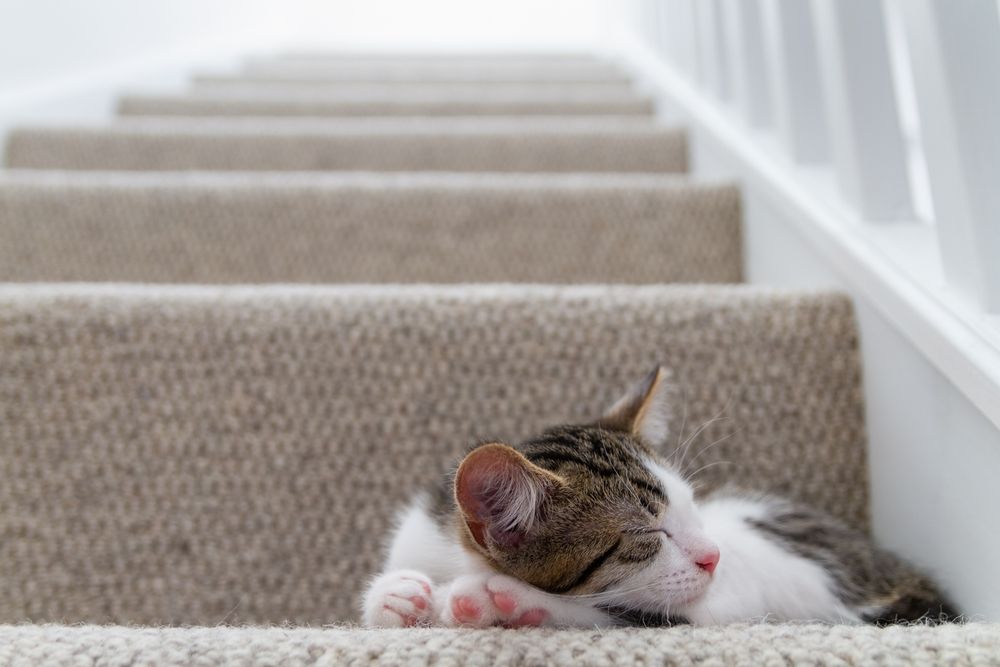
Often, kittens are too small to climb stairs easily, but it depends on the kittens and the stairs. Carpeted stairs are easier for kittens to climb since they can use their claws to climb up. Indeed, climbing is very easy for cats due to the way their claws are naturally shaped and oriented.
Kittens can climb up stairs when they’re relatively young—a boisterous 4- or 5-week-old kitten could definitely claw their way up carpeted stairs. However, because their vision continues to develop until they are about 9 weeks old, they may not have spectacular depth perception prior to this age and consequently may fall down from a height and injure themselves. Therefore, stair climbing should be supervised for kittens until they are at least 3 or 4 months old.
Introduction or desensitization to stairs isn’t critically important for kittens. Healthy, normal kittens can instinctively climb up stairs that aren’t too slippery or steep. Stairs also aren’t a known phobia for cats. Therefore, waiting until your kitten is slightly older before allowing them to take on stairs is perfectly acceptable.

Is It Bad for Kittens to Climb Stairs?
Kittens love to climb. Therefore, it isn’t necessarily bad for them to climb stairs. They will likely be climbing just about everything, anyway. However, you shouldn’t allow the kittens to climb up the banisters or on stairs when they’re young, as they might not be able to properly perceive height and depth and therefore might take a very unfortunate tumble.
Kittens are born blind, and their eyes open at around the second week of life. However, their vision continues to develop thereafter. The retina within each eye continues to develop the various receptors necessary for vision. The central parts of the retina complete development between 4 and 5 weeks after birth, and the side regions, known as the retina’s periphery, complete development at around 9 weeks of age 1.
This means that though kittens are ambulatory and able to climb when they’re around 4 weeks old, their vision isn’t developed well enough for them to know what a safe height is and how they should navigate properly when it comes to going up and down stairs. As a result, if left unsupervised, a kitten younger than 9 weeks of age may fall from a high canopy and injure themselves.

Do note that a cat’s “righting reflex” also doesn’t properly develop until they are at least around 8 to 9 weeks old, either. This means that a kitten under the age of 2 months can most definitely fall without meaning to and will also probably lack the ability to orient themselves properly during the fall to minimize the risk of injury from the fall itself.
In addition, kittens can fall through safety railings since they're tiny. Like children, they may also not be aware of the risks of stairs and inadvertently fall off when playing with a littermate on a staircase. It’s best to let them develop better motor skills before allowing them to climb the stairs without supervision.
You can block the spaces between the banisters with cardboard or a similar barrier. Be sure that your kitten can’t climb over or under it. As mentioned earlier, there’s no reason to rush introducing stairs to your kitten. You can always wait until they’re older and better developed.
Though kittens can instinctively climb and have claws that naturally assist in this process, coming down from a height is considered learned behavior and takes some practice. It’s best to have carpeted stairs so that your kitten has adequate grip when learning how to manage stairs.
At What Age Can Kittens Manage Stairs?
Kittens can physically climb stairs at around a month old. However, as mentioned earlier, it’s not safe for them to climb unassisted at such a young age. It’s best to wait until they are around 3 months or older. It’s important to note that kittens that are born with ocular or motor defects (such as an eye that doesn’t open) should never be allowed to climb stairs unsupervised, as they may never develop the ability to properly gauge the depth or height of a surface properly.

What Age Can Kittens Climb?
Most kittens learn to climb at a young age—around 3 weeks old. At this point, they come out of their dens and start exploring. Kittens take a little while to gain motor skills, so they’re often quite clumsy when they are around 3 to 4 weeks old. They also often practice their locomotive skills by playing with their littermates.
By 6 weeks, all kittens should be able to run, climb, and play. That being said, this age doesn’t completely develop their vision, and they aren’t considered as athletically competent as an adult cat is. A healthy juvenile kitten that’s 4 months old should be able to handle climbing without any issues though.
Conclusion
Kittens are physically able to climb stairs when they are around a month old. However, as their vision is not properly developed until they are around 9 weeks old, unsupervised stair climbing isn’t recommended for a kitten until they are at least at this age. Ideally, it’s better to wait until a kitten is at least 3 months old or so.
Carpeted stairs are often easier for kittens to climb, as they offer more grip for them. Generally speaking though, there’s no reason to rush introducing your kitten to stairs, as the risk of a fall isn’t worth an early introduction to stairs.
Featured Image Credit: Mandy Short Photography, Shutterstock
Expert cat care, straight to your inbox
News, insights, and useful advice, delivered to you.

No spam — unsubscribe anytime.
By signing up, you agree to our Terms & Conditions and Privacy & Cookies Policy.
How useful was this post?
Click a star to rate. You can leave written feedback afterwards. (We read all feedback.)
Kristin is passionate about helping pet parents create a fulfilling life with their pets by informing them on the latest scientific research and helping them choose the best products for their pets. She currently resides in Tennessee with four dogs, three cats, two fish, and a lizard, though she has dreams of owning chickens one-day!