Can Cats See Infrared Lights? Feline Vision Facts


In this article
Most cat parents feel that because cats are sensitive animals, they can see many things that humans can’t. Well, this could be true, except that cats cannot see infrared lights.
Although cats have superior night vision and a wider angle of view than humans, they don’t see infrared lights just like humans. But why can’t your kitty see infrared rays? Read on to find out.

What Is Infrared Light?
Infrared light is a type of electromagnetic radiation. Like other radiation, it is produced when atoms absorb and then release energy.
Infrared light is part of the electromagnetic spectrum, which includes high-frequency gamma-rays, X-rays, ultraviolet radiation, visible light, infrared radiation, and microwaves, along with low-frequency radio waves.
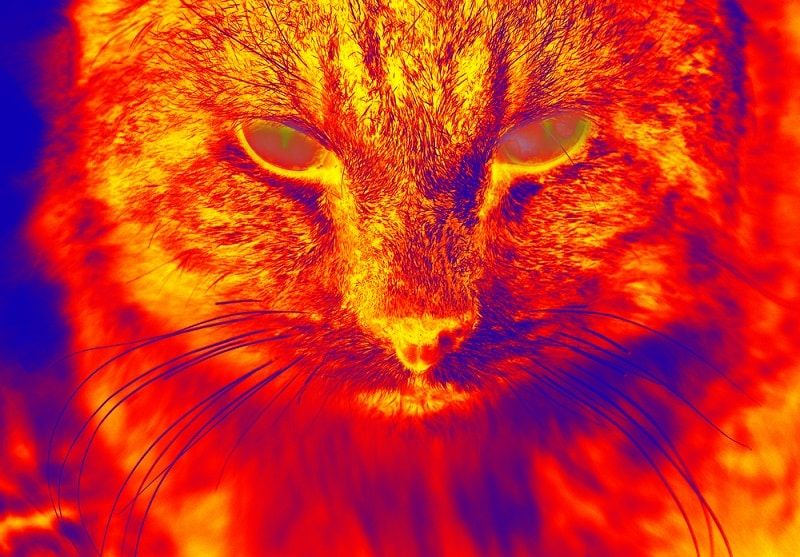
Also known as infrared radiation, infrared light is a type of radiant energy that’s invisible to both cat and human eyes. However, we can feel it as heat. Every object in the universe emits some level of infrared radiation, but two of the most obvious sources are fire and the sun.
Infrared radiation is one of the three ways heat is transferred from one object to another. The other two are convection and conduction.
The infrared spectrum has its range of wavelengths. The shorter “near-infrared” waves, like the ones discharged from a TV remote control to change channels, don’t emit any detectable heat. The longer infrared waves can be felt as intense heat. These are closer to the microwave section on the electromagnetic spectrum.
Why Cats Can’t See Infrared Lights
Cats are warm-blooded mammals, and warm-blooded creatures do not have infrared vision. If mammals like cats and humans could see infrared light, their body heat would create massive interference, meaning their eyes would see a world of temperature instead of color.
Cold-blooded animals, such as some species of snakes, can detect infrared radiation. They use this to locate their prey.
Overexposure to infrared lights, especially those near the microwave spectrum, raises the internal temperature of any creature’s eyes. This heat could essentially “bake” and harm their eyes.
Although cats can’t see infrared, they can detect it as heat. Cats have heat receptors, which is the reason for their uncanny ability to find warm spots anywhere.

How Do Cats See?
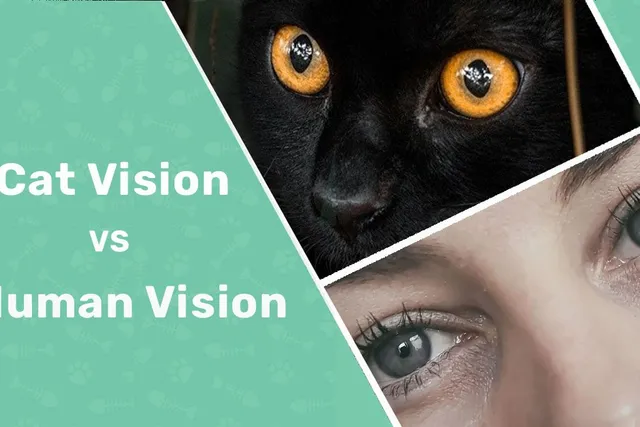
Although you may attribute your kitty’s fondness for laser pointers and shiny objects to its hunting instinct, this character has a lot to do with cats' unique and acute vision. While cats are more colorblind and cannot appreciate colors like other creatures, their world is not entirely black and white.
So, how do cats see?
1. Night Creatures
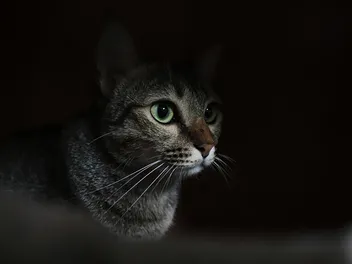
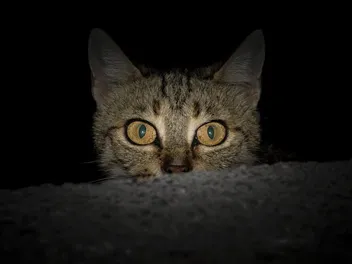
Cats have a superior ability to see in darkness, the reason why they are crepuscular creatures, meaning that they are most active at night and early morning.
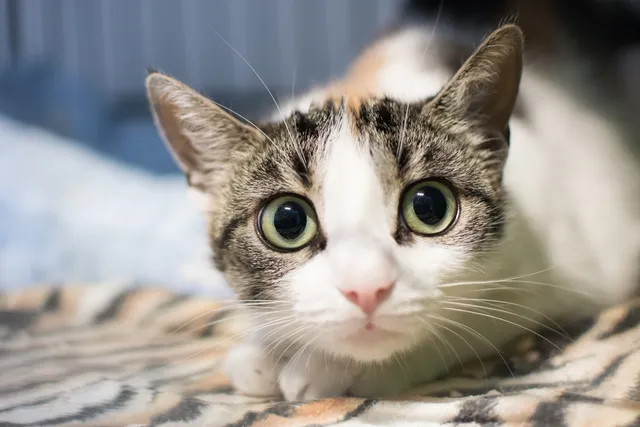
Felines have incredible night vision because of the high number of rods in their retina—six to eight times more than humans. These extra rod cells make the kitty more sensitive to dim light and motion in the dark than cat parents.
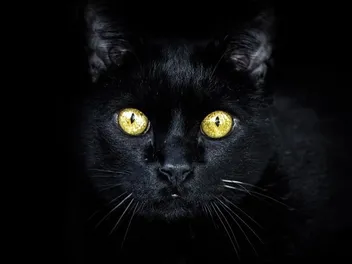
Oh, do you know why a cat’s eyes glow against flashlights in the dark? Cats’ eyes have a layer of tissue called the tapetum that reflects light to the retina. By reflecting light, this structure gives the eyes a chance to gather as much light as possible, the reason why their eyes glow in the dark.
2. Color Vision
Although cats have an edge during night vision, it's not the same case with color perception. Your kitty companion does not experience the color spectrum as humans do because of their eyes’ physical structure.

The reason is, that the human eye has ten times light receptors known as cones, which function best in bright light. This characteristic gives humans up to 12 times better motion detection in bright light than felines.
Humans are also trichromats, which means that they have three types of cones that allow them to see a broad color spectrum, especially blue, green, and red. While cats are also trichromats, the cone’s distribution varies, making kitties unable to see the full range of hues as humans.
But just because felines can’t perceive spectrums like humans doesn’t mean that they don’t perceive different colors completely. A feline’s vision is similar to a colorblind human who may have difficulty seeing objects’ “true” pigmentation.
Since these animals are less sensitive to brightness changes, they can efficiently visualize every item in blue, yellow, and gray shades.
3. Nearsighted
Besides color perception, felines also lack visual acuity, which refers to the clarity of vision. A cat's imagery is not as sharp as a human’s because its eyes lack the necessary muscles that alter its lenses’ shape.
This characteristic makes felines more near-sighted, making them unable to see objects at the same distance as humans can. Instead, cats need to be further away to get a more excellent resolution since an item appears blurry until the cat is much closer to it.
4. Periphery Vision
A cat has a broader angle of view—200 degrees compared to a human's 180 degrees—to compensate for the other vision deficiencies.
Felines have a wider visual field because their eyes are more on the sides of their heads, giving them a better advantage at periphery vision than humans. This means that cats can see what’s ahead of them, above, below, and even to the sides comfortably.

Can You Treat Cats With Red Light Therapy?
Although cats may not see ultra-red lights, your kitty can immensely benefit from Red Light Therapy. Red Light Therapy is a natural, chemical-free, holistic, and non-invasive therapeutic technique that helps treat various human and pet conditions.
Red light therapies use red and low levels of infrared light wavelength to treat various pet issues like:
How Does Red Light Therapy Work on Cats?
The good thing about cats is that although they can’t see infrared lights, they can feel it as heat on their skin, the reason why practitioners expose cats to near-infrared and low levels of red light wavelengths.

While red lights only reach the tissues and heal surface wounds, infrared rays usually penetrate deeper tissues like ligaments, muscles, and bones. Cells then soak the wavelengths up, boosting energy levels which hasten the body’s healing process. And, no! Red light therapy does not hurt or burn a cat’s skin.
What Animals Can See Infrared Lights?
1. Snakes
Could the infrared vision be the snake’s sixth sense? Snakes such as boas, rattlesnakes, and pythons have hole-like receptors known as pit organs on their faces. These organs allow snakes to integrate infrared capacity with their regular sight.
When heat from prey animals reaches these pit organs, it activates the receptors’ protein channel, enabling the snakes to see in the dark. The pit organs allow the snakes to detect a prey’s image from a distance by sensing thermal cues from the animals’ bodies, giving them an incredible extra sense.
2. Bullfrogs
Frogs, such as bullfrogs, use an enzyme that links to vitamin A, a compound that adapts their sight to see infrared radiation regardless of environmental changes.
Unlike the fish, a bullfrog's eyesight is suitable for both open-air and waters, allowing them to retain their infrared vision both in murky waters and dry land. Additionally, bullfrogs have eyes that contain enzymes, which enable vision in the air and the water surface. This makes it easy to catch prey like flies.

3. Bloodsucking Insects
Mosquitoes and bedbugs rely on the smell of carbon dioxide gas that animals and humans exhale to hunt for food, just like other insects.
However, what sets mosquitoes and bedbugs apart is that they can also rely on their infrared seeing skills to pick up thermal signals and detect body heat from prospective warm-blooded hosts to bite.
4. Fish
Some fish types, like salmon, piranhas, goldfish, and cichlids, have enzymes that activate their visual systems to see red and infrared lights. For instance, when salmons migrate from open salty oceans to murky freshwaters, the enzymes switch their eyesight, allowing them to see more clearly. This adaptation helps them to navigate and hunt in new environments.
Similarly, freshwater fish like cichlids and piranhas can detect far-red light, which is the range of light that precedes infrared light on the light spectrum. On the other hand, goldfish can detect both far-red light and ultraviolet rays interchangeably.

Summary
Even though cats see well in the dark, these animals do not enjoy the same visual capacity and clarity as humans. In other words, cat-versions of environments appear less vibrant and less appealing than people-versions.
But that shouldn’t make you ignore and assume your cat’s eyesight health. Be sure to test its vision capacity as it’s already blurry and can still degenerate further, impairing vision or causing blindness.
See also:
Featured Image Credit: Maximillian cabinet, Shutterstock

Expert cat care, straight to your inbox
Vet-reviewed advice, behavior tips, and the best of Catster. Free, and you can unsubscribe anytime.
By signing up, you agree to our Terms & Conditions and Privacy & Cookies Policy.
Christian started writing for a local newspaper as a teenager, and he's been involved in the publishing industry for most of his adult life. Combining his love of writing with a passion for animals, he is currently the Director of Editorial at Pangolia and the Editor-in-Chief at Catster.
Christian lives in the Philippines with his wife, son, and four rescue cats: Trixie, Chloe, Sparky, and Chopper.
Join the conversation
Ask a question, share your story, or send private feedback.