How Do Cat Eyes Work? Vet-Reviewed Facts & FAQ


In this article
If you’re wondering why your cat has such an air of self-importance and superiority about them, it might be because their senses are so powerful and complex that they consider us mere humans simply inferior—and rightly so! Did you know that cats can smell approximately 14 times better than we humans can? Or that they can hear sound frequencies up to 85,000 Hz, while we can only hear up to around 20,000 Hz?
Vision is another area in which cats outperform humans in many ways—though not all. In this post, we’ll explain how cat eyes work and how they perform in certain conditions compared to humans.

How Do Cat Eyes Work?
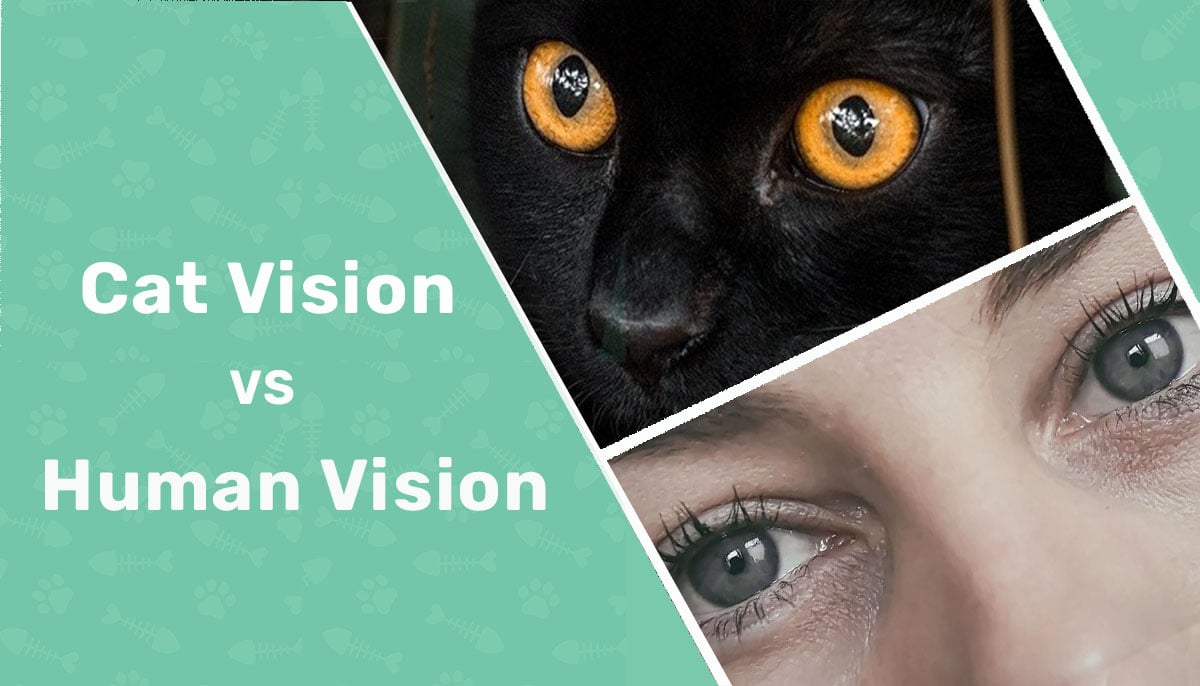
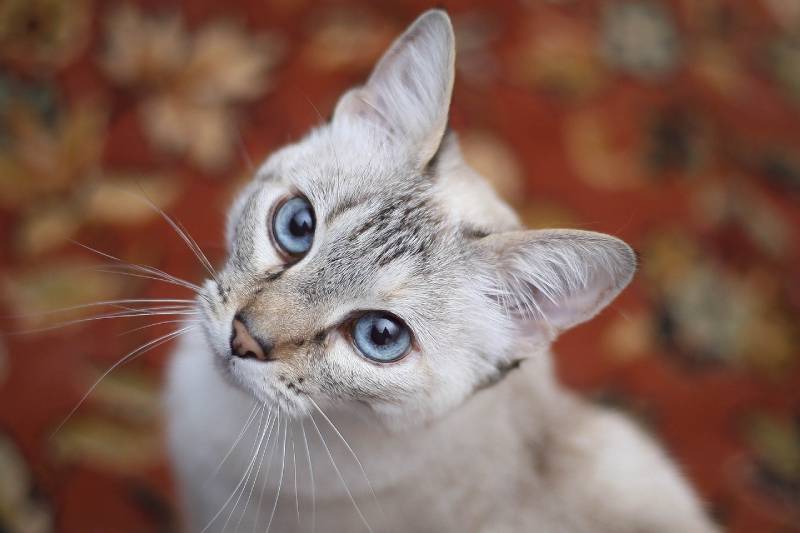
Cat eyes are made up of the sclera (the white part), conjunctiva (the membrane covering the sclera), cornea, iris, pupil, lens, and retina. The eyes also contain various cells that serve different purposes. The eye socket is referred to as the “orbit.” In terms of general functioning, a cat’s eyes work similarly to the way ours do.
The pupil in a human eye adjusts its size depending on how bright the light is, growing smaller in bright light and wider in lower light. This happens because the eye is trying to minimize the amount of bright light that gets into the eye (when it gets smaller) or allow for more light to enter (when it dilates/widens).
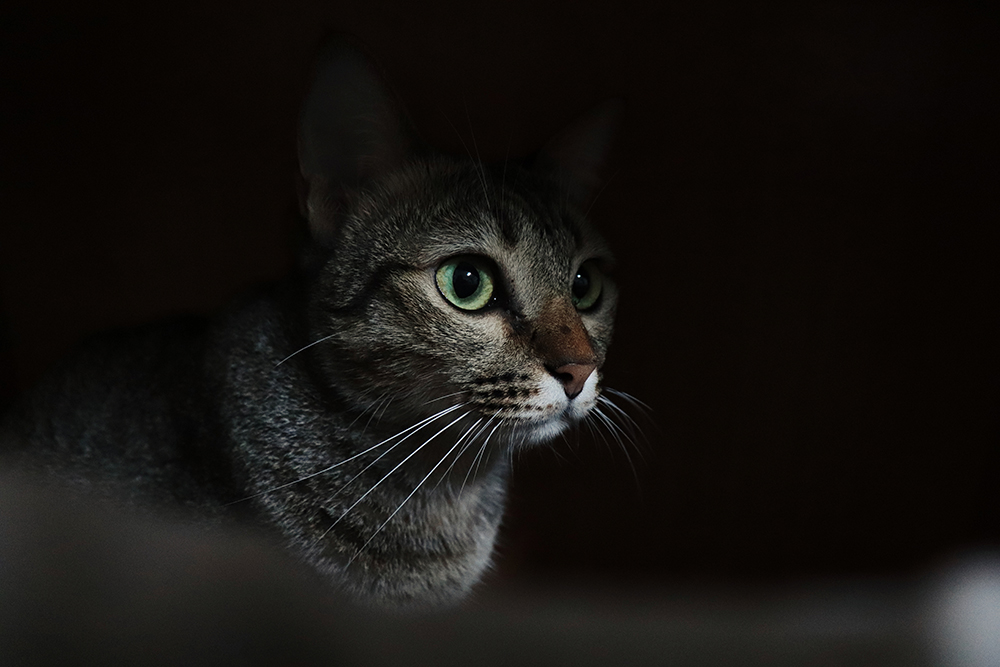
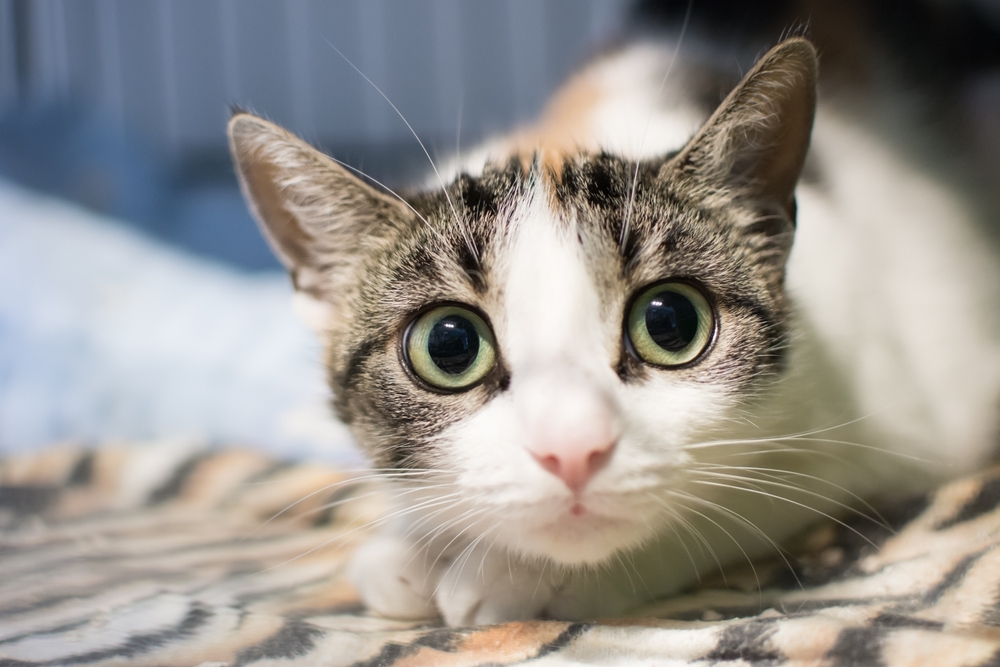
Cat eyes also respond to changes in lighting, but a cat’s pupils can dilate more than a human’s pupils can to let in more light, making their eyes appear almost entirely black in some situations. This means that a cat’s night vision is impressive. On the other hand, humans see better in daylight than cats can. Let’s dive into this in more detail and break down how a cat’s vision compares to that of a human.

The Power of Cat Eyes Explained
Here, we’ll explore what it’s like to see the world through a cat’s eyes. As mentioned above, night vision is one of the areas in which cats outperform us because their eyes are built to receive more light and make the most of small amounts of light. Let’s start there.
Night Vision
Though cats are similar to us in the sense that they can’t see in pitch-black conditions, they have much better night vision. This is due to several reasons. Firstly, cats’ retinas contain more rods; these are the photoreceptor, or light-sensitive cells, responsible for vision in low light conditions. Secondly, cats have a special layer behind their retina that we don’t.
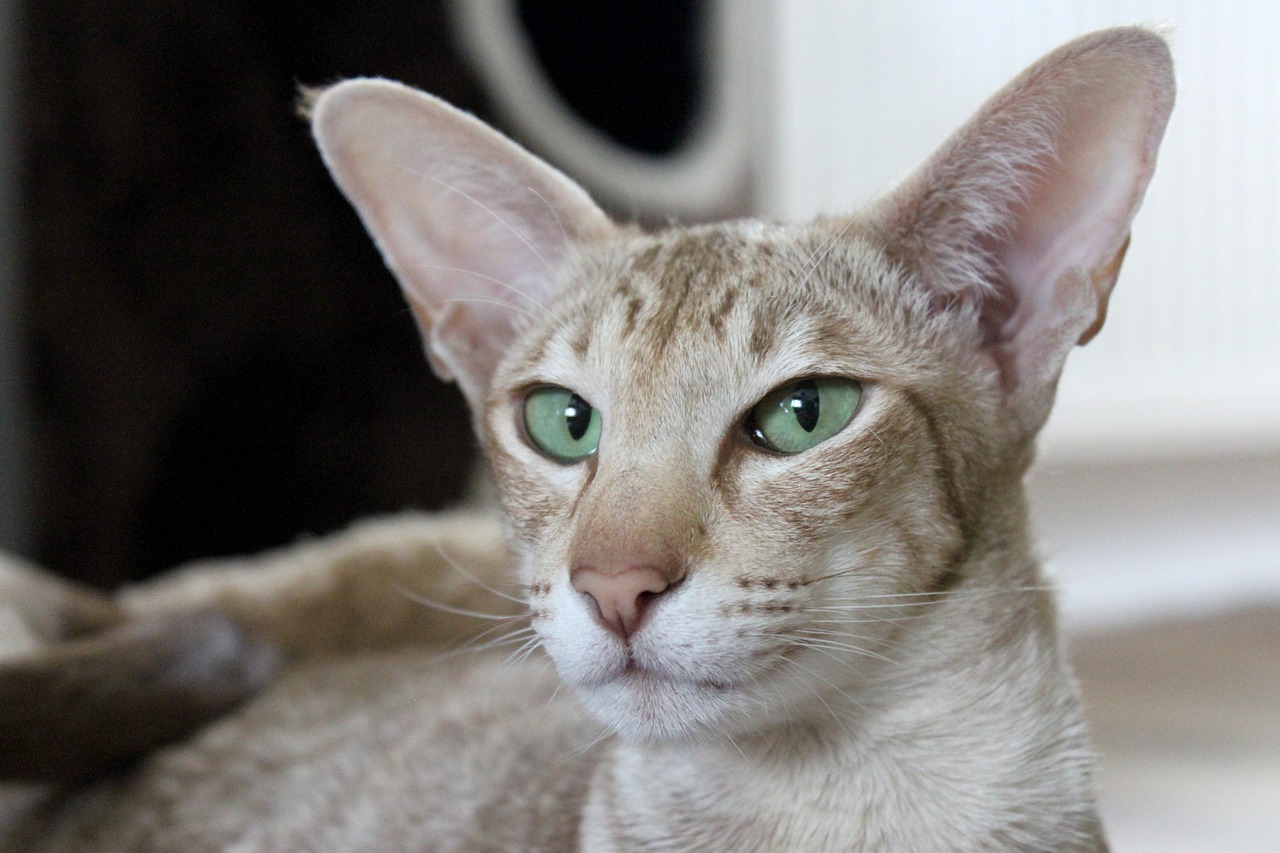
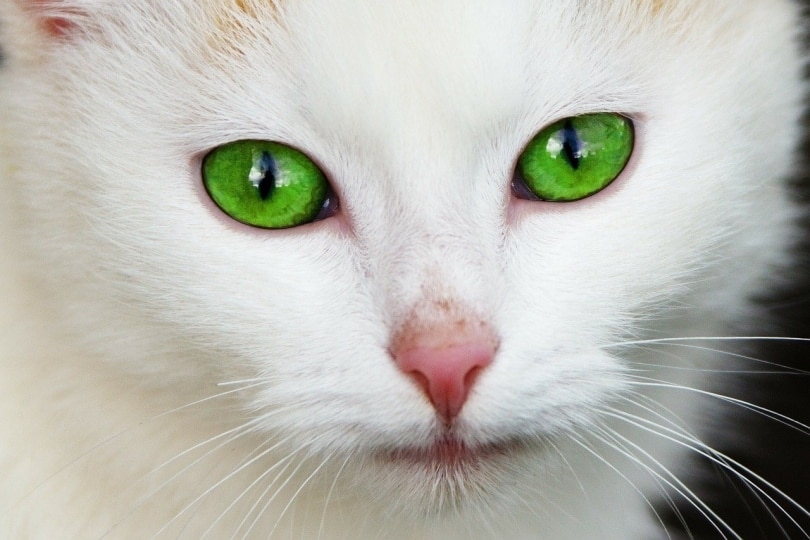
This layer is called the tapetum lucidum, and it reflects light back to the retina and gives the photoreceptors a second chance to use the light that enters the eye, causing the cat to experience a more augmented version of it and thereby improving their vision in low light conditions. If you’ve ever seen that odd green “glow” in a cat’s eyes, it means their tapetum is at work!

Colors
Color contributes greatly to how humans perceive the world, but this is a little different in cats. Both human and cat eyes contain “cones.” Cones are the second type of photoreceptor that are present in a cat’s retina. They are responsible for color vision, and their number and type determine how rich color vision is.
Humans have three types of cones that let them see many different colors and shades. Cats are also considered trichromats; however, they are thought to be able to differentiate between blues and greens, but shades of red and pink are not distinguishable. Also, colors do appear less vibrant to cats than they do to us.

Long-Distance Vision
Humans have the capacity to see objects further away than cats can. While we may get a perfectly good view of an object placed approximately 100 feet away from us and be able to make out its features, a cat would just see a blur.
A cat would have to be within around 20 feet of the object to be able to get a good view of it. Another point to the humans (cue looks of pure disdain and resentment from your cat).

Peripheral Vision
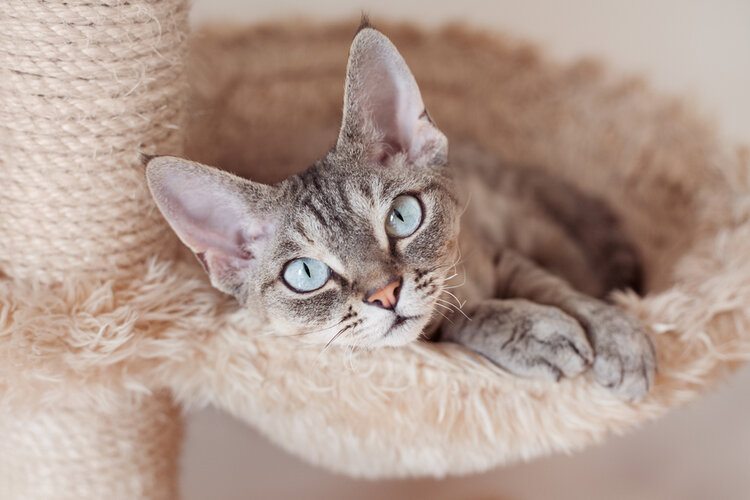
Though cats are weaker in the depth perception department than we are, they do have better peripheral vision. This is because while human eyes are set straight forward, cat eyes are on the sides of their head, giving them a field of view of approximately 200 degrees, so they can better evaluate their wider surroundings.
Motion Detection
The first type of photoreceptor we mentioned, the rods, not only help improve vision in dim light but are also responsible for motion detection. Cats have more rod cells than humans do, which is why they can detect movement better than we can, even if that movement is tiny and happens far away.

Why Is a Cat’s Vision the Way Is It?
A cat’s vision is adapted to help them survive in the wild as how well they see can mean the difference between an empty belly and a full one. It can also mean the difference between life and death if a predator is lurking nearby.
Cats are night hunters, and their impeccable night vision allows them to keep an eye on prey and evade predators when necessary. Meanwhile, the number of rod cells in the cat’s retina helps them pick up on sudden movements, which is beneficial for determining exactly where the prey or predator is located.
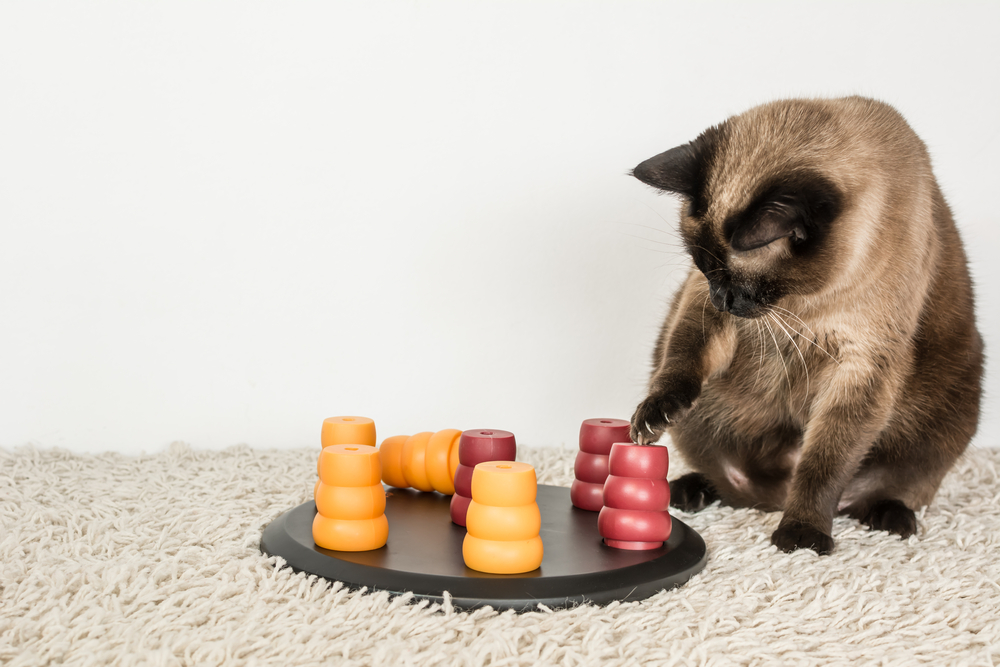
In domestic cats, these visual powers are transferred to the home environment. For example, they can spot the movement of a toy being dangled somewhere to the side of them, detect a mouse scuttling around in the yard, and pick up on birds flying at a distance while looking out of the window.

Advantages of a Cat’s Vision
Though a cat’s vision is impressive in a multitude of ways, it falls short in others. So, to sum up, we’ve decided to compile all the advantages and disadvantages for cats in terms of vision. Here are the advantages:
Disadvantages of a Cat’s Vision
Though there aren’t many, there are some ways in which a cat’s vision is inferior to that of a human. Let’s break this down:
Frequently Asked Questions
Do Cat Eyes Really Glow in the Dark?
Yes! Cats' eyes really glow in the dark. The way a cat’s retina contains a layer called a tapetum gives the eyes a greenish-yellow glow when it reflects light back to the retina. The color of the glow can vary and is not limited to just green/yellow.

Are Cats Color Blind?
Not entirely. Cats can see color, though they can’t see red and green. They also see colors as somewhat muted and are unable to appreciate their vibrancy in the way that humans can.
Is a Cat’s Vision Blurred?
Not always. Cats need to be within about 20 feet of an object to see it clearly. Any further and the cat will perceive the object as a blur.
Conclusion
Though the eyes of a cat are made and function similarly to ours, there are many differences that allow them, in some ways, to perceive the world in a way we cannot. Likewise, humans have certain visual strengths that give them an edge over cats, like being able to perceive objects further away and being able to perceive a broader spectrum of colors.
One thing’s for sure, though: a cat’s vision is one of their most important survival tools in the wild, along with their superior senses of smell and hearing.
Sources
https://firstvet.com/us/articles/how-good-is-a-cats-sense-of-smell
https://www.texvetpets.org/article/can-cats-see-in-the-dark/
https://www.livescience.com/40460-images-cat-versus-human-vision.html
https://www.hillspet.com/cat-care/behavior-appearance/cat-vision
https://www.hillspet.com/cat-care/behavior-appearance/why-do-cats-eyes-glow
https://www.msdvetmanual.com/cat-owners/eye-disorders-of-cats/eye-structure-and-function-in-cats
Featured Image Credit: Paulina Grzybowska, Shutterstock

Expert cat care, straight to your inbox
Vet-reviewed advice, behavior tips, and the best of Catster. Free, and you can unsubscribe anytime.
By signing up, you agree to our Terms & Conditions and Privacy & Cookies Policy.
Kit Copson is a freelance writer and lifelong animal lover with a strong interest in animal welfare. She has parented various furry beings over the years and is currently a proud cat mom of two—one very chilled (unless hungry) Siamese and a skittish but adorable Domestic Shorthair—and dog mom of one—an adopted Bichon Poodle cross. When not writing about or spending time with animals, Kit can be found doodling in her sketchpad, reading, or more often than not, drinking tea.
Join the conversation
Ask a question, share your story, or send private feedback.