Can a Cat Hear Better Than a Dog? Vet Approved Differences & Comparison



Cats and dogs often get compared to each other, and many people engage in heated debates to determine which pet is better than the other. When it comes to the arena of hearing, science has proven that cats generally have better hearing than dogs. They can detect sounds from further away and hear a wider range of pitches.
However, both animals have excellent hearing that surpasses human ability, and their ability to detect sounds is fascinating and worth investigating. Here’s what’s known so far about cats’ and dogs’ hearing.

A Comparison of Cats’ and Dogs’ Ears
Cats can pick up sounds between 45 to 64,000 vibrations per second (Hz), which is a relatively broad range for mammals. Dogs, on the other hand, can pick up sounds between 67 Hz to 45 kHz. So, cats can hear both lower and higher frequencies that dogs can’t. For context humans cannot hear sounds at 20 kHz or greater and our hearing is known to decrease as we age, with babies being able to hear higher frequencies than their parents.
Cats also do a better job of picking up on sounds. Both cats and dogs have ears that are made up of three main parts:
- The outer ear
- The middle ear
- The inner ear
Comparing Cat and Dog Hearing
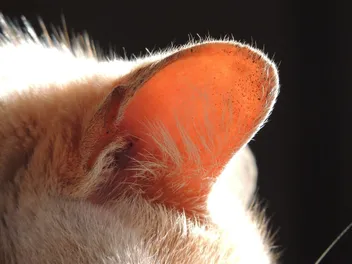
While their ears can be dissected into the same parts, cats’ ears are more complex. To begin with, dogs have 18 ear muscles, while cats have 32 ear muscles. A cat’s ear muscles enable them to swivel the ears up to 180°, and each ear can move independently from the other, which helps them identify and capture sounds from different directions. Dogs have a variety of shaped ears - from the pricked ears of the German Shepherd to the long floppy ears of the Spaniel. The size and shape of dog’s ears affects their ability to move their ears and to funnel sounds.
Both cats and dogs can pick up sounds much further away than us humans too. Dogs can hear sounds four times further away than we can and it appears to be similar for cats. Cats are also well adapted at judging the location of a sound being made, which assists when they are locating prey.
While a cat’s hearing is more refined, dogs still have great hearing. Their ability to hear higher frequencies surpasses human ability, as humans can only hear up to about 20 kHz. Dogs are also more sensitive to hearing softer sounds than humans are. They can hear decibels as low as -5 to -15 dB, while the lowest intensity that humans can typically hear is 0 dB.

How to Be Mindful of Your Cat or Dog’s Hearing
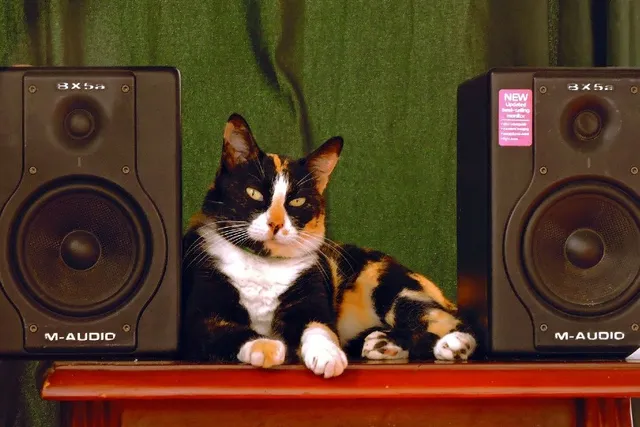
Now that we know just how much more sensitive cats and dogs are to noise than humans are, it’s important to be mindful of noise levels at home. Both cats and dogs prefer quieter volumes, so it’s important to refrain from turning the volume of your TV or speakers too high. Sometimes a noise that is loud for us, may also have high-frequency tones which our dogs and cats can hear, causing them more distress.
Cat and dog owners should never speak or yell directly into their pets’ ears. This can be extremely painful and startling for them.
You can usually tell when a sound is too loud for cats and dogs by their avoidance. Most often, your pet will get up and move to another room if the noise level in your room is too much for them. Smaller cats and dogs may try to hide under furniture in an attempt to muffle the sound.
You might also notice your pets’ ears twitching. While this behavior can signify other moods, it can indicate that a sound is irritating your pet. Cats and dogs that are irritated by noise may also shake their heads along with twitching their ears.

Conclusion
Overall, cats have the upper hand when it comes to hearing because they can hear a wider range of frequencies and also hear sounds made from further away. However, both cats and dogs are more sensitive to sounds than people. A loud home environment can be stressful and irritating to your pets, and constant exposure to loud noises can play a part in hearing loss.
So, it’s important to be mindful of the volume of your voice and other sounds in your home. Your pets will appreciate the effort and will continue to feel happy and content when their homes are peaceful and quiet.
You might also like: Are Cats Faster Than Dogs? Answer Based on Science
Sources
Featured Image Credit: v-svirido, Shutterstock
Expert cat care, straight to your inbox
News, insights, and useful advice, delivered to you.

No spam — unsubscribe anytime.
By signing up, you agree to our Terms & Conditions and Privacy & Cookies Policy.
How useful was this post?
Click a star to rate. You can leave written feedback afterwards. (We read all feedback.)
Jessica is a freelance writer who spends most of her day researching and writing while her fluffy Cavapoo, Nora, naps beside her. She loves and appreciates pets and animals because there’s so much to learn from them, and they do so much for people. As a dog owner, she understands the special connection that pet owners form with their pets. She loves sharing helpful information that people can use to better understand their pets. When she’s not writing, you can find her walking dogs, tending to her plant babies, or drinking her nth cup of coffee.