Can Loud Music Harm a Cat? Vet-Reviewed Info


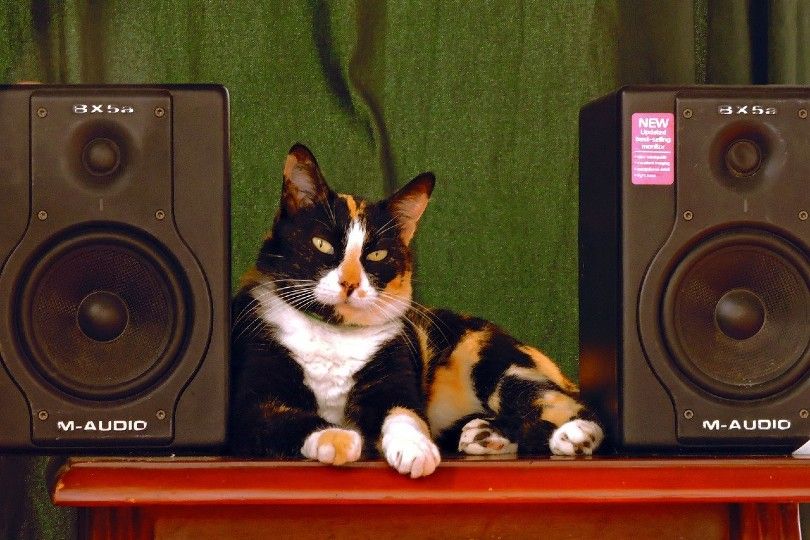
Ears, unfortunately, don't have the handy ability to shut. If you enjoy listening to loud music, you’re forcing your cats to endure it, too. If you share your house with a cat, you might already be aware that loud noises like the vacuum cleaner can have them taking quiet refuge somewhere else.
But can loud music be harmful? The short answer is yes. Cats are more sound-sensitive than humans, which means noises sound louder to them than they would to us. Cats also have a more comprehensive hearing range and can hear noises at lower and significantly higher pitches than people. So, let’s look at exactly how cats’ ears differ from ours and what that means for your future of rocking out to loud music.

Cats & Their Hearing
A cat’s hearing is very sensitive, even better than a dog’s.sup>1/a> Their hearing range is around 45 hertz (Hz) to 64 kilohertz (kHz), while dogs have a range of 67 Hz to 45 kHz. A cat’s ear comprises the same structure as other mammals: the outer, middle, and inner ear. Cats have the best hearing among domestic animals. Hearing this wide range of sounds helps them detect prey and allows them to hear and avoid predators.

The Outer Ear
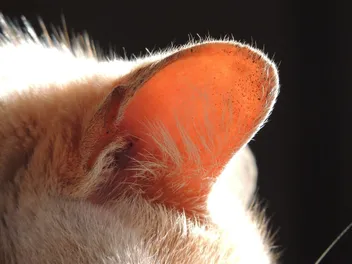
The pinna makes up the outer ear (this is the external triangular fold at the top of their heads), along with the external ear canal. The pinna collects and funnels sound waves down the ear canal to the middle ear. They turn and move independently without cats having to move their heads. Cats almost use their ears like radar. Their ears can turn toward the source of a sound, increasing their sensitivity to the sound in question.
The Middle Ear
The eardrum and small bones, known as ossicles, are contained in the middle ear. The ossicles vibrate when detecting sound waves and transmit the vibrations to the inner ear.
The Inner Ear
The inner ear contains the cochlea, an organ responsible for hearing, and semicircular canals filled with fluid that helps with balance. The cochlea contains a small organ of Corti, whose special hair cells respond to sound vibrations and pass them along to the nerve endings.sup>2/a> They transfer the vibrations into electrical signals through the auditory nerve to the brain to be processed. The vestibular system, found in the inner ear, provides a sense of spatial orientation and balance.

Can Loud Music Harm a Cat?
Prolonged exposure to noise levels above around 85 decibels (dB) can cause hearing loss or damage, based on a href="https://www.ncbi.nlm.nih.gov/pmc/articles/PMC3725606/">studies/a> in humans and laboratory animals. Not only that, but excessive chronic noise can also raise your cat’s blood pressure (hypertension).sup>3/a> This is caused by your cat living in a heightened state of stress.
4/a> This puts how loud music can be into perspective.
| Everyday Noises and Sounds | Average Sound Level Measured in Decibels (dB) |
| Ticking Watch | 20 |
| Soft Whisper | 30 |
| Refrigerator Hum | 40 |
| Normal Conversation | 60 |
| Washing Machine/Dishwasher | 70 |
| Maximum volume for radio/stereo/TV | 105–110 |
It’s clear that a cat’s ear is designed to capture more sound than humans or even dogs, which helps them in the wild. But this skill doesn’t necessarily translate well in domestic life, where a cat doesn’t have control over the sounds they’re forced to live with. In a house, there isn’t a means of escape if your cat needs it, which can stress your cat out.
Cats will generally move away from sounds that are too loud, but they can only do this if there is somewhere for them to go. If they can't leave the room, they might hide. A cat’s body language can be subtle, so it’s up to you to take note of what is normal for your cat, so you have a good idea when they’re upset or stressed. Not only will a cat feel stressed about being confined in a room that is too loud, but it could also cause damage to their hearing health.

What Should You Do?
We’re not saying you can't ever listen to loud music again just because you have a cat, but you will need to be mindful of the cat before you do. Use headphones so that you can enjoy your music while not disturbing your cat with it. Alternatively, make sure your cat has an escape route, or even encourage them into a different room before you start to play music. And don't make it too loud. Also, make sure everything they need is where they can reach it, such as the litter box, cat tree, food and water bowls, and toys.

Conclusion
Loud music can harm your cat. Prolonged exposure cana href="https://www.catster.com/guides/how-to-tell-cat-is-stressed/"> stress your cat out/a> and result in hypertension, and it can also lead toa href="https://www.catster.com/guides/is-my-cat-deaf/"> damaged hearing/a>. If you enjoy listening to loud music, it’s a good idea to wear headphones or to make sure your cat isn’t in the room and that they have somewhere quiet to go. We’re not saying you need to stop listening to music fora href="https://www.catster.com/guides/how-often-should-you-clean-your-cats-ears/"> your cat/a>, but when it comes to those thunderous noises, remember that you have a family member with super-sensitive hearing!
Sources
Pinna Movements of the Cat during Sound Localization - PMC/a>
Ear Structure and Function in Cats - Cat Owners - MSD Veterinary Manual/a>)./li>
Hearing disorders in cats: Classification, pathology and diagnosis - George M Strain, 2017/a>
Hearing in Laboratory Animals: Strain Differences and Nonauditory Effects of Noise - PMC/a>
Listen Up to These Fascinating Facts About Your Cat's Ears/a>
Effect of impulse noise on water consumption and blood pressure in the female cat - ScienceDirect/a>
Featured Image Credit: Anfesamo, Pixabay
Expert cat care, straight to your inbox
News, insights, and useful advice, delivered to you.

No spam — unsubscribe anytime.
By signing up, you agree to our Terms & Conditions and Privacy & Cookies Policy.
How useful was this post?
Click a star to rate. You can leave written feedback afterwards. (We read all feedback.)
Kerry-Ann lives in Scotland and would love to have a bigger garden so she could have her very own Highland cow. But her dogs probably wouldn’t like that idea very much. She has a La Chon called Harry who was sick with a liver shunt when he was a puppy. It wasn't likely he would make it into adulthood, which was difficult to comprehend, but he beat the odds and is a healthy old man now. She also has a Pug called Maddie who is a big foodie. She’s small, sassy, and every day she finds a new way to wind her brother up.
When she isn’t writing you can find Kerry-Ann going for long walks when it isn't raining, reading, or watching cartoons. She would one day like to be a tourist in her own country and travel through the Highlands with her family.