


In this article
Your cat’s diet plays a major role in its well-being. If you feed your cat too much or too little, they won’t maintain optimum health. Likewise, a lack of nutrients can lead to a deficient feline while an overabundance can cause obesity and all the problems that come along with being overweight.
Finding the sweet spot for how much to feed a cat can be difficult, especially for new cat keepers. But in this article, you’ll find all the information you need regarding feeding frequency and amount, helping your cat to live its best life, and taking the guesswork out of the equation.

How Often Should You Feed Your Cat?
This seems like a simple question on the surface, but how would you answer if someone asked how often you should feed a human? We all know that it depends greatly on several factors such as age, size, and appetite. Cats are no different. They eat different amounts, depending on similar characteristics such as age, weight, breed, size, and more.
Younger cats need feeding more often than adults. Growing felines require more food per pound of body weight compared to older cats. Rather than stuff all of that feeding into one sitting, it’s best to spread it out across several feedings throughout the day.
As your cat gets older, it will require less food per pound of body weight, which means fewer feedings. Once your cat reaches adulthood, two or three feedings each day will suffice, so long as your cat is getting all the necessary nutrition within those feedings. A helpful tool for understanding how much to feed your cat is a calorie calculator like the one below.
Calculator
The exact amount of calories an individual animal needs to maintain a healthy weight is variable and influenced by many factors including genetics, age, breed, and activity level. This tool is meant to be used only as a guideline for healthy individuals and does not substitute veterinary advice

Cat Feeding Chart
To determine the size of the feedings, divide the amount your cat eats by the suggested number of daily feedings. It will be different for each kitten/cat depending on how much they eat from the daily suggested range.
Cat Age
Cat Weight
How Much to Feed a Cat in a Day
Daily Feedings
Up to 1 week
3–7 ounces
Kitty formula: 25–65 ml
12
1–2 weeks
5–14 ounces
Kitty formula: 40–110 ml
10–12
2–3 weeks
12–16 ounces
Kitty formula: 110–125 ml
6–8
3–4 weeks
1–1.5 pounds
11 g dry or 40 g wet food
6–8
4–8 weeks
1.3–2.6 pounds
18 g dry or 65 g wet food
3–4
2–3 months
2.2–4 pounds
20 g–30 g dry or 65 g–110 g wet food
3–4
3–6 months
3.5–7 pounds
30 g–50 g dry or 130 g–165 g wet food
3–4
6–9 months
6–10 pounds
45 g–60 g dry or 160 g–215 g wet food
2–3
9–12 months
7–15 pounds
50 g–85 g dry or 150 g–300 g wet food
2–3
1–5 years
8–20 pounds
60 g–105 g dry or 160 g–365 g wet food
2–3
5–10 years
8–20 pounds
60 g–105 g dry or 160 g–365 g wet food
2–3
10+ years
8–20 pounds
60 g–105 g dry or 160 g–365 g wet food
2–4
Source: https://www.catster.com/guides/how-much-to-feed-kittens/
Keep in mind that this chart represents only a rough guideline. The amount of food a cat consumes should be based on daily calories. Different cat foods have specific caloric densities per gram of product. Monitoring a cat’s weight gain during its growth and development and its body condition score during adulthood is the best way to find out how much to feed a cat.
It’s always recommended to consult a veterinarian if you have any questions or concerns about your cat’s diet.
Need veterinary advice but can't get to the clinic? Catster recommends PangoVet, our online veterinary service. Talk to a vet online and get the answers and advice you need for your cat without having to leave your living room — all at an affordable price!

Factors That Influence How Much to Give Your Cat
As mentioned, many factors influence how much food your cat requires. Although younger cats eat more per pound of body weight, they eat less overall. Larger and heavier cats will require more total food. But as a cat gets larger, they can eat more in a single sitting, so feeding frequency decreases, even though the total amount that is eaten continues to rise.
Another factor to consider is your cat’s current activity level. If your cat is sedentary and spends its time lounging in comfortable spots around the house, then it’s not going to require as much food as a feline that’s always running around, playing, or spending a lot of its time exploring the backyard.
You’ll also have to make adjustments for feeding wet or dry food. While either is perfectly acceptable, provided it offers complete nutrition for your cat, they don’t measure out the same. Naturally, wet food weighs more, so you’ll have to feed your cat more of it in terms of weight. As for deciding how much dry food to feed a cat, you’ll feed less of it by weight, but it will appear to have more volume in your cat’s food bowl.

- NO MESS - The 360° tray on this cat food and water bowl set has a raised design to catch and...
- WHISKER FRIENDLY - Shallow and wide metal containers with flat bottoms ensure your kitty can enjoy...
- CHEW-SAFE MATERIALS - Kittens and cats love chewing on silicone and soft rubber - but it's a choking...
If it’s kibble, wet, or a combination of both that your cat enjoys, choosing the right cat bowl to serve it in goes far beyond presentation. Your cat’s comfort is at the forefront with the Hepper NomNom Cat Bowl! The unique design benefits cats in many ways – dual stainless steel bowls are shallow and wide to aid with whisker fatigue and slight elevation for proper posture. The wide catch tray ensures that all food (and water!) stays exactly where you’d expect it to be – inside the bowl! Click here to learn more.
At Catster, we’ve admired Hepper for many years and decided to take a controlling ownership interest so that we could benefit from the outstanding designs of this cool cat company!
Health Dangers for Obese Cats
Obesity is a major problem for domesticated cats in North America. It’s the most common of all preventable feline diseases. In America, about one-third of all cats are considered to be obese with about half of all cats over the age of 5 being considered overweight.
So, what problems will obesity cause for your cat? To start, it will shorten your cat’s lifespan. Obese cats show an increase in mortality rates 2.8 times higher than cats of a healthy body weight.
If that’s not enough, obesity also makes your cat more susceptible to other diseases that can decrease the quality of their life and shorten their lifespan.
- Urinary bladder stones
- Osteoarthritis
- Hypertension
- Diabetes mellitus
- Heart disease
- Cancer
- Anesthetic complications
It’s not just being obese that’s bad for your cat. Obese cats that stop eating might even have it worse. When an obese cat ceases eating or loses weight too fast, they often develop a condition called hepatic lipidosis; a liver disease that can be life-threatening.
Obese cats have a much harder time fighting off infectious diseases since their bodies are already in poor health, which means that diseases are more likely to be serious or even fatal.
Monitoring Your Cat’s Feedings
When cats are stressed or ill, they’re often very good at hiding it. Some of the most obvious signs you can look for are changes to their feeding habits. These can also be an indication of how your cat is responding to its feeding routine, allowing you to make any necessary changes.
If your kitten is eating in the middle of the night, there’s nothing to worry about. Kittens have tiny stomachs, which is why their food must be split into many smaller meals. It’s hard for them to go 8–12 hours without a meal, so it’s fine for a kitten to look for a nighttime snack. Adult cats should be used to a particular feeding schedule though, and shouldn’t need to feed in the middle of the night. If your adult cat begins to exhibit this behavior, it might indicate that there’s another underlying issue.
If your cat is licking its bowl clean every time you feed it, it could be underfed. However, you’ll need more evidence to be certain. Instead of guessing, learn what a cat’s body should feel like so you can assess your cat’s weight. Feel for proper rib coverage and weigh your cat to ensure it’s at a healthy weight.
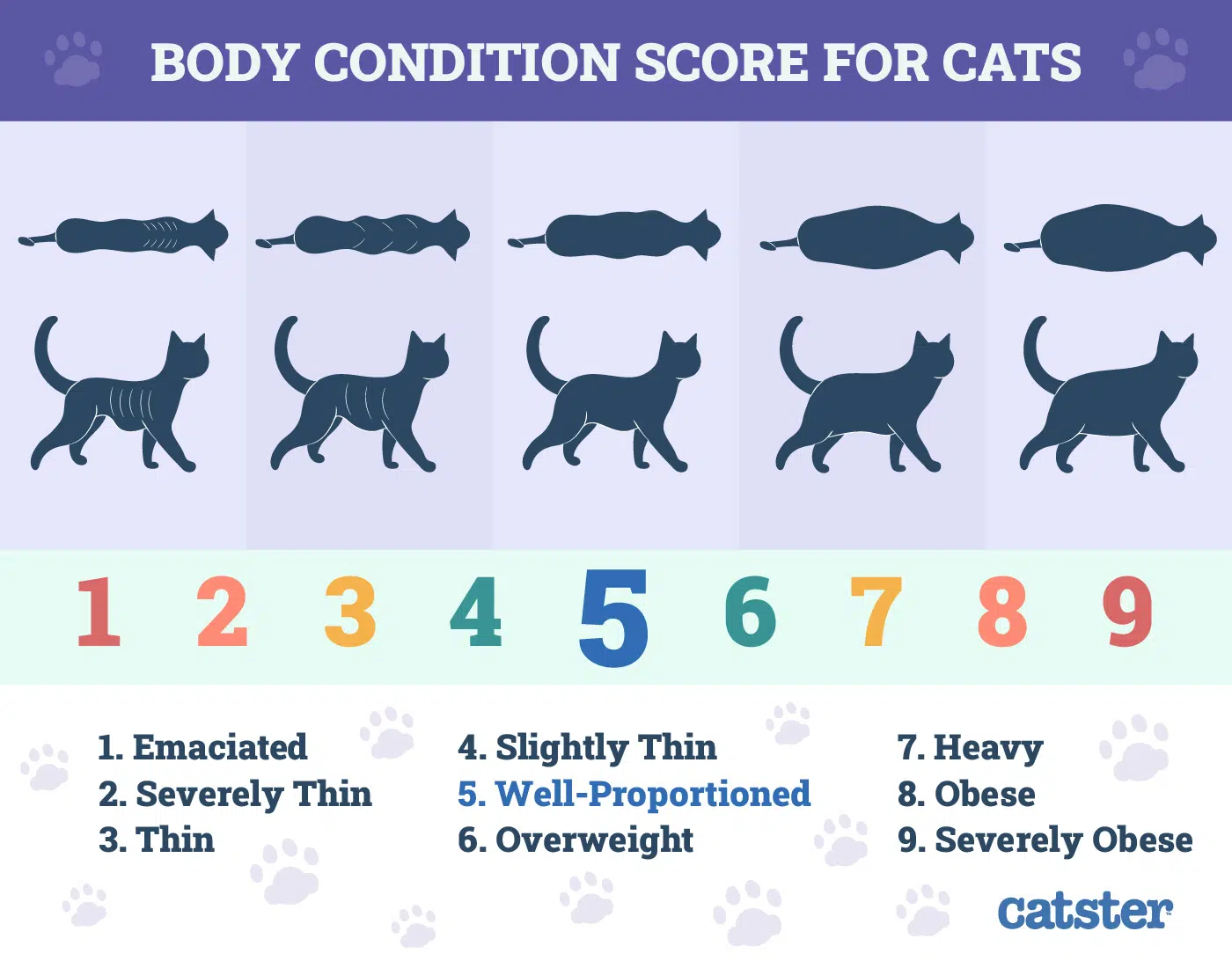
Veterinarians have developed what is known as a body condition score. This system evaluates a cat’s body shape from above and the side as well as how easy or difficult it is to feel the ribs. This system helps to place a cat’s body on a scale that ranges from 1–9. Cats with ideal body weight are in the middle of the scale, at number 5. Underweight cats can be between 1–3, with 1 being emaciated or extremely underweight. Obese cats are placed at number 9, and the range of 7–8 is considered overweight. Using the body condition score with the guidance of a veterinarian is the best way to evaluate and determine how to manage your cat’s diet.
Final Thoughts
There are no hard and fast rules regarding cat feeding frequency and volume. When deciding how much to feed a cat there are many factors are at play, such as the cat’s age, breed, size, weight, activity level, and more. Still, there are some general guidelines that you should follow to ensure your cat is receiving the appropriate amount of nutrition.
If you still have questions or you aren’t sure if you’re feeding your cat too much, too little, or if it’s a healthy weight, then you can consult your veterinarian to help you get the basics down for your cat.
Featured Image Credit: New Africa, Shutterstock








10 Responses
I have a new one-year-old 7-pound neutered male tiger kitty. He was a feral rescue and I have had him about 2 months. He is successfully transitioning to an indoor cat only. When he was rescued he was starving. Unlike any of my other cats in the past, whatever I put in his bowl, he eats all of it and begs for more. Occasionally he is on his own all day or overnight. When I fill his bowl he eats all of it right away, leaving him with nothing for the rest of the day and I come home to a hangry cat! I purchased an auto feeder which doles his daily ration (60 to 105 grams dry food) spread out over several times a day. Even doing this, he constantly begs. Any suggestions for training him to just eat his dry food when he needs it?
Hi Nancy. Dealing with that constant begging is definitely challenging! It's great that you're using an auto-feeder; that's the best tool for managing a cat with a history of food insecurity
For cats with a background of starvation, the drive to eat quickly and constantly beg is a deep-seated survival instinct. The best way to manage this is to make him work for his food with puzzle feeders, trainingand playtime before each meal. It's also important to be absolutely consistent in ignoring the begging and only giving him attention when he is calm and away from the feeding area. If you are concerned about his weight or if the begging is escalating, a professional consultation is always recommended. If you wish to speak with one of our vets, we recommend booking an appointment with a professional at www.PangoVet.com to get a specialized behavioral plan.
Hi Nancy. Dealing with that constant begging is definitely challenging! It's great that you're using an auto-feeder; that's the best tool for managing a cat with a history of food insecurity
For cats with a background of starvation, the drive to eat quickly and constantly beg is a deep-seated survival instinct. The best way to manage this is to make him work for his food with puzzle feeders, trainingand playtime before each meal. It's also important to be absolutely consistent in ignoring the begging and only giving him attention when he is calm and away from the feeding area. If you are concerned about his weight or if the begging is escalating, a professional consultation is always recommended. If you wish to speak with one of our vets, we recommend booking an appointment with a professional at www.PangoVet.com to get a specialized behavioral plan.
Thank you for your help. Have a 4 year old cat. Needed guidance. Online grams converter does the job.
Bootsie Cat is smiling.
Ron
Thank you for sharing, Ron. We love to see smiley cats😸
Thanks for the info on cat's weight and eating recommendations. We use measuring cups to make our cats' portions. It would be helpful if the chart also indicated portion sizes in cups instead of grams.
Also, we have a one year old female who gobbles anything we give her, and a four year old male who is very picky about eating. It's difficult to keep Emma from finishing off all of Vinnie's meals. So she's getting a little belly starting to form.
Any good ideas to keep Emma from overeating when finishing off Vinnie's meals?
Hi Joe, thanks for your comments. Different kibbles have different sizes and densities so it is less accurate to make a calculation in cups. You could try using a kitchen scale to measure the volume of their diet and then mark how much they get in a cup. Your problem with a cat eating all of their portions and then the other cat is quite common and the easiest solution is to separate them during feeding times. Alternatively, you could try an automatic feeder with a microchip reader such as the product listed as #8 here: https://www.catster.com/lifestyle/best-automatic-cat-feeders/
Kind regards and thanks for reading us, we hope this helps. ????
PLEASE put your feeding guides and ALL guides offered in OUNCES not grams OR BOTH oz and g
Otherwise, for me, NOT useful and I will avoid your emails, website, etc.
I am waiting to hear your response as I adore my cat sisters of 13 years (litter mates).
They are in great health, active, fun, silly, & smart. Indoor at sunset and outdoor (backyard) most days.
Keeping them in great health is my objective and I enjoy lifelong learning about best practices for my girls.
Hi Deb, thank you very much for reading us. Catster readers are from all around the world and grams is a more universal measure. Also, with such small weight differences, it would be harder for you to calculate 0.07055 ounces for a 2-gram difference, therefore putting it in grams makes more sense. Perhaps you could consider purchasing a kitchen scale, you can set it to grams or oz. Alternatively, there are several online calculators that you could use. If you still need some additional help to figure out how much to feed your cat sisters, please do not hesitate to book a consultation with a veterinarian at www.pangovet.com, they would be happy to assist you. Again, thanks for reading us and sharing about your beloved cat sisters, we are always happy to share knowledge about cats and love to hear about loving pet parents going the extra mile to keep their kitties happy and healthy.
Search for "convert grams to ounces" online and type in amount of grams – very easy to do!