Get

In Your Inbox

Catster is reader-supported. When you buy via links on our site, we may earn an affiliate commission at no cost to you. Learn more.

Why Do Cats Bite Each Other’s Necks? The Interesting Reasons


Share

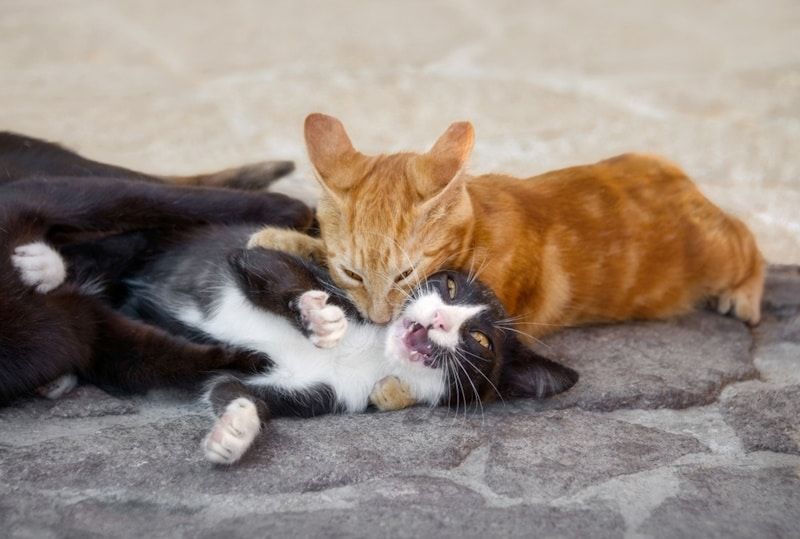
Orange cat biting black cat on the neck

If you have more than one cat, you may have noticed that cats have a tendency to bite each other on the neck. Sometimes these bites are on the scruff of the neck, while other times they happen in the throat area. There are actually a few reasons that your cats might be biting each other on the neck, so let’s jump into a few of the reasons for this feline behavior.

divider 3 paws

The 5 Reasons Why Cats Bite Each Other’s Necks

1. Social Assertion & Territoriality

In nature, cats are usually solitary animals, but domestic cats living in households might compete for territory or resources in the home if there are multiple cats. When first establishing territories and the structures of their social relationship1, aggression including hissing, chasing, swatting, and biting is often seen. Biting other cats, particularly on the back of the neck, is part of this social assertion. After the relationship is solidified, noticeable aggression is rare, provided the environment remains stable and there are no physical disruptions. Occasionally, a cat might bite the other cat’s neck without breaking its skin as a reminder of their place in this territory and to reassert the nature of their social structure.

Black and white cat playing with orange cat
Image Credit: Magui RF, Shutterstock

2. Mating

If you’ve ever seen cats mating, then you know that it’s not something that appears gentle. Part of the mating ritual involves the male cat biting the female cat on the back of the neck. It’s likely that this is done to show dominance and to help keep the female in place. This biting is usually not done aggressively enough to break the skin.


3. Play

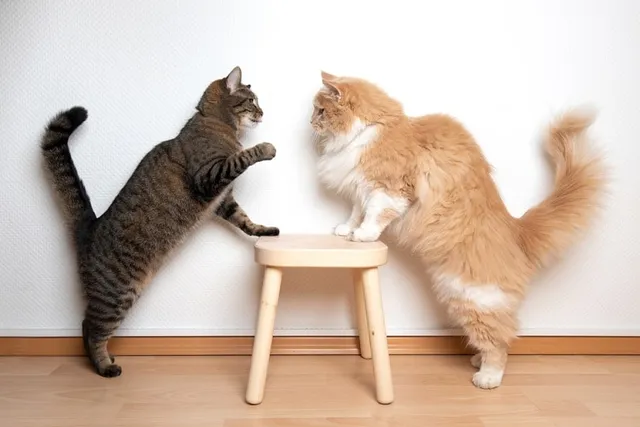
Some cats love to roughhouse, and biting and scratching are simply part of the game. You may see one of your cats pounce on the other’s back and bite them on the back of the neck, but during play, cats are more likely to bite the front part of the neck.

For kittens, playing is a form of practicing their hunting skills, and adult cats bite their prey on the throat to kill them. If done during play, this biting should not hurt the cat that is being bitten and shouldn’t break the skin, although an over-exuberant cat may unintentionally bite the other cat too hard.

Russian blue cat biting a calico cat on the back
Image Credit: Isabel Eve, Shutterstock

4. Aggression

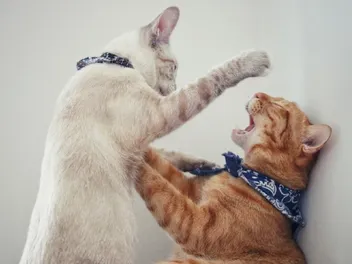
Biting the neck as a form of aggression is a step above using biting to assert a social relationship. If a cat is showing aggression, they are unlikely to only bite the neck, and there is a good chance that they’ll break the skin with both teeth and claws. If your cats are being rough with each other and either of them is hissing, yowling, or showing signs of fear, then it’s time to break things up so everyone can cool off.


5. Maternal Care

Mother cats bite the backs of their kittens’ necks to carry them, and you may also spot a queen biting the back of the neck of a kitten that isn’t cooperating for a grooming session or is simply misbehaving. This is one of the ways a mother will discipline the kittens and teach them how to survive, and how to behave. This type of biting is typically gentle so as not to hurt or injure the kitten, more like a warning, placing a limit, or telling.

divider 3 paws

In Conclusion

Cats naturally bite each other on the neck for multiple reasons, and this is a natural behavior. It’s important for you to keep an eye on your cats if you see biting occurring, though. Sometimes, games can get out of hand and turn aggressive. In some cases, you may need to help your cats as they establish their social relationships and territoriality if there’s a new cat in the home. This establishment of relationships can take time and should be monitored closely to make sure your cats aren’t hurting each other.


Featured Image Credit: Katho Menden, Shutterstock

Want content like this delivered to you?

Sign Up For Our Newsletter

News, insights, expert advice, and everything cat

* By submitting, you agree to our Terms & Conditions and Privacy & Cookies Policy.


How useful was this post?

Click on a star to rate (you can leave written feedback after clicking submit)

Help us improve Catster for pet parents!

Your feedback really matters.

What did you like about this post? Also how can we improve it?

Join the conversation

6 Responses

  1. Hi, my name is Theresa. I have rescued a kitten. It has been a little over a year now. She just got fixed, but I do have an older female cat that is fixed in an older male cat that is fixed when I brought new cat in her name is Hope she is constantly biting on their neck and the two older ones cry out because she’s hurting them. What can I do to stop her from doing this

    1. Hi Teresa, thank you for reading us. For a personalized behavior consultation for your cats, we recommend you book a video call with one of our vets at www.pangovet.com

  2. Thank you for the advice. I do intervene often because she sticks to me, her safety zone, and I am retired. The older cat is improving, but I am also increasing the loudnes of voice, and I am chasing him with spray every time he tries. She is also doing her part. She screeches when he gets near. It's difficult because sometimes they do get along. Anyway, I have devised a few hidey-holes where she can go, and he won't fit. It's sad because they are both very affectionate cats. It is getting better.

    1. Hey Carol! Thanks for sharing the update. Great idea about the narrow entrance hideaway spaces, surely she will feel better having some safe spaces and having a chance to heal now.

  3. I have a male cat who is neutered but bites my neutered little female cat constantly on the neck. She now has a scab that he is breaking open. I yell, spray him, etc. He knows better but won't stop. What can I do? This started after my husband died, and the older, larger cat started being jealous.

    1. Hi Carol. We are sorry to hear about your husband's passing and also to hear bout your struggles with your cat’s behavior. This sounds like something habitual, so for now, your best bet is to separate the cats so she gets time to heal. Also, keep a close eye on the wound; bites can easily get infected. In the wild, she would be able to run away but in your home, that is not possible, and given the size difference, it is your responsibility to intervene. After some time apart, you can try to socialize with them. Please don’t hesitate to contact www.pangovet.com for tips on how to socialize your cats. We hope this helps!

Leave a Reply

You’re very welcome to leave a comment or question. Please know that all comments must meet our community guidelines, and your email address will NOT be published. Let’s have a positive and constructive conversation.


Catster's Digital Magazine is Back!

Vet-approved health & behavior advice

Real cat stories & community features

Vets Urge Owners: Don’t Ignore Sweet Smell Coming From Cats

Cats are not particularly known for having a pleasant aroma. The occasional whiff of fishy cat breath and that unmistakable post-litter-box scent simply...

“A Cat Spay Costs How Much???”

America has a kitten problem. Every day, thousands of cats and kittens are abandoned, surrendered, or discarded. Those who are lucky enough to...

Ask Dr. Paola – Help! My Cat Is Seeking My Attention! (June 15, 2026)

Welcome to our “Ask Dr. Paola” series, where every Monday we bring expert advice straight from Dr. Paola Cuevas (MVZ) to help our...

Everything I Need to Know About Cartoon Comedy, I Learned From My Pets

If you’ve ever looked at your cat doing something ridiculous and thought, “There has to be a joke in that somewhere,” Scott Metzger...

More related

Toxoplasmosis Symptoms in Cats: Our Vet Explains the Causes, Signs & Treatments

Toxoplasmosis is a disease impacting cats that can be picked up from the environment. Toxoplasmosis is commonly discussed in households due to the...

Pure Balance Cat Food Review in 2026: Recalls, Pros & Cons

Review Summary Perhaps you’ve been scouring the aisles at your local Walmart and come across a brand you’ve never heard of before. Pure...

Why Does Your Cat Sit on Things You Are Using? 4 Vet-Reviewed Reasons

What is the deal with your cat sitting on things you are using? There are countless videos on social media of individuals trying...

Are My Cats Playing or Fighting? 6 Vet-Reviewed Ways to Tell the Difference

Cats love to wrestle and play, but they also fight. Even if you have two litter siblings that have lived together their whole...

Keep reading

Can Feral Cats Be Friendly? Vet-Reviewed Facts & Advice

Feral cats aren’t socialized by humans, by definition. They haven’t been raised around humans and have spent much of their time with other cats instead. Therefore, feral cats typically act like wild animals and aren’t usually friendly—unlike the domestic cats...

feral cat on the stairs

Purina Pro Plan vs Purina One Cat Food: 2026 Comparison

Purina is a company that makes a wide range of pet food products for cats and dogs, and we are going to take a look at two of their most popular cat food lines, Purina Pro Plan and Purina One,...

Purina Pro Plan VS Purina One

Do Cats Get Lonely When You Go to Work? Vet-Reviewed Signs & Entertainment Tips

Many people have the view that cats are antisocial; however, that isn’t true. Cats are very affectionate creatures; they socialize in ways different from ours, and there are variations in how sociable cats are toward humans. While we show affection...

cat indoor_Melanie Hogue_Pixabay

Is It True That All Cats Have Carpal Whiskers on Their Legs? Feline Anatomy Explained

There’s no question that cats are unbelievably adorable. Everything from their gorgeous eyes to their tiny little paws is nothing short of cuteness galore. But one often overlooked feature that adds to this cuteness is the whiskers. Everyone knows that...

Close up to a ginger cat paws and claws scratching carpet

Mobile Vet Clinics & Care: Our Vet Discusses Pros, Cons & FAQ

Your cat is wonderful at home but turns into some sort of Tasmanian devil the moment she gets to your veterinarian’s office. Is there an easier way to get her preventative care done so that you know she’s healthy? Let...

vet holding a cat

How to Stop Your Cat From Climbing the Curtains: 11 Vet-Reviewed Ways

Cats can get up to all kinds of mischief around our homes—not out of spite but because they’re trying to release pent-up energy, explore something new and interesting, or simply enjoy themselves. For example, the curtains might be your pride...

How Tight Should a Cat Collar Be? Vet-Approved Sizing & Tips

Choosing the right collar for your cat is vital to keep them safe, but once you’ve got their shiny new collar, how tight should it be? This is a question that many cat owners ask. In brief, you should be...

cat collar

Does Boric Acid Kill Fleas on Cats? Vet-Reviewed Use & Safety Guide

Having fleas on your pet and in your home is a terrible nuisance. Not only do they cause skin irritation for your pets, but they can also lead to other, more serious health problems. There’s also considerable aggravation when it...

boric acid powder in spoon with boric cream and drops bottle

Love Cats? So Do We! Join the Catster Community

Stay informed with expert pet care insights delivered straight to your inbox! Discover professional guidance on animal behavior, feeding tips, trusted product picks, and much more.


Sign up for the Catster Email Newsletter

Stay informed with expert pet care insights delivered straight to your inbox! Discover professional guidance on animal behavior, feeding tips, trusted product picks, and much more.