How to Introduce Your Cat to a New Cat: 8 Vet-Verified Tips & Advice



In this article
Bringing a new cat into your home can be challenging because cats tend to be more solitary than dogs and frequently aren’t too happy meeting new housemates that will disrupt their routine. If you need help introducing a new cat to your first cat, keep reading for a step-by-step guide and plenty of tips and tricks to help ease the process.

Before You Begin
Before you introduce your cat to another cat, consider their respective personalities. While most cats don’t like company at first, some are even more against the idea, and it may be difficult to change their minds. If your cat acts outwardly hostile to a new cat, you may need to consider if it’s worth the trouble, especially if you are trying to provide a companion for your pet and not trying to offer a home to a stray or sheltered feline.
Also, remember that it can take quite a while for two cats to become friendly toward one another, even if they are friendly toward you, so patience is crucial. Trying to force them together will only slow down the process.
The 8 Helpful Tips to Introduce Your Cat to a New Cat
1. Choose the Right Time

If you are bringing a new cat into your home by choice, it can be helpful to choose the right time. If you have recently moved to a new location, brought a new baby around, or had another big event that disrupted your cat's normal routine, they may still be adjusting. Cats can take several weeks to get used to a new living environment, and during that time, they are less likely to be open to sharing the territory with another cat. Introduce your new pet when your first cat is comfortable with their routine.
2. Make Separate Spaces
Create a separate space in your home for the new cat to live in while they get to know each other. Each area should have at least one litter box for the cat to use. Each cat should also have separate food and water bowls. Keeping them separated for a short time can help them get familiar with each other’s scents, which is a big part of them getting to know each other. Cats give off pheromones as a form of communication. They use these to get to know each other even when in different parts of the house.
3. Do a Scent Exchange

Since your first cat will likely be more comfortable with another cat in the next room, you can help them get used to their scent even more by exchanging items in the rooms every few days. Exchanging items like bedding and toys can be an effective way to get cats familiar with each other before they meet.
4. Have Controlled Introductions
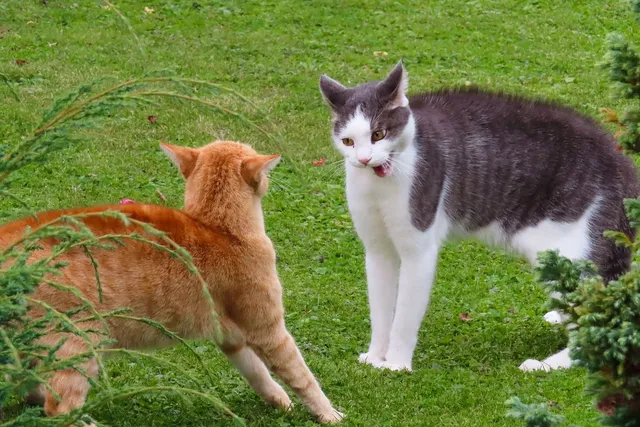
Once your cats have had a chance to get used to each other’s scent, you can start with controlled introductions. Use a baby gate or something similar to let the cats see each other without being able to fight. It’s likely that at first sight, they will stare at each other and maybe hiss and growl. Keep these sessions short, and you should be able to extend them slowly as the cats get used to seeing each other.

Once your cats stop hissing at each other through the gate, you can try to let them “share” a meal. Leave the gate in place, but place a food bowl on either side so they can each eat. Eating will help them get out of fight mode, and eating at the same time can help them become more friendly with each other. Start by keeping the bowls a certain distance apart and bringing them closer as the cats become comfortable with each other.
6. Have Supervised Interactions
Once the cats don’t seem to mind each other’s company when they are eating, even when you place the bowls close to each other, you can try moving to supervised interactions. Remove the gate, and let the cats meet face to face, but keep a close watch so you can separate them if you need to. Keep the meetings short initially, extending them when the cats seem to be getting along.
7. Increase the Number and Length of Interactions

As the cats get along for longer and longer sessions, you can try increasing the number of sessions per day. If there doesn’t seem to be any hostility between the cats, you can start to let each cat explore the other’s environment. Doing so might bring out a bit of hostility if one cat doesn’t like the other in their area, so you may need to separate them again and keep trying.
8. Monitor Them
Once the cats don’t seem to mind the other exploring their territory, you can let them interact for longer times and likely don’t need to supervise them as closely. However, you should still pay careful attention and separate them if they start to quarrel.
Other Useful Information
- Ensure both cats have current physical exams performed by their vet prior to introductions, and are up to date on vaccines and any flea or worming treatment, or retroviral testing, as recommended by your vet.
- Your cat is more likely to relax and be open to other cats in their environment if there are plenty of perches and areas to hide, which helps them feel more secure. You can create hiding spots out of cardboard boxes, and there are also many commercial perches available that your cat is sure to love.
- Reward your cats when they get along by giving them treats, praise, and pets, which will help both cats view their interactions as positive experiences.
- Try to keep the mood light and joyful while interactions are occurring. Use soft voices and even soft music to help them feel more comfortable. Try not to increase the anxiety that they are feeling by talking loudly or moving too quickly.
- Ensure that each cat has a separate litter box, even after they are getting along. Most experts recommend one for each cat, plus one, with at least one on each floor. They will also continue to need separate food and water bowls, though they will likely be fine sharing a fountain.
- Set time aside to play with each cat so neither feels left out and both get the activity and mental stimulation that they need to stay happy and healthy. Doing so might also help reduce the risks that your pets might fight with each other over you.
- Commercial pheromone diffusers can help some cats feel more relaxed, and they can be especially helpful when introducing a new cat to your cat. However, they don’t work on all cats.
- Be patient. It can take a long time for two cats to get along, and they may start to fight even after they have been cooperating for a while. Yelling or getting angry with your pets will only make being around each other more of an unpleasant experience.
- If your cats are still hostile to each other even after trying the steps in this guide, it can be a good idea to contact a vet or animal behaviorist for help. In many cases, they will be able to provide tips that can help your specific cats get along better.
Summary
Getting two cats used to each other can be difficult and take a long time, but if you have patience and follow the steps in this guide, they can usually coexist without too much fighting. Ensuring that there are plenty of clean litter boxes and hiding spaces is the most important thing after a slow introduction, as cats usually like to learn about each other while watching from a distance. Positive reinforcement when the cats get along is also critical to help them feel like being together is a good thing.
If the cats are still hostile to each other after several attempts to introduce them peacefully, talking with your vet or an animal behaviorist can help you get tailored advice.
Featured Image Credit: Nils Jacobi, Shutterstock
Expert cat care, straight to your inbox
News, insights, and useful advice, delivered to you.

No spam — unsubscribe anytime.
By signing up, you agree to our Terms & Conditions and Privacy & Cookies Policy.
How useful was this post?
Click a star to rate. You can leave written feedback afterwards. (We read all feedback.)
Ed Malaker is a veteran writer who has contributed to a wide range of blogs that cover tools, pets, guitars, fitness, and computer programming. When he’s not writing, Ed is usually performing DIY projects around the house or working in the garden. He’s also a musician and spends a lot of time helping people fix their guitars and composing music for independent films.