What Causes Anemia in Cats? Our Vet Explains

In this article
Anemia is a decrease in the body’s normal amount of hemoglobin and/or healthy red blood cells in the blood. This itself is not a disease per se, but rather a result or secondary consequence of another underlying health problem.
In this article, we’ll explore anemia in cats—what it is, signs to look out for, and discuss several causes as well as how to care for a cat with anemia. So, let’s get started!

What Is Anemia?
Red blood cells, also called erythrocytes, are made in the bone marrow. Their most well-known purpose is to transport oxygen to the cells throughout the body via the circulatory system. They do this by carrying a protein, hemoglobin, that helps in oxygen delivery. If either the hemoglobin or red blood cells are decreased, anemia results. In a healthy cat, red blood cells live for about 70–80 days before they are eliminated and replaced with newly made red blood cells.
Anemia can be mild, moderate, or severe. Regardless, any anemia is problematic because a cat with it is unable to provide enough oxygen to their body. Fewer than normal red blood cells can be due to numerous causes which can be broken down into three general categories:
- A loss of red blood cells.
- An increase in the destruction of red blood cells.
- A lack of or inadequate amount of red blood cells being produced.
In addition, anemia is classified as either regenerative or nonregenerative:
- Regenerative anemia means that the bone marrow is responding to a decrease in red blood cells by increasing red blood cell production. Essentially, the bone marrow is responding, but not fast enough to keep the red blood cell count normal.
- Nonregenerative anemia means that the bone marrow is the problem in that it is not adequately responding to the increased need for red blood cells.
In many cases, anemia that is regenerative is often grouped under the causes of blood loss or the destruction of red blood cells, while anemia that is nonregenerative is most often associated with the lack of red blood cells being produced.

What Are the Signs of Anemia?
The signs of anemia will depend on several factors including how severe the anemia is, how long it has been going on, and the specific underlying cause.
Below are some signs that may be seen:
If you are concerned about the health and well-being of your pet, we recommend getting in touch with a vet for guidance.
What Are the Causes of Anemia?
This list of the causes of anemia is quite expansive! As mentioned, the three main categories are loss of red blood cells, an increase in the destruction of red blood cells, and inadequate amount of red blood cells being produced.
Some causes of regenerative anemia:
Some causes of nonregenerative anemia:
How Do I Care for a Cat with Anemia?
1. At the Veterinary Clinic
Caring for a cat with anemia will require help from your cat’s doctor both in determining the underlying cause and for any possible treatment. They will need a very detailed history and physical exam, which to the trained doctor can help provide clues towards where to go next.
Bloodwork, most importantly a complete blood count (CBC), will give them much information about various cells, including red blood cells. One part of a CBC is the hematocrit, or packed cell volume (PCV), which measures the percentage of red blood cells compared to the total blood volume; this number will tell if a cat is anemic or not. Normal values for cats are in the 25–45% range. Anything under 25% is considered anemia, with the lower the number, the more severe the anemia.
Other tests such as a blood smear to look at the red blood cells under the microscope, a slide agglutination test, a coagulation profile, or a fecal exam can also give more information and help rule in or out some potential causes. Tests that check for infectious agents, such as an FIV/FeLV test) are likely to be utilized.
Imaging such as radiographs (X-rays) and/or ultrasound may provide more pieces of the puzzle. In addition, chemistry panel bloodwork (which provides information on many internal organs and electrolytes) as well as a urinalysis can help provide valuable insight. If a cause can still not be found or if it may be suspected, there is the potential for a bone marrow aspirate and/or biopsy.

2. Treatment
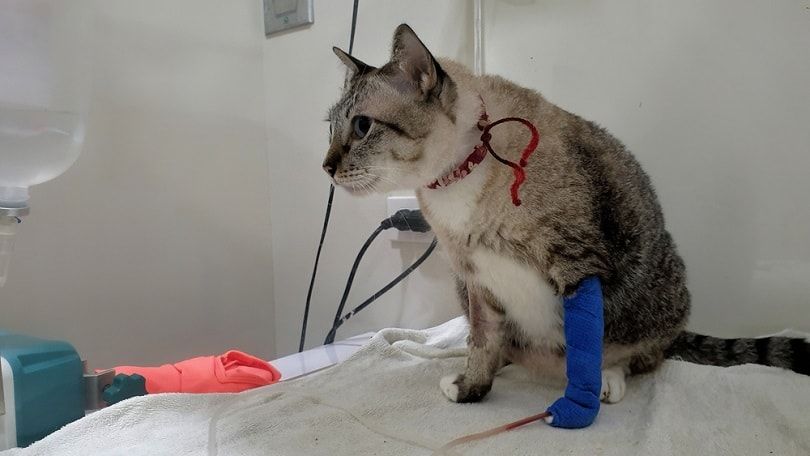
Stabilization in very ill cats is paramount—this could include intravenous fluids, supplemental oxygen, etc. In severe cases, a blood transfusion, which would be more likely to be done at a specialty or referral clinic, may be needed. Supplemental iron, to be given under the direction of a veterinarian, may also be needed.
If a specific cause of the anemia has been found via history, exam, and labwork, then treatment tailored for that cause will be recommended. For example, if parasites are the cause, medication tailored to the parasite will be utilized, while steroids can be utilized in immune-mediated disease. For cats with chronic kidney disease, darbepoetin is an injectable medication that can essentially help the bone marrow produce new lines of red blood cells.
Frequently Asked Questions (FAQ)
What are some of the most commonly seen causes of anemia in cats?
Some more commonly seen causes of anemia can include renal failure, intestinal parasites (eg: hookworm), ectoparasites (such as fleas), feline immunodeficiency virus (FIV), feline leukemia (FeLV), and lymphoma.
Is there a way to prevent anemia in my cat?
Some causes of anemia can be prevented, while others cannot. For example, veterinary-prescribed flea treatment and prevention can keep a cat from having fleas and therefore getting anemia from those parasites. In addition, having an indoor cat who is either indoor-only or only allowed on supervised (such as harness and leash walks or contained outside enclosure) outdoor visits may help limit a cat from getting or being exposed to several causes of anemia such as trauma (hit-by-car, attack from another animal, etc.), parasites, FIV, etc. Other causes of anemia, such as cases of cancer or autoimmune causes, for example, are typically not preventable.
In addition, routine exams, bloodwork, and fecal exams to monitor for changes as well as following your veterinarian’s recommendations on your cat’s lifestyle, internal and external parasite prevention, and the like are all great steps for your cat’s health and can help prevent or catch anemia sooner rather than later.

What is a cat’s prognosis with anemia?
There is no simple answer to this question as it depends on many factors including the exact cause, if a treatment is available and elected, the cat’s overall health, etc. Some cats may die from anemia, while others will improve to normal health, and some will be in-between. This means that a complete cure is not available, but advances in medicine allow for a longer, happier life with treatment than without it.
Generally speaking, regenerative anemia tends to have a better prognosis than non-regenerative anemia. In addition, if the primary cause of the anemia is removed/resolved, the prognosis is expected to be better. Consequently, less severe anemia that is treated early will likely have a better prognosis than a very severe case that is treated much later.
Conclusion
Anemia in cats can be life-threatening and can be due to many different causes. While not all causes of anemia can be prevented, to best help your feline friend, pay attention to subtle health signs and changes and discuss them promptly with your cat’s veterinarian.
Routine check-ups are the best bet in being able to detect and proactively prevent or treat a problem should anemia be present.
Sources
Featured Image Credit: RJ22, Shutterstock
Expert cat care, straight to your inbox
News, insights, and useful advice, delivered to you.

No spam — unsubscribe anytime.
By signing up, you agree to our Terms & Conditions and Privacy & Cookies Policy.
How useful was this post?
Click a star to rate. You can leave written feedback afterwards. (We read all feedback.)
Dr. Rachel Ellison DVM (Veterinarian)
Dr. Rachel Ellison lives on a mountain in Utah with her husband, daughter, and son, as well as their animal menagerie— a Bernese Mountain Dog, a Bengal/Siamese mix, and an orange tabby cat, as well as numerous chickens. During her free time, she enjoys being with those she loves, cooking and baking, reading, hiking, sharing her knowledge about cats, and exploring nature and the world around her.