
In this article
View 3 More +Savannah cats are tall, slim domestic cats that have a wild-cat temperament. It is a hybrid, meaning it’s a cross between a domestic cat and a wild Serval African cat. That’s not where the information ends on these gorgeous cats, however.
Savannah cats are broken down into different generations of hybrid species. These generations are F1, F2, F3, F4, and F5. However, if you’re looking to adopt a Savannah cat, you might be confused as to which generation is the best for you and even what the differences are.
In this guide, we’ll tell you how the F1 Savannah and F2 Savannah cats are similar and how they differ, so join us.

Visual Differences

At a Glance

- Average height (adult): 16–18 inches
- Average weight (adult): 13–25 pounds
- Lifespan: 13–20 years
- Exercise: 1+ hours a day
- Grooming needs: Moderate
- Family-friendly: Yes
- Other pet-friendly: Often
- Trainability: Intelligent, loyal, eager to please, easy to train
- Average height (adult): 15–18 inches
- Average weight (adult): 16–25 pounds
- Lifespan: 17–20 years
- Exercise: 1+ hours a day
- Grooming needs: Moderate
- Family-friendly: Yes
- Other pet-friendly: Often
- Trainability: Intelligent, easy to train, lovable

F1 Savannah Cat Overview
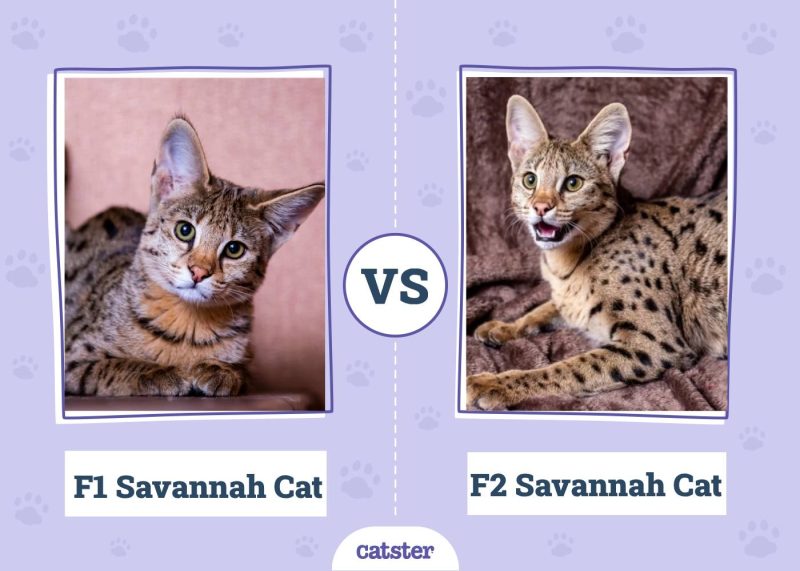
The F1 Savannah cat is a gorgeous creature that makes a great pet, but they have a bit of a wild side that can get the better of them at times. F1 means this is the first generation of this Savannah cat hybrid. Since it is the first generation, this cat will look more like the Serval cat than other generations. It is also the largest Savannah of all the generations since it has the most Serval genetics.
The cat is a relatively new hybrid that’s only been around for the last 30 years and became popular for the first time in the 1990s. We’ll discuss the cat’s personality, health issues, and training below.

Personality / Character
It’s important to remember that an F1 Savannah cat is 50% African Serval. This makes the gorgeous cat a half-domestic and half-wild feline, which means the cat’s wildness is more apparent.
With that being said, this generation of Savannah cats is not considered to be mean or dangerous. If the cat is raised in a safe, loving home, they’re just fine with behaving and controlling its wild tendencies.
They bond with their humans and tend to get along well with children, though, as with any animal, you need to monitor interactions between the F1 Savannah cat and children. They also tend to get nervous around strangers and take a while to warm up to non-family members. They like to be loved and petted, but as with any cat, it’s on their own terms.
Training
Your F1 Savannah cat can be trained to use a litter box quickly and will typically teach itself without requiring your assistance. It is best to keep any plastic or cloth bags out of the cat’s reach, as they tend to see them as litter boxes and may use them instead.
It’s also possible to train an F1 Savannah to walk on a leash, but it’s best to use a harness to prevent strain on their neck. The F1 can be an anxious cat, so a lot of patience, time, and love needs to go into the leash training, and it isn’t going to happen overnight.

Health & Care
As with breeds, there are health issues that you need to watch out for with your F1 Savannah cat. This breed is pretty healthy overall, but it’s better to be informed about potential medical issues.
- Liver shunt
- Extra toes
- Dwarfism
- Ringworm
- Upper respiratory infections
- Bacterial infections
- Cleft palates
If you see any troubling symptoms that may indicate your F1 Savannah is sick, it’s best to visit your veterinarian for treatment.
Suitable for:
The F1 Savannah cat makes an excellent pet for families and singles alike. It is best to watch your cat around younger children, but other than that, the wild kitty is an ideal pet for anyone who has the time and patience to care for one.

F2 Savannah Cat Overview
The F2 Savannah cat is much like the F1. However, they are the second generation of this hybrid breed. The F2 Savannah cat is 35% Serval, so it has fewer wild cat genes than the F1, making it easier to domesticate. The goal of F2 breeders is to produce a cat with an even temperament. The F2 Savannah cat is slightly smaller than the F1 and is even more popular than the first generation.
As with the F1 Savannah cat, we’ll discuss the F2’s personality, training needs, and health issues below.

Personality / Character
The F2 Savannah cat’s personality has been said to be similar to a loyal dog. They are energetic, loving, loyal, and very playful. They are also calmer than F1 Savannah cats.
These cats really enjoy being cuddled and curling up on the couch with their pet owners. They are different from other domestic breeds since they require more attention and care. As with the F1, the F2 is not considered mean or dangerous. They get along well with humans, children, and other pets but need to be trained and socialized as kittens.
Training
F2 Savannah cats are extremely smart and can be trained to walk on a leash, fetch a ball, and use the litter box. They can even be taught to respond to specific commands, making them easier to train than most domestic felines.

Health & Care
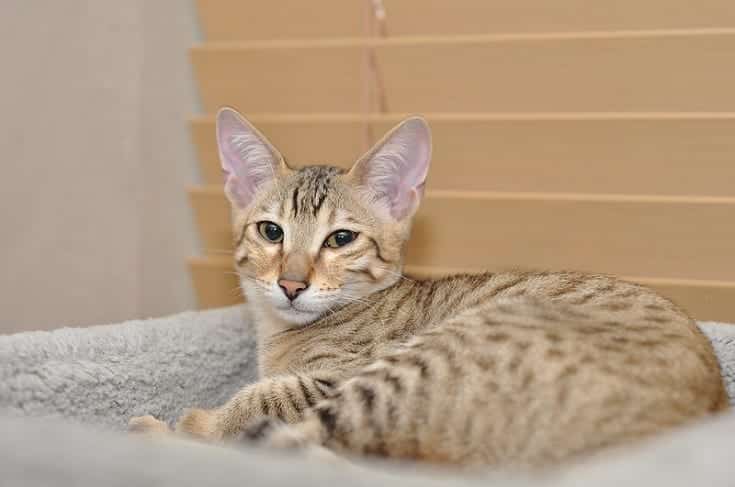
As with the F1 Savannah cat, the F2 is relatively healthy. However, since it’s only 35% Serval, there are other species in its DNA, and the cat may be vulnerable to the conditions prevalent in various breeds.
- URI or Upper Respiratory Infections
- Feline Lower Urinary Tract Disease
- Heart disease
- Dental disease
- Hyperthyroidism
- Diabetes
- Chronic kidney disease
Suitable for:
The F2 Savannah cat is an excellent family pet that gets along well with children and other pets. If you’re thinking of adopting an F2 Savannah cat, you may want to provide a friend for the cat if your family does not spend much time at home. Introducing another pet when the Savannah is young is ideal since they’ll be more accepting of another animal and less likely to claim territory when your home is new to them. However, your Savannah will be content if you work at home or have someone at your house all the time.

Which Breed Is Right for You?
Now that you know the differences between the F1 and F2 Savannah cats, you need to determine which one is the best pet for you. The F1 Savannah is a bit wilder and more energetic than the F2 Savannah, and the F2 loves to cuddle more than the F1. The best way to determine the best pet for you and your family is to consider how active you are, how often you’re home, and which generation seems perfect for your home.
Featured Image Credit: Left – Kolomenskaya Kseniya, Shutterstock | Right – Kseniya, Shutterstock





