Why Is My Cat Staring at the Ceiling? 6 Vet-Reviewed Reasons


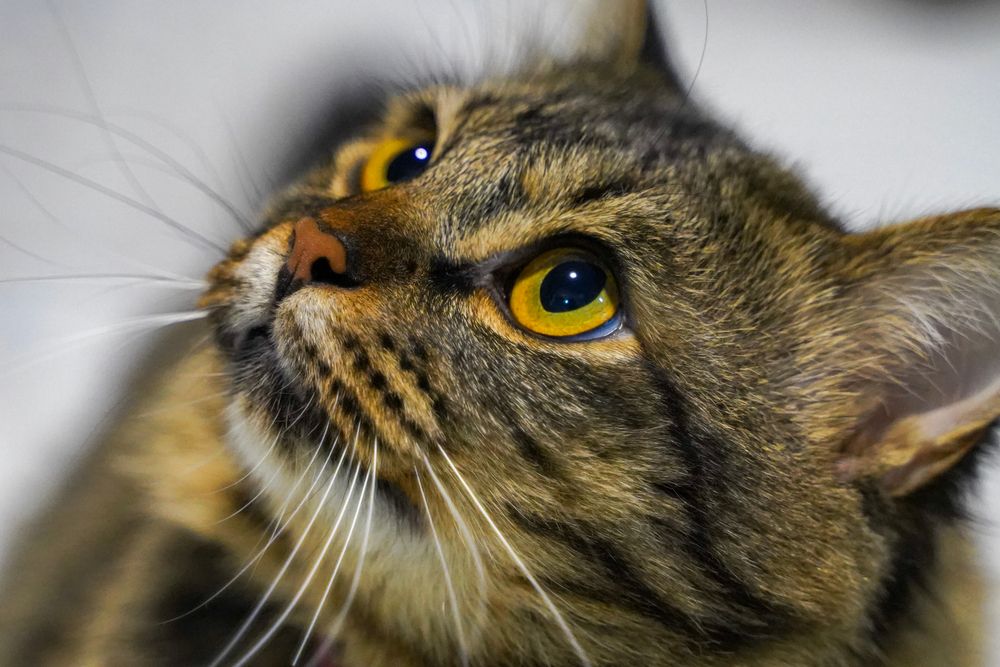
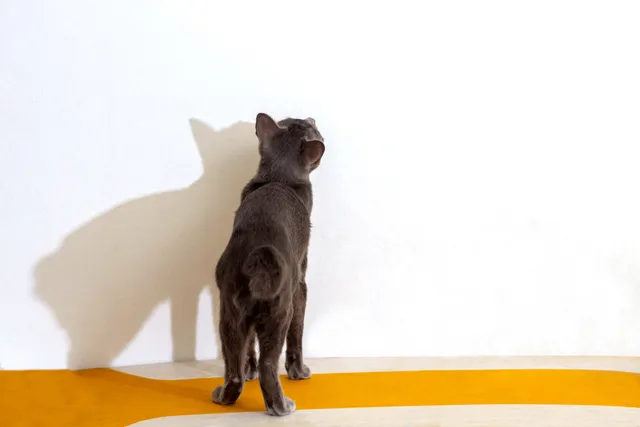
Cats are mysterious creatures. For ages, people have studied their behavior and tried to understand why they do the things that they do. One of your cat’s more curious actions may be staring at the ceiling of your home for what appears to be no reason.
Seeing this type of activity can be unsettling, and you probably instantly think that something is on the ceiling or that something may be wrong. That isn’t always the case, however. Let’s learn more about your amazing cat and the common reasons that they may be sitting and staring at your ceiling.

The 6 Reasons Why Your Cat Stares at the Ceiling
1. They See Differently Than Us!
You may notice your cat staring at the ceiling and try your best to look for whatever has captured their attention but find nothing. This is common because your cat sees differently than you do. Your kitty can see in the UV spectrum1 due to having cornea that don’t reflect UV light as ours do, and instead allow it to pass to the retina.
This is thought to enable them to pick up on things that you can’t. They are also relatively short-sighted compared to humans so will not see the ceiling as clearly as you. Don’t become alarmed or spooked when your cat stares at the ceiling. It’s natural for them to be able to see things that we can’t or have trouble focusing on distant objects that we can.

2. They Have Better Hearing
We’ve all heard people brag about how well a dog can hear, but did you know cats have better hearing than even man’s best friend? It’s true. A cat’s hearing range falls between 48 Hz and 85 kHz.2 Dogs only hear in a range of 67 Hz to 45 kHz. When your cat is staring at the ceiling or perhaps a wall in your house, it may be that they hear something you can’t.
Often, mice or insects scurry around inside the ceilings of our homes. Your cat is capable of hearing all this activity. Their hearing is also advanced enough to pick up the small creaks and moans your house makes when it’s settling or the wind is blowing.
3. Your Cat May Smell Something
Your cat can hear pests in the ceiling, but they can probably smell them as well. Cats have an excellent sense of smell—far better than ours (they have 14 times the number of scent receptors).
Cats also have a sensory organ on the floor of their nasal cavity called the vomeronasal organ used for detecting pheromones. With such a great sense of smell and detecting chemical signatures3, it’s reasonable to expect that they would pick up on the scent of rodents or other things we simply cannot on the ceiling or in the roof space.

4. Cats Remember the Past
Just like us humans, cats have episodic memory.4 This means they can remember details from the past. It’s possible that when your kitty is staring at the ceiling, they’re remembering that one time they saw a spider crawling there or heard a mouse in the attic.
It is possible that your cat’s momentary fixation on your ceiling is simply a memory and not a new creature hiding up there.
5. Cats Are Curious Predators
The old saying goes, “Curiosity killed the cat.” While most cats don’t all foul of their curiosity, it’s still there as part of their predator instincts. Cats need to understand why they hear things, what’s taking place, and whether they are in any danger from it or can eat it.
Due to their predator instinct to focus on prey and stay alert for danger, this curiosity could leave them in the same spot for a while. Whether your cat is trying to determine what they are seeing or hearing or if they’re waiting for their chance to pounce on the source of their attention, being overly curious about a particular area of the home is commonplace when cats are part of the family.

6. They May Have a Medical Problem
Unfortunately, while staring at the ceiling occasionally is normal for most cats, that isn’t always the case. There are medical problems that could result in your cat appearing to stare at the ceiling. Diseases such as those affecting the liver, eyes, and brain could result in abnormal staring at the ceiling or over-extension of the neck so that the head is held up.
If you notice your cat suffering from unusual behaviors especially if combined with other signs of illness such as changes to appetite, ability to walk or vomiting, it’s best to visit the veterinarian for a thorough examination.
Determining When Something Is Wrong
Trying to determine whether your cat may be suffering from a medical issue or is simply being a normal cat isn’t always the easiest thing. If your cat hears, sees, or smells something that you can’t, in most scenarios, you’ll eventually be alerted to the culprit, or your cat will ultimately lose interest and wander away.
If your cat continually stares at the ceiling and has other unexpected or alarming signs that don’t seem right to you, don’t wait. Health issues can arise quickly in your kitty that need attention from their veterinarian. Staring at the ceiling is innocent enough, but if it’s coupled with other signs, your kitty could be very ill. Always pay close attention to how your cat is acting in other ways.
Are they eating, drinking, and toileting as normal? Are there other times they are showing odd behavior that has not occurred before such as walking in circles, bumping into objects, or stumbling? Make note of anything out of the ordinary for your cat and bring your concerns to a veterinarian.
Conclusion
As you can see, there are several reasons that your cat may sit and stare at the ceiling. While some of us think about the possibilities regarding what our cat can sense that we can’t, in most situations, it’s something simple. Don’t be surprised after finding your cat staring at a particular spot if a dead spider or moth turns up. That’s just your cat doing their job.
You may also eventually hear the scurrying of a mouse in the walls. It’s when your cat stares at the ceiling and exhibits other signs of something being wrong that you should take action and seek medical help. If that isn’t the case in your situation, enjoy trying to solve the mystery of what your cat knows that you don’t!
Sources
Featured Image Credit: Nigi Nigiri, Shutterstock
Expert cat care, straight to your inbox
News, insights, and useful advice, delivered to you.

No spam — unsubscribe anytime.
By signing up, you agree to our Terms & Conditions and Privacy & Cookies Policy.
How useful was this post?
Click a star to rate. You can leave written feedback afterwards. (We read all feedback.)
A native of East Tennessee, Melissa is an avid animal lover who enjoys writing in her notebooks and playing outside with her many pets. Currently, she has two cats, Princess and Pepper, who are total opposites that demand constant attention. Her three dogs, Jazzy, Whitey, and Demon, are spunky troublemakers.
Melissa is also a dedicated wife and mother to two children. Beyond her career as a freelance cat writer, she's a published Indie author under the pen name Rena Marin!