Why Does My Cat Stare at the Wall? Our Vet Discusses Common Reasons & What to Do

In this article
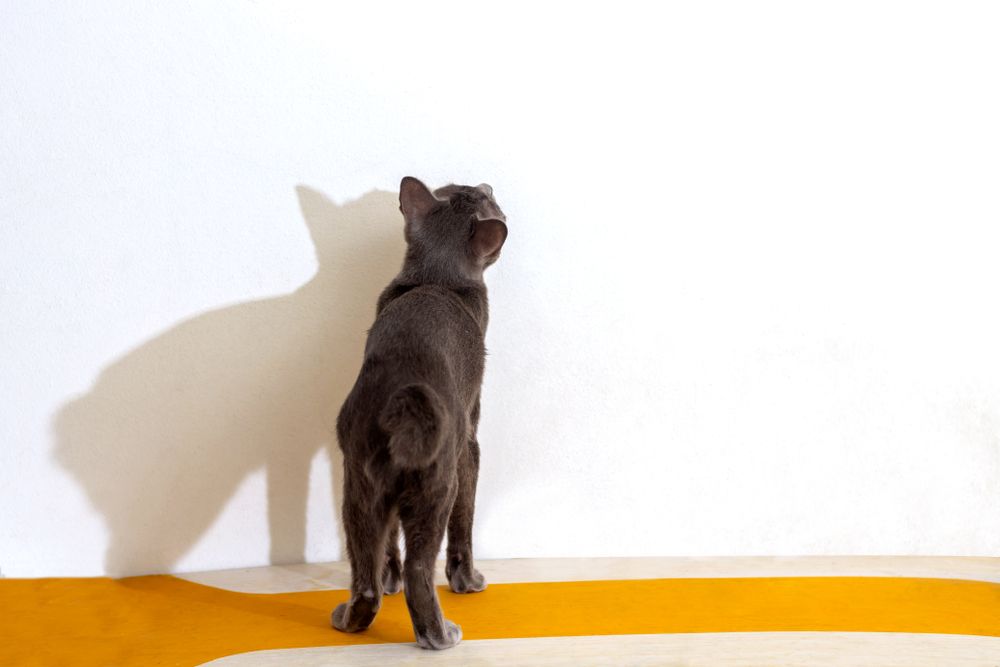
There are many things our cats do that confuse and confound us, and one behavior that can be quite concerning is when they start staring intently at a wall. Are they sleeping with their eyes open? Do they see something we can’t? Or are they deliberately misleading us in a way that only a cat can? While we can’t necessarily rule out that last one, there are several reasons to explain this sort of behavior, some that are quite worrying, others merely perplexing.
Read on to learn more about the reasons why cats stare at walls.

The 7 Common Reasons Why Cats Stare at Walls
1. Your Cat Has Heard Something That You Can’t
Cats have sensitive hearing and can easily detect small sounds that pass us by. We’ve heard stories of families finding rodents or raccoons making nests in their walls after they were alerted to a specific spot by their cat staring at it!
If your cat’s ears are pricked toward the wall and appear fiercely concentrating, they may be listening to something you can’t hear, such as the sound of a family member’s car arriving home. While it looks like they’re staring at the wall, they’re concentrating on figuring out what the sound is and exactly where it’s coming from.
If your cat is simply listening to something behind the wall, they may also paw at the wall, and move to different locations if the source of the sound is moving.

2. Feline Cognitive Dysfunction Syndrome
Just like humans, cats are susceptible to deteriorating brain function as they get older, and feline cognitive dysfunction (FCD), often referred to as feline dementia, can result in a range of different signs and behaviors like confusion, staring into space, and seeming to forget why they entered a room. Cats with FCD tend to be at least 12-13 years old, and may also show signs such as:
- increased vocalization, especially at night
- forgetting to eat, or forgetting they have just eaten
- disorientation
- toileting outside the litter box
- personality changes
Although there is no cure for FCD, there are treatments and modifications you can implement to slow the progression of this syndrome and help reduce your cat’s anxiety and stress.
3. Kidney Disease
Another unfortunate and common problem in aging cats is kidney (renal) disease. One of the main roles of the kidneys is to filter out the toxic waste products of digestion, and when that filtration system starts to fail, those toxins start to build up in the bloodstream. When this happens, it can lead to signs similar to that of FCD.1

4. Liver Disease
Similar to the kidneys, the liver plays a vital role in filtering waste products from the blood, so any disease that affects this process can also lead to a condition known as hepatic encephalopathy. Cats that are experiencing hepatic encephalopathy will usually be showing several other signs of liver disease, including vomiting, inappetence, jaundice, abdominal enlargement, and weight loss.
5. Your Cat Sees Things Differently
In some ways, cats have far superior vision to humans, but there are certain things we can see that they can’t. The feline eye is designed to spot the slightest movements, but they can’t see the spectrum of colors that we humans get to enjoy. Their vision may not be as colorful, but they will see contrasting shades better than we can. A plain surface like a wall might seem uninteresting to our eye, but our cats may be able to detect movement or tiny creatures that we aren’t able to readily see.

6. Neurological Disease
In addition to FCD and hepatic encephalopathy, certain infectious diseases, toxins, and tumors can result in abnormal brain function and behavior. Often, these sorts of disease processes will be accompanied by other signs such as:
- compulsive pacing or circling
- disorientation
- seizures
- vision problems, including dilated pupils
- excessive vocalization
- head pressing
Head-Pressing Versus Head-Butting
Don’t confuse head-pressing with head-butting. Cats will often briefly head-butt things, including us, as a normal way of leaving their scent pheromones on areas of their territory.

7. They’re Depressed
Yes, cats can get depressed, although it’s not exactly the same condition experienced by humans. Feline depression is most often seen in indoor cats that aren’t given enough mental stimulation.
Ensuring your cat has enough enrichment and interest around the house can keep them happy and healthy. You can distract your cat from their staring session by encouraging them to play or setting up a bird-watching station so they can stare out of the window instead.


What Should Owners Do if Their Cat Is Staring at the Wall?
Although there’s every chance your cat’s wall-staring behavior is nothing to be worried about, it shouldn’t be dismissed out of hand. Whenever your pet behaves differently, you should look at the big picture to see if you can work out what might be causing the change.
- Are they getting older?
- Has their appetite changed?
- Are they drinking more than usual?
If your cat is pouncing, chasing, and staring, they’re likely seeing or hearing something we can’t, but if not, it’s time to contact a vet.

Final Thoughts
Feline behavior is something we may never fully understand, and it is very possible that our cat may stare at walls for no other reasons than ‘because they are there’. However, several serious health conditions could explain this behavior, so it’s not something we should simply ignore.
Keeping your cat entertained and enriched is vital for their welfare and mental health, and ensuring they have regular checkups with the vet is the best way to ensure you stay ahead of any worrying health conditions.
It may be nothing, but it could be something, so don’t hesitate to ask your vet or one of our veterinarians at PangoVet (from the comfort of your own home!)
See Also:
Featured Image Credit: Boonlert Saikrajang, Shutterstock
Expert cat care, straight to your inbox
News, insights, and useful advice, delivered to you.

No spam — unsubscribe anytime.
By signing up, you agree to our Terms & Conditions and Privacy & Cookies Policy.
How useful was this post?
Click a star to rate. You can leave written feedback afterwards. (We read all feedback.)
Dr. Karyn Kanowski BVSc MRCVS (Veterinarian)
Dr. Karyn comes from Queensland, Australia, and has lived in the UK for the past 10 years. In 2010, she graduated from The University of Queensland School of Veterinary Science and also has a Bachelor’s degree in Zoology. She is passionate about using evidence, experience, and owner collaboration to provide the best solutions for pets, and believes in making reliable information about animal health accessible to all. Dr. Karyn shares her home with five cats, four dogs, and one husband. When she is not in the scrubs, she spends her time writing, gardening, and cleaning up pet hair!