Cat Pupils: Eye Meaning Explained (Vet-Verified)



In this article
The proverb “The eye is the window to the soul,” is fitting when it comes to cats. They use it to communicate a broad spectrum of emotions. We can even tell when something is wrong by looking at our cat's eyes. Your pet may try to hide what’s going on inside, but their eyes are a good giveaway. Felines excel at non-verbal communication, as it’s one of their keys to survival.
Part of the reason that a cat's eyes are so revealing is their many facial expressions. Scientists have documented 276 distinct expressions1, with 26 unique muscle movements. These movements, combined with changes in pupil size, help to understand a cat’s body language even better. Learn more about the meaning behind your cat's eyes below.

Feline Eye Structure

A cat’s eye is similar to a human’s. After all, they do the same thing, albeit with varying results. The differences reflect a feline’s role as a crepuscular predator and an obligate carnivore. Cats’ superior night vision is thanks to some special features in their eyes. Their retinas have a larger proportion of rod photoreceptors, and these are light-sensitive cells that work in low light conditions.
The pupils also respond to the available environmental light. They dilate in low-light conditions and narrow to slits when it’s bright or sunny. However, cats can see better than humans with less light. They also have an additional tissue layer, the tapetum lucidum, that reflects even more light back to the retina. These adaptations give them an advantage when hunting.
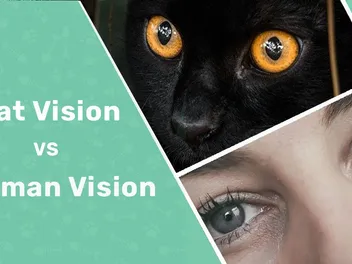
Generally speaking, felines need to be seven times closer to see an object as clearly as we do, meaning they are near-sighted. This is calculated by the Snellen fraction, which in normal humans is 20/20 and in cats is approximately 20/150. This means that a cat can see objects clearly at 20 feet, while we can see from up to 150 feet away.
We have richer color vision compared to the relatively dull range that felines have. Because of how their eyes are positioned, cats have a wider field of view, which gives them a competitive edge in locating prey. The anatomy and functionality of feline pupils is highly refined, providing them with the functions they need to survive.
Visual Communication
The facial expressions we referenced earlier averaged four movements of the 26 unique ones in each case. They included actions involving their ear positions, whiskers, blinks, and lips. That opens up many possibilities of what the cat is trying to get across to a caregiver or another animal.
We can make some generalizations about the meaning of cat pupils based on their emotions, which include the following observations:
| Relaxed: | Pupils normal to slits |
| Alert: | Pupils normal |
| Tense: | Pupils normal to somewhat dilated |
| Anxious: | Pupils dilated |
| Fearful: | Pupils fully dilated |
| Extreme Fear: | Pupils fully dilated |
One thing is apparent: Dilated pupils are more the status quo as the risk of a threat increases. Remember the function of this action. It allows more light into the animal’s eyes so they won’t miss anything potentially dangerous. It’s worth delving more into a cat’s relaxed state as communicated by pupils as slits.
One study correlated half-blinks and narrowing of the eyes as being more attractive to cats when humans take these actions. The felines were more likely to mimic this movement when their owners did it. The animals were also more inclined to approach the researchers. These findings support the hypothesis that eye narrowing is a friendly gesture.
It’s worth mentioning that dilated pupils can also be an indication of pain in pets. It undoubtedly makes sense that a cat would feel anxious and fearful because the animal is vulnerable from an inability to defend themself fully. That provides compelling evidence of the range of emotion conveyed by the state of a cat’s pupils. Remember that this action is also involuntary.
The other visual signs accompanying the state of a cat’s pupils remove any uncertainty about their mood. For example, an animal that is extremely afraid is likely growling or hissing with their ears pinned back onto their head. A puffed-up tail is another indication of a highly agitated feline. You don’t necessarily need to look into a cat’s eyes to know what they’re telling you.
Catnip may mimic the effects of an anxious or fearful pet. However, the accompanying behaviors make it clear this response isn’t sexual or aggressive. Their actions suggest that smelling the plant is a pleasurable experience. Some scientists theorize the insect-repelling properties may have made this reaction desirable to protect the felines from parasitism and disease.
When Something Is Wrong
A cat’s pupils can convey more than how they’re feeling. Pupils also change size due to medical conditions. Anisocoria describes a condition when they are of different sizes. The odd appearance is indeed enough to set off alarms in any pet owner. However, it isn’t diagnostic in itself. Many things can cause it. They include the following:
- Uveitis
- Toxoplasmosis
- Cancer
- Retinal disease
- Glaucoma
- Eye or brain injury
Of course, all point toward a severe medical condition requiring immediate veterinary attention. The treatment and prognosis depend upon the underlying cause. Blindness or more serious complications can occur if left untreated.
It is also worth noting that abnormal pupils not only present as unevenly sized, but unresponsive, fully dilated pupils in both eyes can be an indication of high blood pressure. Whenever you notice any abnormality to your cat’s pupil(s), make sure to contact your vet right away.

Final Thoughts
Cats can communicate with people and other animals non-vocally. It benefits them from a survival standpoint in order to prevent life-threatening conflicts. Cat pupils reveal a lot about their emotional state even if they can’t otherwise tell you what’s wrong. And they don’t lie because their movements are involuntary. They truly are a window into your pet’s soul.
Sources
https://www.science.org/content/article/cats-have-nearly-300-facial-expressions
https://www.merckvetmanual.com/cat-owners/eye-disorders-of-cats/eye-structure-and-function-in-cats
https://www.scientificamerican.com/article/the-inner-life-of-cats/
https://indoorpet.osu.edu/sites/indoorpet/files/assets/documents/hospital/indoorcat/
https://www.ncbi.nlm.nih.gov/pmc/articles/PMC1480656/pdf/canvetj00079-0049.pdf
Featured Image Credit: Anne Richard, Shutterstock
Expert cat care, straight to your inbox
News, insights, and useful advice, delivered to you.

No spam — unsubscribe anytime.
By signing up, you agree to our Terms & Conditions and Privacy & Cookies Policy.
How useful was this post?
Click a star to rate. You can leave written feedback afterwards. (We read all feedback.)
Chris has been a science-focused pet writer since 2009, specializing in health and the environment. She lives with her husband Norm and three amazing cats in the land of 10,000 lakes. When she's not writing about cats, Chris also enjoys boating and sampling wine. She has her WSET 1 and 2 certifications and is currently pursuing her Certified Wine Specialist Award (CSW).