Will Cats Protect Chickens? Our Vet Answers

In this article
Cats are natural predators, and the impact they have on the environment is well investigated. Cats kill billions of birds each year in geographical locations they aren’t native to, which definitely introduces an element of controversy when it comes to allowing pet cats to roam unsupervised 1.
Yet, many folks who keep chickens as pets wonder if their cat will be able to protect their flock from other predators. So, will cats protect chickens? In some circumstances, a cat may inadvertently protect your chickens by fending off other cats or predators that they view as a territorial threat. However, there’s no guarantee that they will do this, and there’s no proven way to train a cat to protect a chicken flock. A cat can also kill chickens or injure them and their chicks (either intentionally or while playing with them).
Let’s explore this more.

Will Cats Protect Chickens?
There’s absolutely no doubt that cats have been documented as serving the role of a protector and savior for their humans. A very popular example of such an interaction was recorded when a now-famous cat, Tara, saved a toddler from an aggressive dog.
Though it is unclear what Tara was truly feeling at the moment, cats are territorial predators and are known to protect what they perceive as “theirs” (known as resource guarding). In the incredible story above, Tara was likely displaying the signs of resource guarding against another predator and sprung into action right away.
Many chicken owners stated that their cats doing the same with their flock of chickens: they will protect their flock from other predators. Anecdotally, this is true. It is possible that some cats will become desensitized to a flock and will not see them as prey. This is much like how cats have been successfully housed with other prey animals (as seen all over social media from time to time). It would come down to a cat’s personality, the size of the chickens, and perhaps the way the introductions are done.
Such cats often don’t chase or attack “their” chickens and are seen as a great deterrent to other predators because their territorial instinct will likely drive them to not tolerate other predators (especially other cats) in the area. Thanks to the internet, it’s very easy to find examples of such interactions as well.
In short, there’s no guarantee that a pet cat will protect a flock of chickens. However, in some circumstances, their presence may be favorable for a flock and they may be contributing towards the flock’s safety without necessarily intending to do so. This distinguishes them from guard dogs trained to protect livestock.

Why Do Some Cats Seemingly Protect Chickens?
Whether cats that are desensitized to a flock actually want to consciously protect them is not fully established or proven. However, the psychological analysis of a predator (in this case, a cat) would suggest that they are appearing to protect the flock by one or a combination of several factors:
- Territory Guarding: The cat might just be interested in securing their own territory and not allowing other cats in, which means they inadvertently protect the chickens.
- Positive Association: A cat that left chickens alone once or twice might have received praise or treats from their owners and might have associated the act of leaving the chickens alone as an incentive to gain something from their owners.
Why Do Some Cats Leave Chickens Alone?
This too, requires some postulation and guesswork. However, the most likely explanations are as follows.
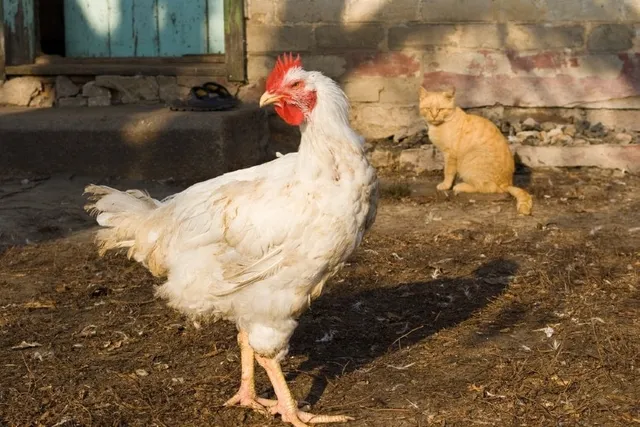
- Non-Prey Association: Many domesticated chicken breeds are often far larger than their wild counterparts (the red junglefowl). A cat may simply find chickens too large to attack.
- Learned Behavior: Anyone who’s kept chickens knows that a broody hen is not opposed to attacking anything she perceives as a threat to her eggs or chicks. A cat may have learned to leave chicks alone after being chased off by an irate hen, and anecdotal evidence of them leaving a flock alone after being chased by a rooster exists as well.
- Learned Sounds: Studies of wild cats show that they’re able to identify the warning calls of many species, and once they know they’ve been spotted, they abandon a hunt. Chickens have different calls for aerial and land-based threats, and a cat may sometimes possibly know they’re spotted by a flock and, therefore, may decide that it’s not worth ambushing them.

Why Are My Chickens Not Afraid of My Cat?
Chickens are far more intelligent than they’re given credit for. Though often just viewed as a food source, studies into their cognitive abilities have shed some light on their intellect. Studies have shown that from a very early age, chickens can identify faces and can become desensitized to them 2. They can even distinguish these faces from others when given a choice of selection. Therefore, the people who claim that their chickens don’t raise an alarm when seeing the house cat but do so when they see a strange cat probably aren’t lying to you! It’s entirely possible within a chicken’s cognitive abilities to distinguish between cats.
Is There a Risk Introducing My Cat to Chickens?
It seems that there are many potential upsides to having a pet cat introduced to your flock of chickens. However, this relationship isn’t considered harmonious. We should reiterate that there’s absolutely no guarantee that your cat will protect or leave your flock undisturbed. A cat definitely has the ability to injure or kill a chicken, and they may also do so while engaging in what we describe as “play”. In addition, your cat’s presence may not necessarily be good news for your flock. There are several reasons why this is the case.
- Predator Conflict: Your cat may be an attractant for other predators that either want to squabble for territory or mate with your cat. This would put your flock in danger, too.
- Risk for Cat: A cat isn’t an apex predator, and in many parts of the world, cats are preyed upon by other, larger predators. Chickens are an absolute favorite prey item for such predators. This poses an ethical dilemma, as having your cat with your flock might be putting your cat in danger.
- Roaming Risks: A cat that roams outdoors to “protect” your flock is at risk from other things too, such as diseases, motor vehicle accidents, or ending up as either stolen, lost, or displaced.
- Lack of Territorial Drive: A cat that’s desexed will likely not have as strong a territorial drive as an intact cat. Again, this poses an ethical conundrum: is it ethical to leave your cat intact to ensure their territorial instinct remains strong, which, in turn, will contribute to the other issues intact cats are prone to (increased fighting, uncontrolled mating, etc.)?
The risks mentioned above definitely warrant careful consideration before deciding to introduce your cat to your flock.
What’s the Best Way to Protect My Chickens?
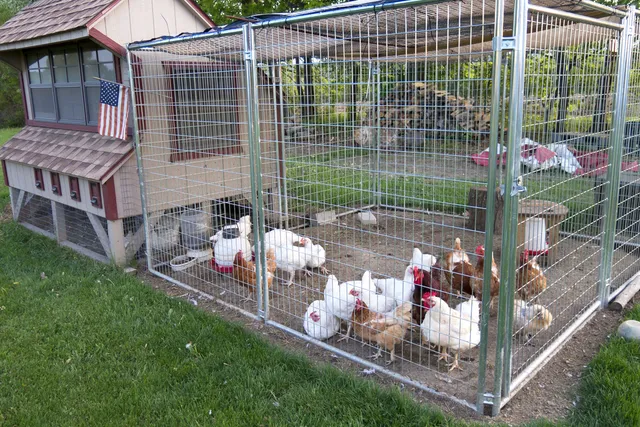
The most practical and cost-effective way to protect your chickens from any predator is to place them in a predator-proof coop. Many options are available for commercial purchases, and DIY projects can also be considered for large, customized enclosures.

Conclusion
Anecdotal evidence suggests that cats may indeed protect chickens in some circumstances. However, whether they choose to do so voluntarily or inadvertently remains a mystery.
Even if your cat seems to live peacefully with chickens, it doesn’t guarantee the flock’s safety from other, larger predators. Ultimately, relying on just a cat to protect your flock is not recommended and is also considered unethical by many.
See Also:
Featured Image Credit: slowmotiongli, Shutterstock
Expert cat care, straight to your inbox
News, insights, and useful advice, delivered to you.

No spam — unsubscribe anytime.
By signing up, you agree to our Terms & Conditions and Privacy & Cookies Policy.
How useful was this post?
Click a star to rate. You can leave written feedback afterwards. (We read all feedback.)
Dr. Luqman Javed DVM (Veterinarian)
Dr. Luqman (also known as Dr. Lucky) grew up with an immense passion for animals of all kinds. By becoming a veterinarian, he turned his childhood dream into reality. Now, his goals are focused on providing help to cats all around the world by helping to cat owners understand their feline friends better to ensure the best quality of life for them. His passions are wildlife, exotic pets, pet owner education, and animal welfare. He graduated with his DVM from the Universiti Putra Malaysia in 2020. He has worked with a variety of animal species and has decades of personal experience with keeping many different types of exotic pets, such as turtles, hamsters, freshwater fish, chickens, songbirds, and parrots (and he has extensive skills in training parrots, too).