Get

In Your Inbox

Catster is reader-supported. When you buy via links on our site, we may earn an affiliate commission at no cost to you. Learn more.

My Cat’s Spay Incision Is Slightly Open, Should I Worry? Our Vet Explains

Share

healing-spay-incision-after-neutering-female-cat

As a responsible cat parent, you know that spaying your cat is the right thing to do for her health and happiness, as well as to eliminate the risks of her becoming pregnant and adding to the number of cats needing homes. Knowing this doesn’t necessarily make it easy when the day comes to leave them at the veterinary hospital for their surgery, and when something goes wrong, you’re bound to panic.

As the most common surgery performed on female cats, there is always a chance of postoperative complications, but fortunately, they are relatively uncommon and almost always minor. Often, the biggest problem we see with cats after this operation is that they feel fine very shortly after surgery, and they don’t always rest up as much as we’d like, which can result in swelling or inflammation of their wound and could even cause the wound to open.

Sometimes, sutures might break and a cat’s spay incision will open up, even if they have been taking it easy, which will undoubtedly cause you to worry.

Here’s the good news: Your cat will almost certainly be just fine, but you do need to take them back to the vet.

divider cat paws 2 oct 2024

What Will Happen if My Cat’s Spay Incision Opens Up?

The first thing you’ll want to do is make sure your cat can’t lick the wound by placing a surgical collar, shirt, or onesie on your cat until you can get them to the vet. It would also be sensible to confine them, either to a very small area or in their pet carrier.

What happens next will depend on how recent the surgery was, what part of the wound has opened, and by how much.

If only the skin has opened up a tiny bit, the vet may just recommend that you prevent your cat from licking the wound and keep them confined until it heals. If the skin has opened more than 5 millimeters, or if the muscle layer has also opened, the vet may need to give your cat a sedation or anesthetic to clean and re-suture the incision, or they might just use skin staples to close the skin.

If your cat’s wound has become infected, it is likely that they will need antibiotics, and the incision may need to be cleaned and re-sutured.

If you need to speak with a vet but can't get to one, head over to PangoVet. It's an online service where you can talk to a vet online and get the advice you need for your pet — all at an affordable price!

PangoVet_Mention-in-Content for PangoVet2 save money

Why Would My Cat’s Spay Incision Open?

There are a number of reasons that a cat's spay incision could open.
  • If the cat has managed to lick or chew their wound.
  • If the cat has been active, such as running or jumping.
  • If there is swelling around the wound.
  • If the suture material breaks.
  • If the wound becomes infected.

Although you and the vet will have taken all precautions against any of these events, like using a surgical collar to prevent licking, sending your cat home with anti-inflammatory medication, or keeping them confined to a small room, it is impossible to tell a cat what to do (or what not to do), and sometimes complications just happen.

Most of the time, it is just the skin layer that might open up, but sometimes, the muscle layer could open as well. Most of the time, cats don’t seem to be in pain or even bothered when this happens!

cats-belly-with-incision-scar
Image Credit: Natures Charm, Shutterstock

Cat Spay — What’s Involved?

Most cats are spayed via a small incision in the midline of their abdomen, although some vets use a technique called a flank spay, where the incision is on the side. In either case, the incision is made in the skin, through a very thin subcutaneous layer and through the abdominal muscles, into the abdominal cavity. The blood supply to the uterus and ovaries is tied off, and the reproductive organs are removed (ovariohysterectomy).

In cats, this is usually quite a straightforward procedure, as the ovaries are quite mobile, making them easy to get to without causing much disturbance, and feline blood vessels are so tiny that there is usually very little bleeding.

The incision is normally closed in two separate layers: the muscle layer and the skin layer.  The sutures that close the muscle layer will eventually dissolve, but this can take at least 3–4 months. The skin may be closed in a number of different ways, but there will usually either be nylon sutures on the outside of the wound or intradermal sutures placed within the skin layer, which will also dissolve in time.
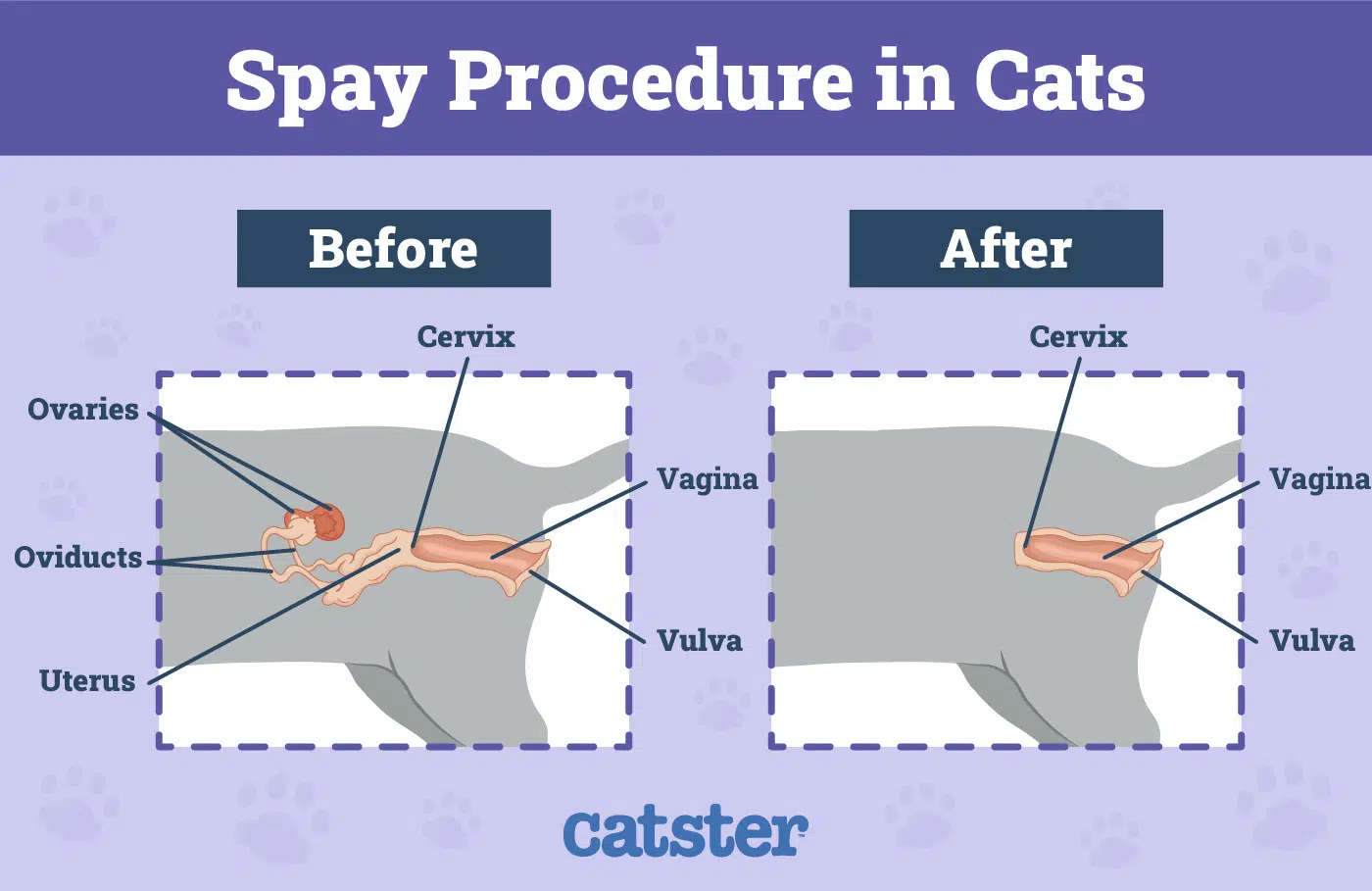
You are free to use this image but we do require you to link back to Catster.com for credit

Could My Cat Eviscerate Through the Wound?

It is possible, but this would be very rare. Firstly, most cat spay wounds are quite small and would not usually allow more than a tiny bit of abdominal fat to peek through. Secondly, most of the time, the muscle layer stays closed, even if the skin has opened a little, and this is the important layer in terms of keeping everything inside.

The flank spay approach is often used in feral cats if they cannot be kept inside for very long. The reason is that if the wound opened up on their side, gravity makes evisceration almost impossible.

divider cat paws 2 oct 2024

Final Thoughts

Although cat spays are a common and relatively straightforward procedure, complications can still occur. If you notice that your cat’s spay incision is slightly open, there’s no need to panic, but get in touch with a vet for guidance. They will check for signs of infection, check that the muscle layer is intact, and decide whether or not the wound needs re-suturing.

Prevention is always the best medicine, and keeping your cat confined to a single room, making sure they can’t run and jump, and using a surgical collar (cone of shame) to prevent them from licking their wounds are the best ways to reduce your cat’s risk of post-op complications.


Featured Image Credit: DreamHack, Shutterstock

Want content like this delivered to you?

Sign Up For Our Newsletter

News, insights, expert advice, and everything cat

* By submitting, you agree to our Terms & Conditions and Privacy & Cookies Policy.


How useful was this post?

Click on a star to rate (you can leave written feedback after clicking submit)

Help us improve Catster for pet parents!

Your feedback really matters.

What did you like about this post? Also how can we improve it?

Join the conversation

Leave a Reply

You’re very welcome to leave a comment or question. Please know that all comments must meet our community guidelines, and your email address will NOT be published. Let’s have a positive and constructive conversation.


Talk With A Vet Online

Peace of mind,
anywhere, anytime

Affordable vet advice

Do Cats Cause Schizophrenia? Scientists Find a Link – Here’s What It Means

Being a fierce advocate (and occasional recipient of) mental health support and awareness, the term ‘crazy’ is not one I like to fling...

One in 100 Cats Gets Diabetes – Here’s How to Catch It Early

One in every 100 cats develops diabetes.1 That’s not a rare, unlucky condition reserved for cats with obvious health problems. It’s common enough...

Dramatic Rescue Turns Into Dramatic Reunion

What started as a routine call for the RSPCA became a heroic, five-hour rescue featuring one trapped and traumatized cat, an emotional family...

Ask Dr. Paola – Help! How Do I Know if it’s Ear Mites! (May 4, 2026)

Welcome to our “Ask Dr. Paola” series, where every Monday we bring expert advice straight from Dr. Paola Cuevas (MVZ) to help our...

More related

9 DIY Cat Treadmills You Can Build Today (With Pictures)

In the wild, cats are ferocious hunters that rule the forest, jungle, or savanna in which they live. As they have become more...

Litter Genie Easy Roll Pail Review 2026: A Detailed Look

When my nephew was born in the ‘90s, I was amazed the first time I saw my sister change his diaper. It wasn’t...

3 Homemade Tuna Cat Treats You Can Make Today: Our Vet’s Recipes

So, you’re looking for a healthier alternative to the packages of cat treats you can pick up in the store? Does your cat...

My Cat Ate a Hair Tie! Here’s What to Do (Vet Answer)

Any cat parent will know that their feline friends can be mischievous and love to play. Although cats are often more sensible than...

Keep reading

Can Cats Eat Doritos? Vet-Approved Facts & FAQ

Doritos are a well-loved chip, to the point that they have been turned into everything from taco shells to casseroles. If you’re a Doritos lover, then your cat is almost certain to come into contact with Doritos, or at least...

Can Cats Eat Doritos

10 Best Raw Cat Foods in 2026 – Reviews & Top Picks

The saying, “you are what you eat,” applies to cats too, and one diet that’s growing in popularity is raw food. Although more controversial than regular kibble or canned food, raw diets are designed to better mimic the way that...

tabby cat eating from metal bowl

6 Best Fresh Cat Food Delivery Services in the UK in 2026 – Reviews & Top Picks

Most cat foods on supermarket shelves, whether they are dry or wet, tend to be processed and can contain artificial and less-than-ideal ingredients. But preparing fresh food every day for your cat, ensuring that you handle raw ingredients safely, and...

black and white cat eating food from a stainless bowl

Does Massage Help Constipation in Cats? Vet-Verified Facts & Treatments

Constipation in cats is not that uncommon, but that doesn’t mean it should be treated lightly. Massage therapy is among the remedies that have been evaluated in numerous clinical studies—in humans.1 But does it truly help with constipation in cats?...

cat-massage

Why Does My Cat Run Away From Me? 10 Vet-Reviewed Reasons & How to Stop It

If you have a cat that keeps running away, it can be a scary and frustrating experience, even if they always come back. If you are looking for ways to prevent this, you’ve come to the right place. Here are...

scared British blue-point cat hiding under the bed

Why Does My Cat Like Water & Swimming? Vet-Reviewed Feline Behavior Explanation

Cats have a reputation for disliking water. But, while it is true that some of our feline friends detest getting in baths and would never dream of taking a dip in the river or ocean, some breeds love nothing more...

Scottish straight-eared long-haired cat swimming

Soulistic Cat Food Review of 2026: Recalls, Pros & Cons

Review Summary Soulistic Cat Food often receives high praise and top-quality rankings with its simple formulas marketed to not only feed your cat’s body but also to “feed your cat’s soul.” In this review, we deep-dive into the brand to...

Soulistic Cat Food Review

Is the Buttercup Toxic to Cats? Vet-Approved Facts & FAQ

The buttercup plant (Ranunculus acris), also known as butter cress or figwort, is a member of the Ranunculaceae family (that’s a mouthful!). It’s a common yellow plant in the US. If you grew up near them, you might have used...

Catster_Is the Buttercup Toxic to Cats

Love Cats? So Do We! Join the Catster Community

Stay informed with expert pet care insights delivered straight to your inbox! Discover professional guidance on animal behavior, feeding tips, trusted product picks, and much more.


Sign up for the Catster Email Newsletter

Stay informed with expert pet care insights delivered straight to your inbox! Discover professional guidance on animal behavior, feeding tips, trusted product picks, and much more.