Get

In Your Inbox

Catster is reader-supported. When you buy via links on our site, we may earn an affiliate commission at no cost to you. Learn more.

Grey and White Siamese Cats: Info, Pictures, Facts & History

Share

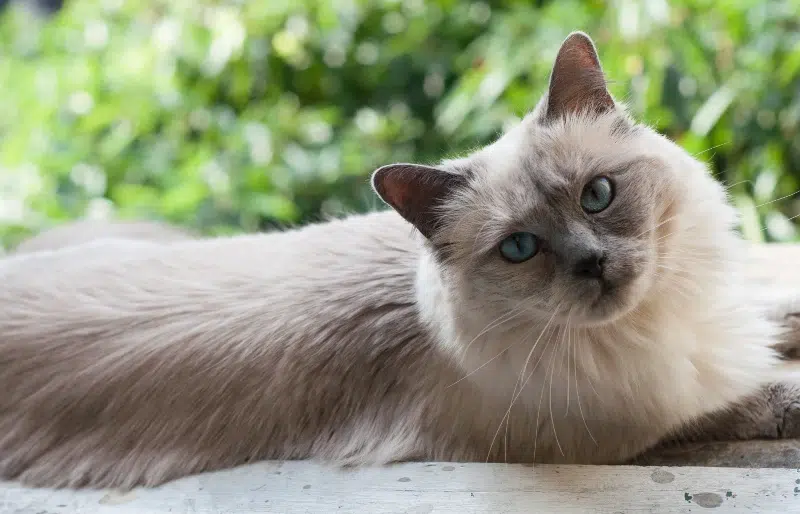
siamese ragdoll mixed breed cat

The Siamese is certainly an ancient and interesting breed. They combine many traits that make domestic cats very alluring to people. Siamese cats have a certain vibe of having the wisdom of the ages and are also intelligent, easy to train, and vocal.

Siamese cats tend to have very similar color patterns, no matter what color you actually consider them to be. They can be anywhere from very pale grey and white to rich and dark. This article aims to discuss the Siamese breed itself and the color variation of grey and white.

Breed Overview

Height:

12–18 inches

Weight:

15–35 pounds

Lifespan:

12–15 years

Colors:

White, blue, silver, red, brown, gray, black

Suitable for:

Active families, those looking for a low-shedding dog

Temperament:

Talkative, inquisitive, intelligent

Not all Siamese would be classified as grey and white. There is a particular color pattern called the fawn-pointed siamese, which combines soft grey points with creamy white bodies. The depth of color isn’t quite as strong as some of the other variations of Siamese, but its pale quality makes it so beautiful.

Grey and White Siamese Cat Characteristics

Energy
+
A high-energy cat needs a lot of physical and mental stimulation to keep healthy and happy, while a low-energy cat needs minimal physical activity, but still needs mental stimulation. When choosing a cat, It’s important to ensure their energy levels match your lifestyle.
Trainability
+
Cats that are easy-to-train are more willing and skilled at quickly learning prompts and actions with minimal training. Harder-to-train cats are usually more stubborn or aloof and require a bit more patience and practice.
Health
+
Certain cat breeds are more prone to various genetic health problems, and some more than others. This doesn’t mean that every cat in those breeds will have these issues, but they do have an increased risk, so it’s important to understand and prepare for any additional needs they may require.
Lifespan
+
Due to their size or potential genetic health issues of a specific breed, some cats have shorter lifespans than others. Proper nutrition, exercise, mental stimulation, and hygiene also play an important role in your cat’s lifespan and quality of life.
Sociability
+
Some cat breeds are more social than others, both towards humans and other cats and animals. Cats that are more social have a tendency to rub up on strangers for scratches or jump on laps for cuddles, while cats that are less social shy away, hide, are more cautious, and even potentially aggressive. No matter the breed or gender, it’s important to socialize your cat and expose them to many different situations.

divider 1 paws

The Earliest Records of Grey and White Siamese Cats in History

It has been predicted that Siamese cats originated in Thailand sometime between the 14th and 18th centuries. At the time, Thailand was called Siam, which influenced the Siamese name. In those days, these cats were sacred and thought to protect Buddhist temples. Even though they were not formally recognized until 1906, they first appeared in the US in 1878 when the American Consul in Bangkok brought one over.

It is not clear when exactly the grey and white Siamese cat came about, but Siamese cats come in many different color variations that have developed over the years.

Two Siamese kittens playing
Image Credit: Pelevina Ksinia, Shutterstock

How Grey and White Siamese Cats Gained Popularity

Siamese cats have come a long way from guarding Buddhist temples. They have made their way into homes, serving as companions to many people. These types of cats are considered very people-oriented cats, making them even better than some other breeds if you love affection and interaction with your feline pals.

In addition to their exquisite personalities, grey and white Siamese cats are also recognized because of their extremely unique color. The Siamese is an incredibly recognizable breed and has been used to create several other types of domestic cat breeds.

Formal Recognition of the Grey and White Siamese Cat

In the United Kingdom, the Cat Fanciers Club recognized the Siamese in 1902. In 1906, the US recognized the Siamese in its own Cat Fanciers’ Association (CFA). The only recognized colors of Siamese cats for show are seal point, chocolate point, blue point, and lilac point according to the CFA.

It is hard to say whether a grey and white Siamese cat would be recognized for show under CFA standards. It’s possible that they would fall under the blue point or lilac point category, but it depends on the exact shade of grey and other markings on the cat.

divider 1 paws

Top 4 Unique Facts About Siamese Cats

Siamese cats are certainly one of the oldest and most exciting breeds of all. Here are some interesting facts about them.

1. Siamese Cats Are Chatty

The Siamese is certainly not a quiet breed. If you were looking for a cat that is very still and looks pretty, this is not the cat for you. These cats love chatting it up, constantly being interactive with their human companions.

They always seem to want to know what’s going on around the house, as if everything requires their approval. The Siamese cat will talk to you when they want affection, when they’re hungry, and just to see how your day went.

Anyone who is a Siamese fan typically loves this quality. However if you’re not familiar with it, a talking cat all day long might get on your nerves. This is completely up to owner preference. This isn’t also to say that every single Siamese will be chatty. We’re sure that there are quiet ones among the bunch. We just haven’t met them yet!

portrait of a blue point siamese cat
Image Credit: Tatiana Chekryzhova, Shutterstock

2. Siamese Kittens Are Born White

Have you ever heard of Dalmatians taking a while to come into their spots? Interestingly, the same concept goes for the Siamese. All Siamese kittens are born white and don’t develop their interesting markings until several weeks later.

On average, it takes roughly 2 to 3 weeks to start seeing color develop on their ears, tail and paws.


3. Temperature Influences Siamese Coat

What is even more interesting than them developing their color later is that temperature plays a huge factor in how their coat ends up. Cooler temperatures typically lend cooler colors, whereas heat is the opposite. Siamese cats are often called “walking heat maps” in reference to this phenomenon.

Snowshoe Lynx Point Siamese kittens
Image Credit: Brenda Carson, Shutterstock

4. Siamese Cats Have Poor Eyesight

Siamese cats have notoriously poor eyesight in comparison to other felines. Their nighttime vision is particularly bad, making them not so excellent nighttime hunters. Even though people might think that cats are naturally nocturnal, that is not true.

Cats are actually crepuscular creatures, meaning they see best at dawn and dusk hours. The Siamese still need help, making them a little insufficient for nighttime prowling.

divider 3 paws

Do Siamese Cats Make a Good Pet?

The Siamese can make an amazing catch for virtually any cat-loving household. The Siamese isn’t one to take crap. So if you have a peppy dog that likes to be up in their face, they’ll put their foot down immediately.

The Siamese is certainly not a pushover and will amaze you with their independence and march to the beat of their own drum. Taking care of the Siamese is comparable to caring for any domestic feline. They have short, easy-to-manage coats that they care for themselves.

Siamese are avid groomers, meaning they are constantly giving themselves baths, preferably in a warm windowsill. Your Siamese will want to interact with you at all times. The Siamese is a very playful cat, so ensure you have lots of entertainment.

divider 3 paws

Conclusion

Now you understand a little more about the Siamese breed as a whole and the grey and white coloration. These classic cats have inspired many characters and have been selected many times to make hybrid breeds. They have awesome characteristics, such as talkativeness, sociability, and curiosity.

The grey and white color variation is a beautiful coat color, indeed. However, keep in mind that it is just a color and doesn’t change anything about the Siamese’s actual physical and personality traits.

See also:


Featured Image Credit: Laura Drake Enberg, Shutterstock

Want content like this delivered to you?

Sign Up For Our Newsletter

News, insights, expert advice, and everything cat

* By submitting, you agree to our Terms & Conditions and Privacy & Cookies Policy.


How useful was this post?

Click on a star to rate (you can leave written feedback after clicking submit)

Help us improve Catster for pet parents!

Your feedback really matters.

What did you like about this post? Also how can we improve it?

Join the conversation

2 Responses

  1. I have a white and gray siamese and her name is sweetheart she saved my kids and my life because of a flood she lick my face at 4:00am the basement was flood omitted upstairs I love sweetheart ????

    1. Wow!! ????Kristin Dooly, thank you for sharing Sweetheart's amazing and heroic story! Please submit a high-quality photo of Sweetheart for our Cat of the Week contest at https://www.catster.com/submit-your-cat/.

Leave a Reply

You’re very welcome to leave a comment or question. Please know that all comments must meet our community guidelines, and your email address will NOT be published. Let’s have a positive and constructive conversation.


Talk With A Vet Online

Peace of mind,
anywhere, anytime

Affordable vet advice

Ask Dr. Paola – Help! My Cat Suddenly Has Dandruff! (March 30, 2026)

Welcome to our “Ask Dr. Paola” series, where every Monday we bring expert advice straight from Dr. Paola Cuevas (MVZ) to help our...

Your Cat Keeps Vomiting After Eating: Here’s What’s Going On

Cats vomit. It’s one of the less glamorous facts of life with a feline, and most cat owners have cleaned up more than...

Rescue Cats Deserve Beautiful Endings

We all know that beauty is only skin deep, and that scars always tell a story, and this is one cat with a...

Ask Dr. Paola – Help! My Cat Gets Diarrhea from Wet Food! (March 23, 2026)

Welcome to our “Ask Dr. Paola” series, where every Monday we bring expert advice straight from Dr. Paola Cuevas (MVZ) to help our...

More related

History of Cats in the White House: A Look Over the Last Centuries

While most of us think of the White House in Washington, D.C., as the place where the President of the United States lives,...

17 Friendliest Cat Breeds (With Info & Pictures)

We’ve all heard horror stories of people who bring cats into their homes that simply want nothing to do with them. You try...

Can You Get Rabies from a Cat Scratch? Vet-Reviewed Facts & FAQ

Rabies is a disease that used to be relatively common among domestic animals, including dogs, ferrets, and cats. It’s possible for any mammal,...

Do I Have To Play With My Cat? Vet-Reviewed Facts & Tips

Playtime with your cat isn’t just a fun activity; it’s vital to your cat’s well-being. Cats don’t want to spend all nine lives...

Keep reading

My Cat is Leaving Blood Drops Everywhere, What’s Wrong?

Anytime your cat bleeds, it is concerning. Often, bleeding that continues for more than a few minutes is a sign that your cat needs veterinary attention. Before we jump into why your cat may be leaving drops of blood everywhere,...

charcoal bengal cat lying on the floor

6 Natural Home Remedies to Treat a Cat Wound (With Pictures)

Whether your cat is an indoor or outdoor cat, she is likely to pick up scratches and scrapes at some point in her life. The most common type of injury is that of a scratch or bite from another cat,...

cat with bandage

Can My Cat Breastfeed After Being Spayed? Vet-Verified Facts & FAQ

If you participate in a trap-neuter-return program for stray and feral female cats or you currently own a nursing cat, you may have thought about having her spayed. The process is crucial for stray and feral cats to prevent multiple...

Gray mother cat feeding kittens while taking a nap

Is String of Pearls Toxic to Cats? Vet-Verified Toxicity & Safety

Plants are a popular decoration for adding a little nature to your home. Especially with more people than ever working from home, adding plants to our surroundings has experienced a real boom in popularity. But many plants, like the string...

Catster_Is String of Pearls Toxic to Cats

Why Do Cats Sometimes Drink Dirty Water? Vet-Verified Reasons, Risks & Prevention Tips

Some of the habits of our feline friends can perplex us as cat parents, which raises questions about their eating, sleeping, or grooming habits. For instance, even though your cat has a full and accessible water bowl, you’ll sometimes catch...

siamese cat drinking water

How to Evacuate With Cats: 7 Vet-Approved Tips on Preparing for Disaster

While we don’t want to think about disasters, it’s important for cat owners to set up an evacuation plan just in case. Knowing how to safely evacuate with your cats during an emergency situation can be lifesaving, and also prevent...

a-woman-hugging-her-cat_U

Can Cats Eat Squid? Vet-Approved Nutrition Facts, Risks & Feeding Info

Squid isn’t common table fare in all locations, but depending on where you’re at, it might be a popular dish. In America, squid is most commonly served fried with a side of marinara sauce in a dish known as calamari....

Can Cats Eat Squid

14 Signs a Stray Cat Likes or Dislikes You (Vet-Reviewed)

Many people have a few cats that tend to hang up around their houses. Maybe they gather under your front porch or show up because they know they can get a good meal at your house. While some feral or...

stray cat sitting in the street

Love Cats? So Do We! Join the Catster Community

Stay informed with expert pet care insights delivered straight to your inbox! Discover professional guidance on animal behavior, feeding tips, trusted product picks, and much more.


Sign up for the Catster Email Newsletter

Stay informed with expert pet care insights delivered straight to your inbox! Discover professional guidance on animal behavior, feeding tips, trusted product picks, and much more.
