History of Cats in the White House: A Look Over the Last Centuries

While most of us think of the White House in Washington, D.C., as the place where the President of the United States lives, it's also been home to several amazing cats over the years.
Felines have kept presidents and their families company since the late 19th century, when Abraham Lincoln, the 16th President of the United States, lived with two cats named Tabby and Dixie. In fact, 11 presidents have shared the White House with a feline companion. Keep reading to learn more about the incredible history of cats in the White House!

History of the Building
The nation's first capital was Philadelphia, Pennsylvania, but the seat of government moved to the District of Columbia in 1800. Construction on the White House building began in 1792, just 9 years after the American Revolutionary War ended with the signing of the Treaty of Paris.
After the end of the American Revolutionary War, George Washington, the first president of the United States, selected the location where the White House was to be built. James Hoban, a newly immigrated Irish architect, designed the building. Hoban received $500 and a bit of land in the city as payment for his design services.
John and Abigail Adams were the home's first residents, and the couple moved in before construction was completed. Adams was the second president of the new nation and was inaugurated in 1779.
The White House burned down in 1814 during the War of 1812. British Soldiers started the blaze, which also destroyed the Capitol. After the war ended with peace terms made official by the Treaty of Ghent in 1815, renovations were started. James Monroe took up residence in 1817.
The building has undergone several renovations and additions over the years. Neither the West Wing nor the Oval Office was part of Hoban's original plans. The West Wing was completed in 1902 during Theodore Roosevelt's administration, and the Oval Office, where the current president conducts official business, was built during William Howard Taft's presidency. A second fire in 1929 required much of the West Wing to be renovated.
Pets have long been common White House residents. Only three presidents, Donald Trump, James K. Polk, and Andrew Johnson, didn't have pets while living in the home.
Andrew Jackson had an African gray parrot named Poll, who attended the president's funeral and created a scene with his loud and repeated profane outbursts. Jackson also kept fighting cocks as pets.
Goats, horses, rabbits, squirrels, and even alligators have roamed the White House grounds over the years. In the 20th and 21st centuries, dogs and cats have been the most common presidential pets.


White House Cats in the 1800s
Abraham Lincoln (1861–1865)
Tabby and Dixie were the first cats to live as presidential companions in the White House. The pair were given to Abraham Lincon by William Stewart, the Secretary of State. Lincoln was a well-known cat lover who often sought feline company when stressed. He once fed Tabby from the presidential table during a state dinner and is alleged to have stated, “Dixie is smarter than my whole cabinet! And furthermore, she doesn't talk back!"1 Lincoln also had a life-long habit of caring for stray cats he encountered.
Rutherford B. Hayes (1877–1881)
After Lincolin’s assassination, cats were absent (in an official capacity) from the White House until the election of Rutherford B. Hayes. The Hayes family had a cat named Piccolomini and two Siamese cats, one of which, Siam, was the very first documented Siamese cat in the United States. Siam was given to the family in 1878 by David B. Sickels, a diplomat stationed in Bangkok.

White House Cats in the 1900s
Theodore Roosevelt (1901–1909)
Theodore Roosevelt had two cats, Slippers and Tom Quartz; the latter was named after a cat that appears in Mark Twain's semi-autobiographical work, "Roughing It." Slippers was a polydactyl cat that had more toes than the average kitty.
The Roosevelt White House was home to several pets, including ponies, guinea pigs, and dogs. The family's Bull Terrier, Pete, was sent away after repeated biting and chasing incidents. He allegedly jumped on the French ambassador, and the Secretary of the Interior's pants were torn off in a similar incident. Pete also may or may not have bitten a policeman and chased a visiting politician up a tree. After chasing a State Department official, he was sent to live in Roosevelt's New York home in 1908. Other family pets included a hyena, rabbit, rat, pig, lizard, macaw, and snake.
Calvin Coolidge (1923–1929)
Calvin Coolidge and his family had dozens of pets while living in the White House. The family's companions included dogs, birds, a donkey, and even a bobcat. Two domestic cats, Tiger and Blackie, also lived with the Coolidges. Tiger wore a collar with his name and place of residence due to his tendency to go exploring and get lost. In fact, he eventually disappeared.
Blackie was a rough-and-tumble kitty that enjoyed hunting and hanging out in the guardhouse more than nibbling on fine presidential treats. When given access to the White House, Blackie often preferred to nap in the kitchen.

John F. Kennedy (1961–1963)
Kennedy's daughter Caroline had a cat named Tom Kitten. The family had quite the menagerie, with multiple dogs and ponies all living on the White House grounds. The family also kept a horse, ducks, parakeets, and a rabbit as pets while in residence. The ducks were eventually sent to live in nearby Rock Creek Park due to ongoing conflicts with one of the family’s dogs.
Gerald Ford (1974–1977)
During Gerald Ford's term, a Siamese cat named Shan Shein made the White House home, though technically, she belonged to the president's daughter, Susan. Shan and Liberty, the Ford family's dog, reportedly struggled to get along. The cat was known to be partial to hiding under the bed in the Lincoln bedroom. Shan was quite a media fixture, and there were even proposals to write a book about her days in the White House.

Jimmy Carter (1977–1981)
Jimmy Carter's daughter, Amy, had a famous cat named Misty Malarky Ying Yang, a beautiful Siamese cat. Misty Malarky Ying Yang was known as a particularly vocal cat that liked to sing along as his favorite person practiced violin. The cat was particularly attached to Amy and was rumored to have enjoyed hanging out in dollhouses!
Bill Clinton (1993–2001)
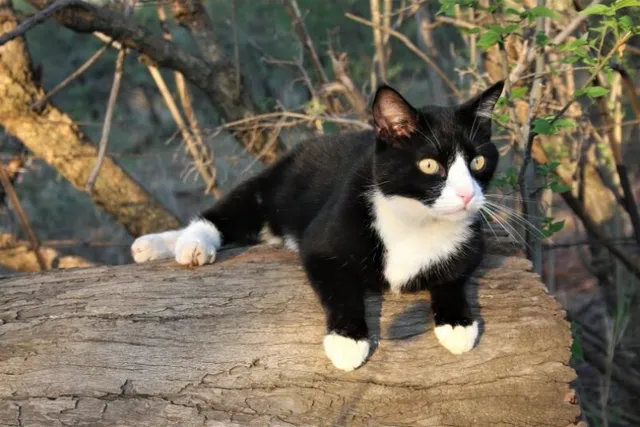
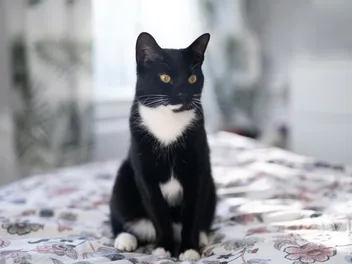
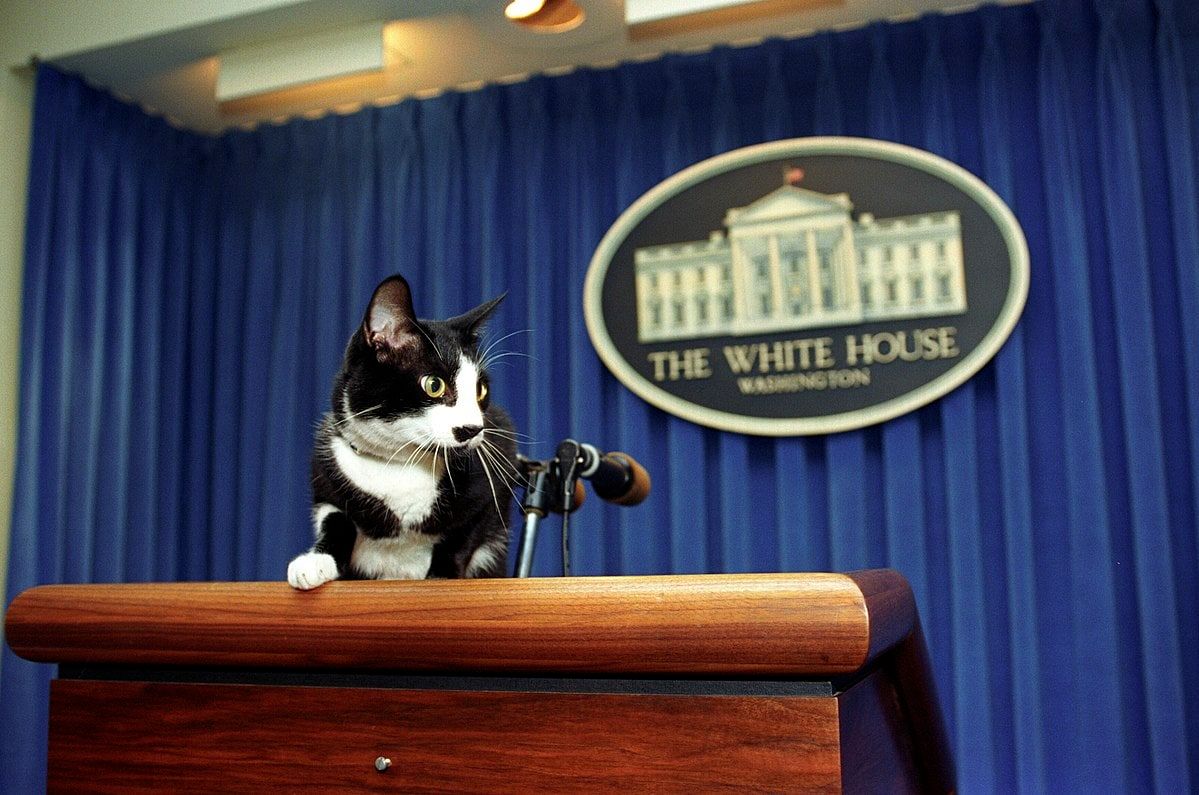
The Clinton family had a black and white cat named Socks. He was a stray when adopted, so his precise birthday remains unknown. He was probably already at least 1 or 2 years old when he came to live with the Clinton family in Arkansas in 1991. Socks moved with the Clintons from Arkansas to Washington, D.C., after the 1993 presidential inauguration. He played a prominent role in White House life, often visiting schools and hospitals. The family adopted a Labrador Retriever named Buddy in 1997, but the two presidential pets didn't get along and had to be kept apart. Socks went to live with Bettie Currie, Clinton's former secretary, when the family left the White House in 2001.

White House Cats in the 2000s
George W. Bush (2001–2009)
George W. Bush and his family had a female black cat named India with a soft spot for hanging out in the White House library. She initially lived with the Bushes in Texas and came with them to the White House. The cat was named for one of the family's favorite baseball players, Rubén "El Indio" Sierra. India died in 2009 at the age of 18. The family also had two gorgeous Scottish Terriers, Barney and Miss Beasley, living in the White House.
Joe Biden (2021–2025)
President Joseph Biden and his wife, Jill, welcomed a cat named Willow to the White House in 2022. Willow was a farm cat that jumped on stage during one of Jill's campaign appearances on her husband's behalf. Named for Jill's hometown of Willow Grove, Pennsylvania, Willow is a beautiful short-haired tabby cat with stunning green eyes. Willow shares the White House with a canine friend, Commander, a gorgeous German Shepherd with adorable ears.

Conclusion
The White House has been home to several cats over the years. More than 11 presidents have shared the residence with a feline companion. James and Abigail Adams were the first presidential couple to live in the home, taking up residence in 1800. But Tabby and Dixie became the first official feline residents when they moved in with Abraham Lincoln. Joe Biden and his family welcomed the latest White House cat, Willow, in 2022.
See Also: Does Kamala Harris Have Cats?
Sources
https://constitutioncenter.org/blog/how-philly-lost-the-nations-capital-to-washington
https://en.wikipedia.org/wiki/List_of_capitals_in_the_United_States
https://edition.cnn.com/2022/06/17/politics/willow-the-white-house-cat/index.html
https://en.wikipedia.org/wiki/United_States_presidential_pets
https://www.smithsonianmag.com/history/a-colorful-history-of-cats-in-the-white-house-180979561/
https://en.wikipedia.org/wiki/Pete_(Theodore_Roosevelt%27s_dog)
https://www.whitehousehistory.org/galleries/presidential-felines
https://www.presidentialpetmuseum.com/pets/misty-malarky-ying-yang/
https://www.upi.com/Entertainment_News/2009/01/05/First_Feline_India_dead_at_18/UPI-86721231179731/
https://clintonwhitehouse4.archives.gov/WH/kids/inside/html/Spring99-2.html
https://www.whitehousehistory.org/the-christmas-eve-west-wing-fire-of-1929
Socks the Cat Explores (Image Credit: Barbara Kinney, Wikimedia Commons CC: Public Domain)
Expert cat care, straight to your inbox
News, insights, and useful advice, delivered to you.

No spam — unsubscribe anytime.
By signing up, you agree to our Terms & Conditions and Privacy & Cookies Policy.
How useful was this post?
Click a star to rate. You can leave written feedback afterwards. (We read all feedback.)
Lorre Luther is a writer who is firmly convinced that cats are smarter than humans. She left her law career in the United States and moved to the Netherlands to follow her dream of becoming a writer. Lorre currently lives in Rotterdam, she enjoys traveling and greatly appreciates the beauty of nature. Lorre has a spot for animals and admires the intelligence of cats.