How Geriatric Felines Are Helping to Unlock the Mysteries of Alzheimer's Disease

When it comes to getting older, something people fear more than death is the loss of their cognitive abilities. It is also, arguably, one of the most difficult aspects for their families to cope with. Losing a loved one is difficult enough, but losing that person while they are still alive can be absolutely devastating. But that’s exactly what happens when Alzheimer’s takes hold. As proteins build up in the brain, patients begin to lose their memories, personalities, and all the things that made them them.
Until recently, one of the greatest obstacles to understanding this horrendous condition has been the lack of research subjects and disease models. The confusion and behavioral changes inherent in Alzheimer’s patients make research challenging, and, understandably, families are not often inclined to consent to post-mortem studies after their loved ones have passed. Most Alzheimer’s research has been limited to artificially recreating the clinical characteristics of this degenerative disease in mice in a desperate attempt to study the disease.
Interestingly, a team of neuroscientists at the University of Edinburgh in Scotland has put the mice away and brought cats into play.
Just as it is for humans, one of the downsides of our cats living well past ‘retirement age’ is an increase in disease occurrence, particularly those of a degenerative nature. Those who have had the privilege of sharing their lives with a geriatric feline may already be familiar with the age-related decline in mental function known as Feline Cognitive Dysfunction or Decline (FCD), or feline dementia.
Clinically speaking, this syndrome shares many characteristics with human Alzheimer’s disease, with signs such as disorientation, sleep/wake cycle disruption, increased vocalizations, altered activity, anxiety, and vacant episodes. But what’s more interesting is that those similarities go much deeper than we realize.
A team led by Resident in Veterinary Neurology and Neurosurgery, Dr Robert McGeachan, has discovered that not only does FCD resemble Alzheimer’s disease superficially, it also shares many of its cellular properties as well.
A Naturally Occurring - and Cruelty Free - Model of Alzheimer's Disease
We often hear the terms dementia and Alzheimer’s used interchangeably, but it’s important to note that the two are not the same.
Dementia is a term used to describe a decline in mental function that affects memory, behavior, and personality, beyond what is expected in normal ageing.
It has numerous causes, the most common of which is Alzheimer’s.
Alzheimer’s disease is a specific condition caused by a buildup of amyloid plaques in the brain, leading to the death of brain cells. It is responsible for around 70% of human dementia cases, and is invariably fatal.
This is an important distinction, as it would appear that the underlying cause of feline dementia may be the very same as Alzheimer’s, meaning that our ageing cat population may hold the key to understanding this fatal disease, which may have huge implications for both human and feline patients.
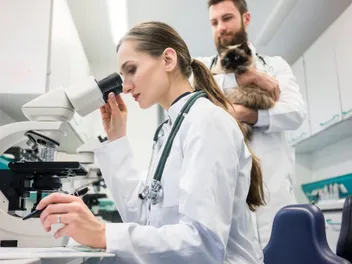
This groundbreaking study* compared the brain tissue of cats that had demonstrated behavioural changes consistent with FDC for at least 3 months that could not be attributed to any other medical condition, with sex- and age-matched individuals, as well as a younger subset of cats that had displayed no signs of neurological dysfunction.
What’s really exciting about this discovery is that the more we learn about the way in which this disease affects long and short-term cognition in both cats and humans, the better we can help both our feline and human family members. With cats reaching geriatric life stages at around 15-16 years of age, the ability to observe behavioral and physical changes, as well as responses to different treatments, can take place over a much shorter time period, potentially accelerating the progression of therapeutic trials in humans.
Of course, this research would not be possible without feline test subjects, but these cats have not been kept in laboratory conditions specifically for Alzheimer's research, a distinction that Dr McGeachan is very passionate about.
“These are owned pets, really well-loved pets, and they've started to develop dementia, and a lot of them we had a relationship with at the hospital (The Hospital for Small Animals, Royal (Dick) School of Veterinary Studies, The University of Edinburgh).
“Myself or Professor Danièlle Gunn-Moore, who does a lot of the feline dementia stuff, has had a relationship with the owners and the cats while they were alive, and then once, unfortunately, they passed away, the owners have very kindly donated the bodies to us, and that allows us to do research in these animals that could help cats in the future with dementia, and also people with Alzheimer's disease.”

Quid Pro Quo
In the vast majority of clinical studies where animals are used as models for human disease, there is little to no benefit for the animals, but as Dr McGeachan points out, this line of research is an example where everybody wins.
“Clinical trials in humans cost insane amounts of money, so it's easier and it's cheaper, and it would also be quicker because we're working on a slightly shorter time frame.
So humans benefit, but also seeing as the changes in the cat's brains are exactly the same as human brains, cats can also benefit from advances that are being made from the human point of view, and we're not using hundreds and thousands of mice for research where maybe they're not the best model.”
And this ‘reciprocal arrangement’ may already have promising news for cats. In recent years, a treatment for Alzheimer’s disease has been found to slow down the rate of cognitive decline by removing the toxic clumps of protein from the brain. Knowing that the process is so similar to that seen in cats opens up more treatment options for cats suffering from FCD, so this isn’t merely a one-way street.
Future Directions
Next on the agenda is focusing on interventional research, looking for biomarkers, and using cognitive scores in order to identify potential patients at an earlier stage. Once patients start to exhibit signs of dementia, much of the damage has already occurred, making it less likely that the disease can be reversed. By finding ways to intervene much earlier, there is reason to believe that the future looks much brighter for both Alzheimer’s sufferers and feline patients.
Is there a cure in sight? Dr McGeachan thinks so.
“I absolutely think that within our lifetime, we're going to really improve the management of these conditions. And I think it's, for that reason, a very exciting time to be involved in Alzheimer's disease research.
I'm quite hopeful that living with Alzheimer's disease is no longer a certainty for people who are being born today.”
And that’s something we can all feel pawsitive about.
More From Weekly Mews:
The Cat Man of Maui: Saving Hawaii’s Stray Cats Against All Odds
LA’s Biggest Cat Event is Back: CatCon Celebrates 10th Anniversary
Cat Therapists & Boarding Bedtime Stories: Yelp’s Most Popular Extravagant Pet Services
Feature Image Credit: Imag Credit: Strannik_fox, Shutterstock
Did You Know?
- Our breaking news articles are featured in our weekly emails. Don't miss out on the latest and sign up for our newsletter below!
Expert cat care, straight to your inbox
News, insights, and useful advice, delivered to you.

No spam — unsubscribe anytime.
By signing up, you agree to our Terms & Conditions and Privacy & Cookies Policy.
How useful was this post?
Click a star to rate. You can leave written feedback afterwards. (We read all feedback.)
Dr. Karyn Kanowski BVSc MRCVS (Veterinarian)
Dr. Karyn comes from Queensland, Australia, and has lived in the UK for the past 10 years. In 2010, she graduated from The University of Queensland School of Veterinary Science and also has a Bachelor’s degree in Zoology. She is passionate about using evidence, experience, and owner collaboration to provide the best solutions for pets, and believes in making reliable information about animal health accessible to all. Dr. Karyn shares her home with five cats, four dogs, and one husband. When she is not in the scrubs, she spends her time writing, gardening, and cleaning up pet hair!