

In this article
Bengals are the hottest cat on the block right now, and everyone is trying to get their little slice of the wild to bring home. However, with the cats being so close to their wild ancestry, some states and cities have regulated or banned Bengals.
Before you look into getting your new cat, make sure you’re following all of your area’s laws to ensure a smooth transition for you and your cat. Here are some states that have specific laws regarding Bengals.
The answer might depend on the state you are looking for.

How Did We Make This List of States?
Not all states have laws specifically regulating the care and keeping of Bengal cats. As such, we can’t include a law that is not explicitly stated. Check the laws of your local municipality to ensure that you’re following them when bringing your new cat into your family.

Alaska – Regulated
The Alaskan government has banned all Bengal cats less than four filial generations removed from the Asian Leopard Cat. Even cats permitted to reside in the state must have a registered pedigree indicating the previous four generations to be legal in Alaska.
California – Legal ✅
There are no laws regulating the keeping of Bengal cats in California.
Connecticut – Illegal ❌
Bengal cats are illegal to own in Connecticut, regardless of generation.
Delaware – Regulated
Bengal cats are legal with a permit only in Delaware.
Colorado – Legal ✅
Colorado State has no laws, but the five most recent generations of your cat’s family must have all lived in captivity in Denver.
Georgia – Regulated
Bengals have a required permit for keeping in Georgia.
Hawaii – Illegal ❌
It’s illegal to own a Bengal of any generation in Hawaii.
Iowa – Regulated
Iowa’s laws are a bit more in-depth than some other states. Bengal cats in Iowa must be the fourth or later filial generation of offspring, where the first filial generation is the offspring of a domestic cat and an Asian Leopard Cat. The remaining four generations must be two domestic cats to be legal.
Indiana – Legal ✅
It is legal to own a Bengal cat in Indiana.

Massachusetts – Regulated
To own a Bengal cat in Massachusetts, the cat must be “registered with a nationally or internationally recognized breeding association or registry that certifies that pedigree to be without any wild felid parentage for three generations.”
New York – Regulated
In New York, Bengals must be at least five generations removed from the Asian Leopard Cat and registered with the American Cat Fanciers’ Association or the International Cat Association. However, they’re entirely banned in New York City.
Washington – Regulated
Bengals are illegal to own in Seattle, Washington. Cats outside of Seattle may be permitted per local ordinances.
Utah – Legal ✅
Bengals are legal in Utah as their ban on wild feline hybrids doesn’t apply to breeds that the International Cat Association recognizes.

Why Are Bengal Cats Illegal in Some States?
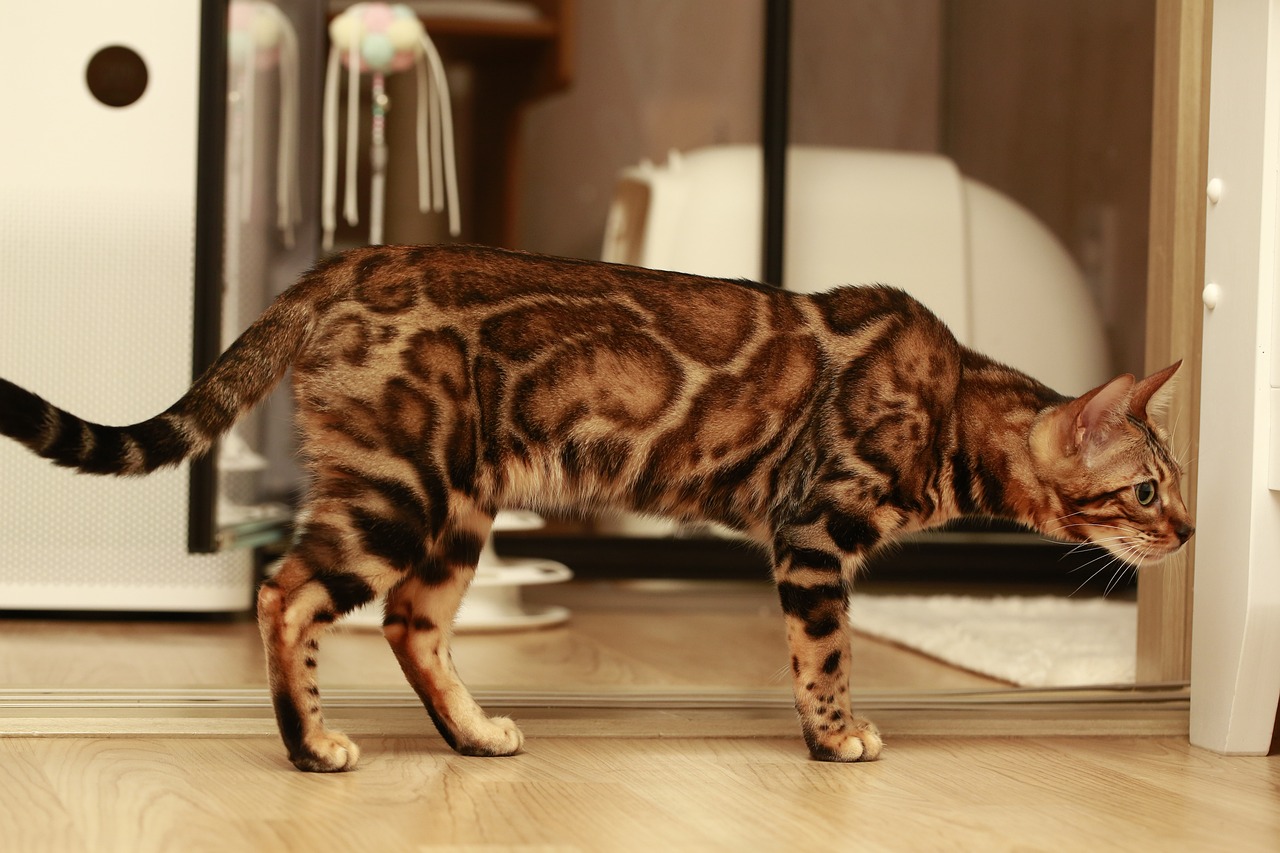
Bengal cats are the result of breeding the Asian Leopard Cat with domestic cats. The end result is a striking large breed cat that resembles a tiny leopard. Many people believe that bringing people closer to wildlife in these ways will increase their awareness of wildlife destruction and spur them to act and vote to protect the wildlands around us.
Additionally, many people fantasize about owning a big cat (Tiger King, anyone?) While it would be cruel to keep an actual leopard indoors, a domestic cat that looks like a leopard won’t suffer the same adverse health effects.
However, the waters are a lot murkier than that. Bengal cats can trace their lineage back to the Asian Leopard Cat, giving them their distinct spotted fur pattern. Many Bengals have a living Asian Leopard Cat relative. When breeding hybrid animals with wild blood, there are a lot of worries that the animal will be unmanageable and cause destruction or hurt someone.
Domestication is more than a short-term behavioral modification. Many stray-born kittens are taken in and become excellent house pets because their lineage is littered with domestic cats who grew up in a home with people.
This changes their instinctual drive, but it also influences what their parent cats would have taught them when they were still growing. If the parent cats don’t fear humans, they’ll teach their young not to fear them.
The cats we know today result from domestication over 9000 years as cats were first widely domesticated in Egypt around 7500 BCE. These cats have been removed from their wild heritage for thousands of generations and have different genealogical and behavioral traits than feral cats.
Bengals being so close to their wild heritage makes many people nervous. They’re large cats that make formidable opponents even if they are considered domestic. That’s why they’re regulated as wild animals; they practically are.

Do Bengal Cats Still Make Good Pets?
While all of that might sound like a lot of doomsday talk, it’s important to remember that Bengals are considered domesticated for a reason. They’re recognized by the Cat Fanciers’ Association and the International Cat Association as being fully tame and easy to integrate into a household pet.
Bengals make good pets for experienced cat owners and active households. They can get bored when left to their own devices for too long. So, they’re best suited to a family where someone is home for most of the day, in case they need some attention.
It’s also worth noting that the Bengals are smart as a whip. Food puzzles and other toys that stimulate them mentally will be a big hit with these cats. If you want a cat who will play for hours and still have the energy to keep going, this is your cat. Some Bengals have even adjusted to walking on a leash to enjoy the great outdoors with their owners!
Just because Bengals are close to their wild roots doesn’t mean they make destructive pets. It means that prospective owners will need to be careful and mindful when bringing the new cat into their home. Make sure that everything is set for the new arrival!

Final Thoughts
While Bengals may not be the big giant cat that some people wish they could keep in their backyard, they’re pretty darn close. Many Bengals would be glad to give you a little taste of the wild with their fun-loving and friendly antics. Unfortunately, they are illegal in some states. So, check your local laws to ensure you have a safe forever home for your cat!
Featured Image Credit: Cressida Studio, Shutterstock





