Get

In Your Inbox

Catster is reader-supported. When you buy via links on our site, we may earn an affiliate commission at no cost to you. Learn more.

When Can I Let My Kitten Roam the House? Vet-Approved Info & 4 Safety Tips

Share

siamese kitten playing

Kittens are curious creatures that like to explore and get into mischief. Letting a kitten roam free in the house can be a dangerous proposition. They are tiny and unaware of lurking dangers. Their ability to hide in small spaces can make supervision particularly challenging. While it’s reasonable that at some point, your cat will be able to have free range in your home, it’s important to be patient with the process. There are a few things to take care of before you can let your kitten roam the house.

divider cat faces 2 oct 2024

When Can I Let My Kitten Roam Free?

There’s no set age when you can let your kitten roam the house. Each one grows and develops at their own pace, though you can speed up the process. Ideally, you wouldn’t let a kitten roam freely without supervision until they are litter trained and used to the furniture and objects in your home.

Once sufficient training is in place, you can let your kitten roam the house during the day when you can provide reasonable supervision. You should not let them roam free while you are away from home or during the night when you can’t protect them from harm.

Certain risks come with letting a kitten roam the house:

  • Insufficient litter training — If your kitten isn’t sufficiently litter trained, they will make a mess throughout the house. The only way that they can clearly understand your expectations is to train them. Some cats can take 4–6 weeks to become fully litter trained.
  • Not knowing their way — At times, kittens are litter trained but can’t find their way to a litter box in time. As a result, they may end up having accidents in odd places.
  • Hiding — Kittens are experts at squeezing into unusual places where they can’t be found. They can often get into a space but can’t get back out. It’s especially hard to find small kittens when they do this.
  • Risk of getting outside — Kittens can escape out open windows or take advantage of the smallest opportunity to get outside. They can then easily get lost, which is why they need supervision when roaming free.
  • Risk of injury — Kittens are prone to getting injured, as they don’t know the dangers of various appliances or items that they might encounter.
  • Risk of falls — If you live in a multi-story house or apartment, kittens can sometimes fall from a higher floor and injure themselves. This is because though they are able to walk around, they don’t have a full understanding of depth perception until they are slightly older (around 4-6 months old).
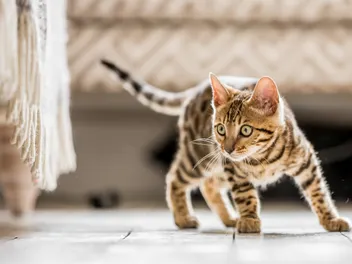
savannah kittens playing
Image Credit: Kolomenskaya Kseniya, Shutterstock

divider cats oct 2024

Top 4 Tips for Kitten-Proofing Your House

There are a few ways that you can modify your home to make it safer for your kitten to roam free.

1. Restrict Access to High Locations

Cats like to climb curtains, counters, bookshelves, and anything else that they can use to get up high. Rearranging things can make it harder for them to climb and less likely to fall.

Tabby cat looking up with long whiskers
Image Credit: Krysten Merriman, Pexels

2. Know your Home’s Hiding Spaces

Take a good look throughout your house, and note small spaces where your kitten can hide. You can restrict access to these places, and if your kitten does crawl into one, at least you’ll know where to look.


3. Put Breakables Away

If you have breakables, such as vases, china, or decorative pieces that you wish to keep intact, put them somewhere that can’t be accessed by your kitten.


4. Check Your Houseplants

Not all plants are safe for cats, so make sure you don’t have houseplants that could be toxic.

cat and orchid
Image Credit: Pixabay

divider cat paws 2 oct 2024

Final Thoughts

There is no specific age for letting a kitten roam free in the house. Your kitten should at least be able to safely navigate your home and be litter trained before they do so. Some cats take longer than others to be comfortable in a new home, and kittens can be mischievous. There’s no harm in keeping your kitten confined to a safe space or room until you’re certain that they are safe and comfortable.

Giving a kitten too much freedom too early can lead to behavior problems in the long term. These are difficult to remedy, so it’s much better to prevent them in the first place.


Featured Image Credit: Zdan Ivan, Shutterstock

Want content like this delivered to you?

Sign Up For Our Newsletter

News, insights, expert advice, and everything cat

* By submitting, you agree to our Terms & Conditions and Privacy & Cookies Policy.


How useful was this post?

Click on a star to rate (you can leave written feedback after clicking submit)

Help us improve Catster for pet parents!

Your feedback really matters.

What did you like about this post? Also how can we improve it?

Join the conversation

Leave a Reply

You’re very welcome to leave a comment or question. Please know that all comments must meet our community guidelines, and your email address will NOT be published. Let’s have a positive and constructive conversation.


Talk With A Vet Online

Peace of mind,
anywhere, anytime

Affordable vet advice

Ask Dr. Paola – Help! My Momma Cat Is Very Thin! (May 18, 2026)

Welcome to our “Ask Dr. Paola” series, where every Monday we bring expert advice straight from Dr. Paola Cuevas (MVZ) to help our...

The Cat Biting Mistakes Most Owners Make (And What Works Instead)

Cat bites sent more than 400,000 people to emergency rooms in the US each year.1 Not scratches. Bites. And the reason they’re so...

Do Cats Cause Schizophrenia? Scientists Find a Link – Here’s What It Means

Being a fierce advocate (and occasional recipient of) mental health support and awareness, the term ‘crazy’ is not one I like to fling...

One in 100 Cats Gets Diabetes – Here’s How to Catch It Early

One in every 100 cats develops diabetes.1 That’s not a rare, unlucky condition reserved for cats with obvious health problems. It’s common enough...

More related

Grey Cat Names: Great Ideas for Your Dusty Cat

There’s no denying that grey cats are gorgeous, so it’s essential you find a name that’s just as worthy of everyone’s attention. There...

10 Facts About Cats’ Eyes: Vet Verified

We sometimes wonder if our cats see the world the same way we do. Are cats’ eyes similar to humans? Do they work...

Can Cats Eat Meatballs? Vet-Reviewed Dangers & Facts

Spaghetti and meatballs are a classic comfort food and a childhood favorite meal for many people. If you and your family regularly enjoy...

Does Health Monitoring Cat Litter Work? Vet Reviewed Facts & FAQ

Approximately 46.5 million households in the United States own a cat, and if you’re part of this statistic, chances are you’ve stumbled across...

Keep reading

How to Get a Cat Used to a Collar: 5 Easy Vet Reviewed Tips

Cats like routine and familiarity, and trying new things is not their favorite activity. Trying new things may be necessary when it comes to your cat’s safety, such as wearing a collar. You must take your time with the process...

cat with red calming collar

Can a Cat Overheat? Vet Approved Signs & How to Help Them

Due to their desert-dwelling ancestors, cats are often believed to not be affected by hot weather. While their normal body temperature is higher than our own—101.0°F to 102.5°F—cats are no better at handling overly hot weather than humans are. Cats...

cat stretching a rocky beach and a beautiful sunset over the ocean

6 Health Risks of Keeping a Dirty Litter Box: Vet-Approved Sickness Signs

Cleaning the litter box is one of the most laborious (not to mention smelly) tasks a cat owner must do every day, so it’s easy to let this job slide to the wayside. But did you know that slacking on...

woman cleaning cat litter

At What Age Should You Neuter or Spay Your Cat? Vet-Approved Facts & FAQ

Over the years, the recommended age for spaying or neutering cats has changed slightly. There are still varying opinions, but most veterinarians agree that the best time to do it is before a cat’s first heat. The standard age is...

veterinary-doctor-puts-the-bandage-on-the-cat-after-surgery

Taste of the Wild Cat Food Review of 2026: Recalls, Pros & Cons

Review Summary Taste of the Wild is a brand of Diamond Pet Food, which is a pet food company based in the USA. All of its foods are manufactured in the USA and are billed as being affordable and using...

Taste of the Wild Cat Food Review

Kitten Development: First 12 Weeks (Vet-Reviewed Guide)

Bringing a new kitten home is a joyous and exciting occasion for all soon-to-be cat parents. This usually occurs when a kitten is between 8 and 10 weeks of age, depending on their size, health, vaccination protocol, and breed. However,...

american shorthair kitten

What’s the Maximum Height a Cat Can Fall from & Survive? Vet-Reviewed Science & Info

Everyone has heard that cats have nine lives, but the real secret of felines is that they rarely have to use more than one. Their incredible agility has led many to believe that cats almost always land on their feet...

cream-colored-maine-coon-cat-jumping-over-the-couch_Nils-Jacobi_shutterestock

6 Vet-Approved Natural Home Remedies to Treat Scabs on Cats

Frequent and persistent scabbing on your cat’s body is not normal. Keep track of where the scabs appear on your cat’s body and schedule a visit to your veterinarian immediately once you notice them. Treatment of the cause varies widely...

Close up of a rash or Diagnosis of scabies or Dermatological diseases on the skin of the cat's ears

Love Cats? So Do We! Join the Catster Community

Stay informed with expert pet care insights delivered straight to your inbox! Discover professional guidance on animal behavior, feeding tips, trusted product picks, and much more.


Sign up for the Catster Email Newsletter

Stay informed with expert pet care insights delivered straight to your inbox! Discover professional guidance on animal behavior, feeding tips, trusted product picks, and much more.