Get

In Your Inbox

Catster is reader-supported. When you buy via links on our site, we may earn an affiliate commission at no cost to you. Learn more.

What Are Polydactyl Cats? Why Are They Called Hemmingway’s Cats?

Share

orange polydactyl cat sleeping

Polydactyl cats are felines with one or more extra toes. They’re commonly referred to as Hemmingway’s cats because the author, Ernest Hemmingway, owned a cat, Snow Ball, who had the characteristic. Cats with the trait are most often found in England, Wales, the Eastern United States, and Canada.

divider cat paws oct 2024

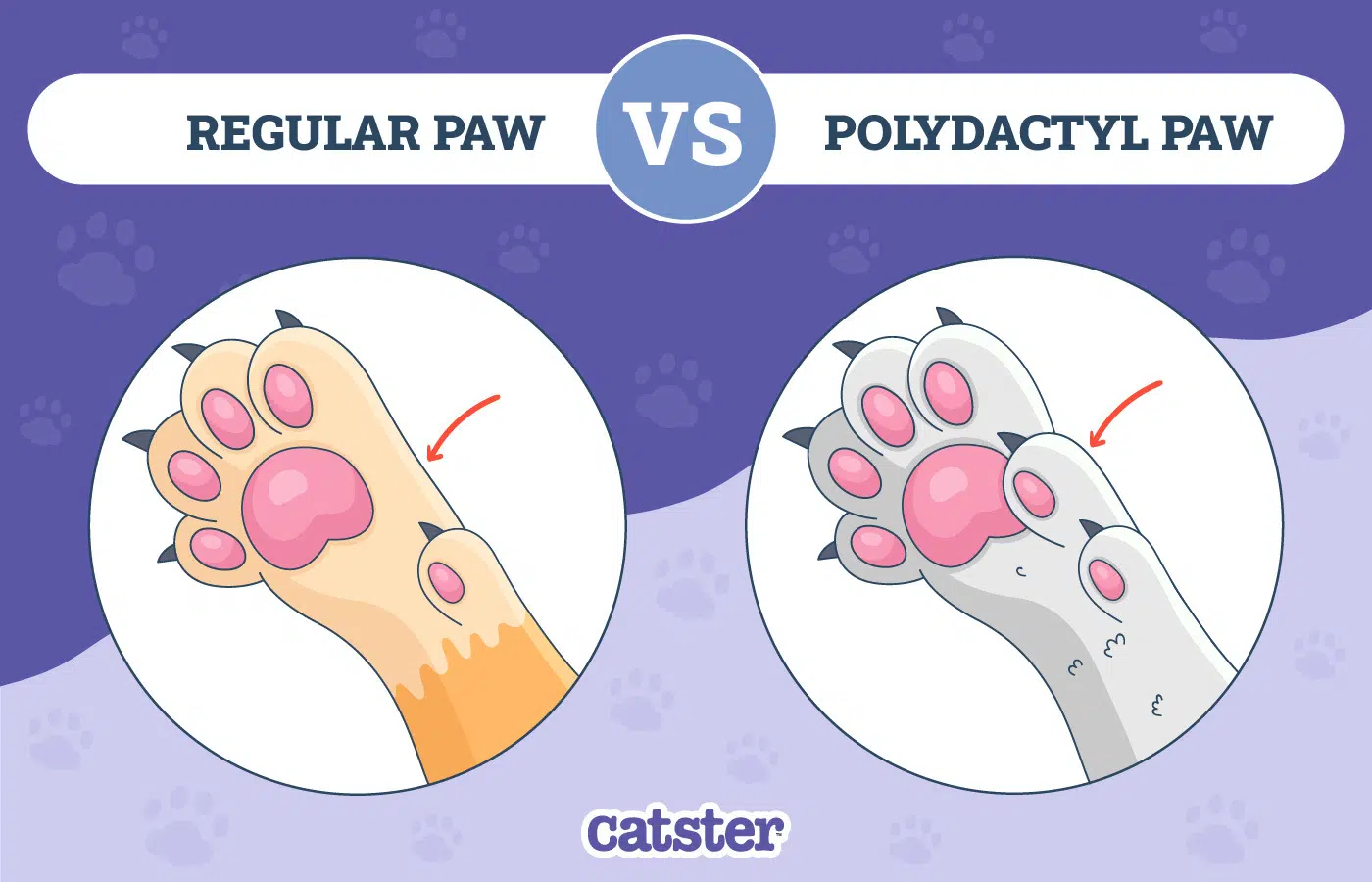
Normal Cat Paw vs Polydactyl

You are free to use this image but we do require you to link back to Catster.com for credit

Polydactylism is inherited and results from a genetic mutation. Cats with extra toes are usually just as healthy as other cats, and the trait doesn’t appear to impact affected animals much.

Most polydactyl cats have anywhere from five to seven toes; normal cats have five toes on their front paws and four on each back paw. A ginger tabby with 28 fully formed toes holds the record for the most extra digits. The extra toes usually grow close to the dewclaw, often making it appear like the cat has a thumb.

The front paws are most commonly impacted, but the abnormality is also found on cats’ back paws. Cats with extra toes on all four feet are quite rare. The trait is found in nearly every breed and among males, females, and large and small cats.

Although historically, many Maine Coon cats were born with the trait. The characteristic sometimes delivers benefits as it often provides an advantage in balance and hunting. Regarding the polydactyl cat personality, there isn’t a noticeable difference compared to a normal feline.

How Much Is a Polydactyl Cat Worth?

a polydactyl macerel tabby cat
Image Credit: Melissa Sue, Shutterstock

Polydactyly doesn’t impact a cat’s worth. A purebred cat with the trait will not be worth more or less than a similar cat without extra toes.

Are Polydactyl Cats Rare?

Not really. The trait results from a relatively common genetic mutation. If a cat with the gene for polydactyly procreates, there’s a 50% chance its offspring will have extra digits.

Where Can I Go to See a Polydactyl Cat?

Hemmingway’s former house in Key West is now a museum and home to several polydactyl cats descended from the writer’s pet.

divider cat paws oct 2024

Conclusion

Polydactyl cats are animals with extra toes on one or more paws. The trait results from a genetic mutation and is quite common among cats in England, the Eastern United States, Canada, and Wales. The feature can be found in cats of all breeds, colors, and coat lengths. There’s no link between the polydactyly mutation and other health conditions.

Related Reads: 


Featured Image Credit: Lux Blue, Shutterstock

Want content like this delivered to you?

Sign Up For Our Newsletter

News, insights, expert advice, and everything cat

* By submitting, you agree to our Terms & Conditions and Privacy & Cookies Policy.


How useful was this post?

Click on a star to rate (you can leave written feedback after clicking submit)

Help us improve Catster for pet parents!

Your feedback really matters.

What did you like about this post? Also how can we improve it?

Join the conversation

Leave a Reply

You’re very welcome to leave a comment or question. Please know that all comments must meet our community guidelines, and your email address will NOT be published. Let’s have a positive and constructive conversation.


Talk With A Vet Online

Peace of mind,
anywhere, anytime

Affordable vet advice

Ask Dr. Paola – Help! My Cat Suddenly Has Dandruff! (March 30, 2026)

Welcome to our “Ask Dr. Paola” series, where every Monday we bring expert advice straight from Dr. Paola Cuevas (MVZ) to help our...

Your Cat Keeps Vomiting After Eating: Here’s What’s Going On

Cats vomit. It’s one of the less glamorous facts of life with a feline, and most cat owners have cleaned up more than...

Ask Dr. Paola – Help! My Cat Gets Diarrhea from Wet Food! (March 23, 2026)

Welcome to our “Ask Dr. Paola” series, where every Monday we bring expert advice straight from Dr. Paola Cuevas (MVZ) to help our...

Cat Shampoo Alternatives That Are Already in Your House

If your cat has ever gotten into something disgusting and you’ve found yourself without cat shampoo, we’re here to help. Before you panic...

More related

Benefits of Going to a Pet Loss Support Group: 7 Ways They May Help

Losing a pet can be extremely difficult. They’re a part of our family and are often gone too soon. Pet loss doesn’t receive...

What Type of Cat Is Garfield? Possible Options

There are few felines as well-known as our beloved cartoon cat Garfield. This fat orange cat has brightened people’s days with his surly...

Is It Normal For Well-Adjusted Cats To Get Into Fights? Vet-Verified Reasons & Solutions

Cat fights can be a serious issue in multi-pet households, both for the pets involved and the humans who love them. Not only...

Treating Heartworm Disease in Cats: Can It Be Cured? Vet-Approved Info

Finding out your cat may have heartworm can be a shock, although the diagnosis may be quite challenging to establish. Heartworms are parasites...

Keep reading

My Cat Lost a Claw – Do Cat Claws Shed? Vet-Reviewed Facts & Advice

If you’ve found bits of your cat’s claws around the house, the good news is that this is a normal and healthy part of owning a cat. As cat claws grow out from the blood supply (also known as the...

cat paws and sharps claws

Cat Airplane Ears: 4 Vet-Verified Reasons Why Cats Do This, Facts & FAQ

Cats are known for their quirky behaviors, but one that continues to baffle pet owners is when they have “airplane ears.” This seemingly strange behavior does have a purpose, and it’s not necessarily a good thing when your cat has...

Cat laying on the grass with airplane ears

Can Cats Eat Carob Chocolate Substitute? Vet-Reviewed Facts & FAQ

Chocolate is well-known for being toxic to dogs, and most cat owners know it is toxic to cats, too. If you are familiar with carob, a natural substitute for chocolate, you may be wondering if it also comes with those...

Can Cats Eat Carob Chocolate Substitute

Why Do Cats Like the Smell of Bleach? Vet-Reviewed Feline Behavior Explanation

Cleaning with bleach may be a stellar way to kill off pesky pathogens, but the smell left behind can be a bit overwhelming. Most people don’t love the odor of bleach, but some cats can’t seem to get enough of...

Bleach Bottle Spray

Breakaway Collars Guide: Vet Reviewed Uses, Safety & Advice

No cat owner wants to consider the possibility of their kitty getting lost, but it’s always better to be prepared for the worst-case scenario. If your cat escapes your house or yard, you want to make it easy for anyone...

Breakaway Red Collar Cat

3 Homemade Cat Gravy Recipes: Vet Approved Healthy Options

Cats are obligate carnivores, so they need nutrients only found in animal products for a complete diet—including animal protein and fat. Cats are also notoriously picky, so reliable kibble may not be enough to entice their appetite sometimes. While it’s...

kitten eating gravy food

Cat Bunting: What Is It? Vet Approved Feline Behavior Guide

Cats are curious creatures that have many behaviors that we must study to understand, as they are not natural human ones. One such behavior is something called cat bunting. In short, cat bunting is when a cat places or butts...

Girl butting heads with her ginger cat

Is Basil Safe for Cats? Vet-Verified Nutritional Facts & Safety Guide

Basil (Ocimum basilicum), also known as sweet basil, is a member of the mint family. It is native to India but grown across the world, especially as a culinary herb. It is used heavily in Italian cooking and is the...

Catster_Is Basil Safe for Cats

Love Cats? So Do We! Join the Catster Community

Stay informed with expert pet care insights delivered straight to your inbox! Discover professional guidance on animal behavior, feeding tips, trusted product picks, and much more.


Sign up for the Catster Email Newsletter

Stay informed with expert pet care insights delivered straight to your inbox! Discover professional guidance on animal behavior, feeding tips, trusted product picks, and much more.