Get

In Your Inbox

Catster is reader-supported. When you buy via links on our site, we may earn an affiliate commission at no cost to you. Learn more.

How Do Cats Run? The Amazingly Complex Details! (Vet-Verified)

Share

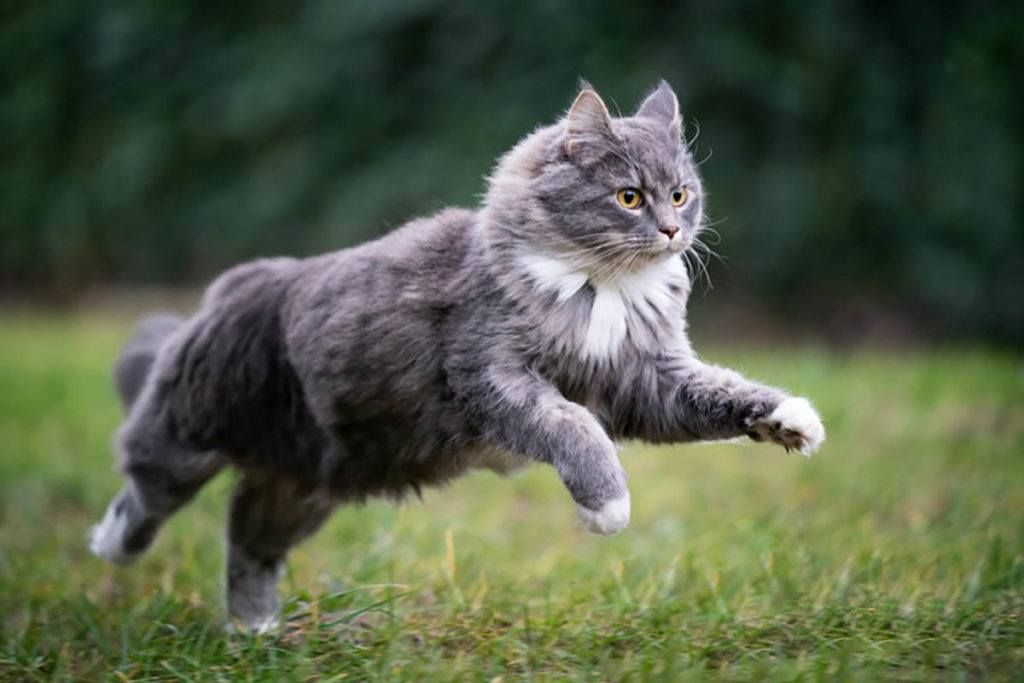
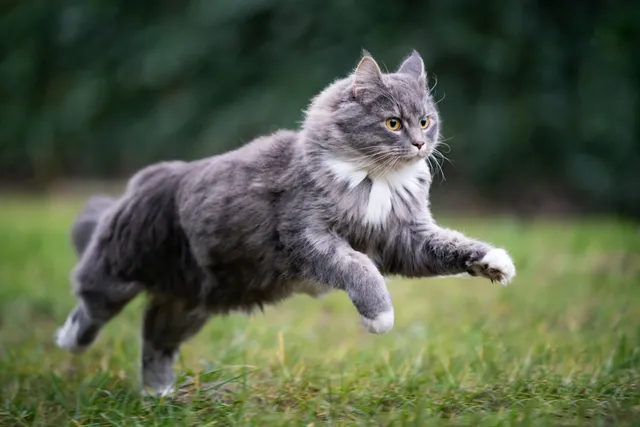
blue tabby maine coon cat running outdoors

Cats are impressive in a multitude of ways, not least in how they make feats like climbing and running look easy. Cat parents will be familiar with their feline friend’s gracious movements and elegance even when running at fast speeds, but how exactly do cats run, and what is it that makes them so speedy? The answer is complex and really depends on what the cat is trying to accomplish at any given moment. Read on to get the low-down on how cats run.

divider cats oct 2024

How Do Cats Run?

The way cats are built and what they’re built to do (hunting out in the wild) has a lot to do with how they run and why they run the way they do. The way they run is also determined by how fast they need to go.

Walking

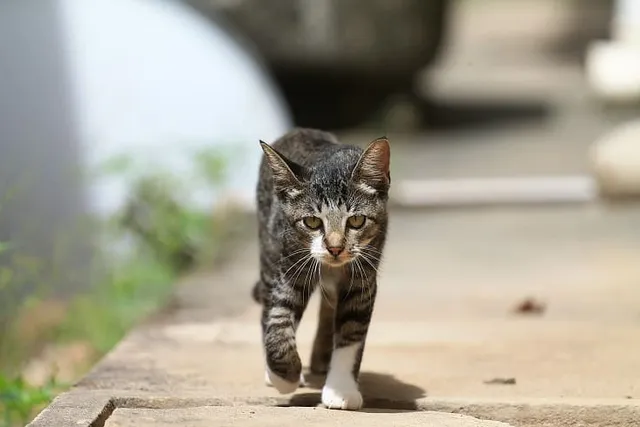
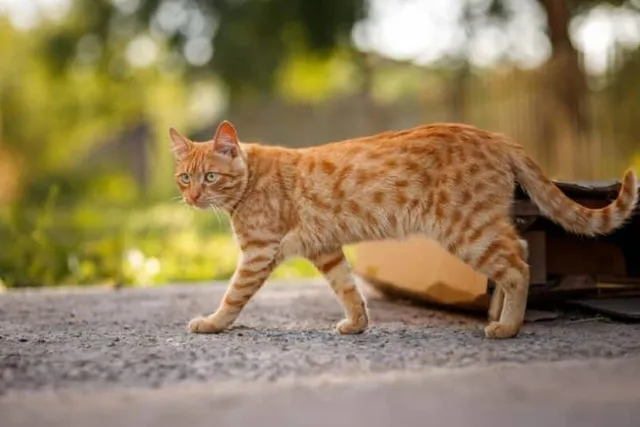
For example, a walking cat would first put forward a front leg and the hind leg opposite to it, moving forward in a diagonal motion and in a four-beat pattern of movement. The paws would not all touch the ground at the same time. Two or three feet would be touching the ground, the deciding factor for this being the speed at which the cat is moving. The tail would be positioned carried naturally, often level with or slightly below the spine.

Norwegian forest cat walking outdoor
Image Credit by: Elisa Putti, Shutterstock

Trotting

If the cat were to progress to a trot, the opposite (diagonal) paws would be touching the ground at the same time, the head may lower, and the tail would be positioned low and held in a straight-outward fashion. The cat would advance in a two-beat movement pattern.

Running (Gallop)

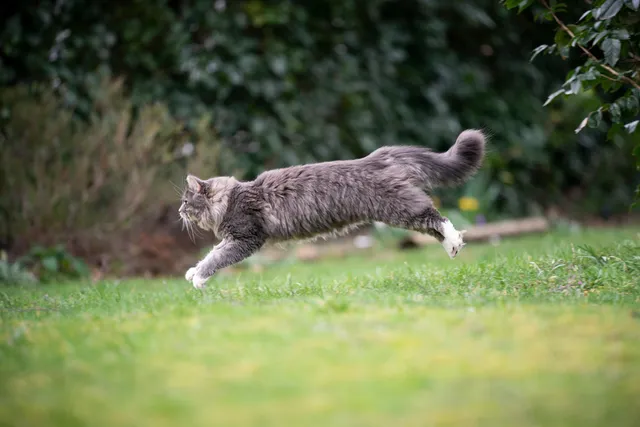
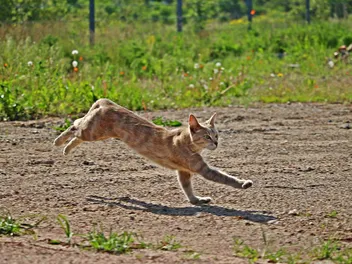
Now, if a cat runs at speed, things start to get really interesting. A cat gallops in a four-beat gait with alternating suspension phases, rather than a three-beat pattern. There may be phases where the legs don’t touch the ground at all. This is called a single or double-suspension phase. During the suspension phase, the hind legs are responsible for propelling the cat’s body in a forward motion.

One of the front legs touches down just before the other, and the rear end is drawn under the body, at which point the hind legs can land in the same way as the front legs—one a split second before the other. The hind legs come into very close proximity to the front legs when they land, creating what looks like a sort of bounding motion.

blue russian cat running in nature
Image Credit by: ddisq, Shutterstock

How Fast Cat Cats Run & Why?

Domestic cats are capable of reaching speeds of up to 30 miles per hour (48.28 kilometers per hour). Many factors contribute to this, including the fact that cats are digitigrade, which means that they walk on their toes. This not only allows them to move more quickly, but it also makes for a stealthier predator. As digitigrades, cats are better able to keep quiet when they move.

Moreover, the way a cat’s body is formed contributes greatly to how quickly they can move. For one thing, their spines are very flexible. Elastic discs sit between the spinal bones, allowing for smoother, more fluid movements. This also accounts for why cats look so graceful when they jump, climb, and run.

To add to this, bone doesn’t connect the cat’s shoulder blade to the body—muscles do. Because of this, the shoulder area isn’t hampered by a hard material and can move about more freely.

Cats can also avoid air resistance when in a suspension phase (when their feet don’t touch the ground at all) and can use their claws for extra grip when running. They also have strong, powerful hind legs and back muscles to help thrust them forward. Finally, their natural sense of balance is impeccable, which allows them to stay on course and upright as they reach their top speeds.

You are free to use this image but we do require you to link back to Catster.com for credit

divider cats oct 2024

Final Thoughts

The way a cat runs is different from the way they walk and even trot, but what’s clear is that the feline’s incredible physiology—the fact that they are digitigrades and have excellent balance, flexibility, and power in the hind limbs—is responsible for our fluffy friends’ exquisite grace and speed.

So, even if your cat is a little on the chunky side and prefers snoozing the day away to exploring, remember that beneath that sloth-like exterior is a real powerhouse!

See also: How Many Legs Does a Cat Have? Vet Approved Facts & FAQ


Featured Image Credit: Nils Jacobi, Shutterstock

Want content like this delivered to you?

Sign Up For Our Newsletter

News, insights, expert advice, and everything cat

* By submitting, you agree to our Terms & Conditions and Privacy & Cookies Policy.


How useful was this post?

Click on a star to rate (you can leave written feedback after clicking submit)

Help us improve Catster for pet parents!

Your feedback really matters.

What did you like about this post? Also how can we improve it?

Join the conversation

Leave a Reply

You’re very welcome to leave a comment or question. Please know that all comments must meet our community guidelines, and your email address will NOT be published. Let’s have a positive and constructive conversation.


Talk With A Vet Online

Peace of mind,
anywhere, anytime

Affordable vet advice

Do Cats Cause Schizophrenia? Scientists Find a Link – Here’s What It Means

Being a fierce advocate (and occasional recipient of) mental health support and awareness, the term ‘crazy’ is not one I like to fling...

One in 100 Cats Gets Diabetes – Here’s How to Catch It Early

One in every 100 cats develops diabetes.1 That’s not a rare, unlucky condition reserved for cats with obvious health problems. It’s common enough...

Dramatic Rescue Turns Into Dramatic Reunion

What started as a routine call for the RSPCA became a heroic, five-hour rescue featuring one trapped and traumatized cat, an emotional family...

Ask Dr. Paola – Help! How Do I Know if it’s Ear Mites! (May 4, 2026)

Welcome to our “Ask Dr. Paola” series, where every Monday we bring expert advice straight from Dr. Paola Cuevas (MVZ) to help our...

More related

How to Get Rid of Cat Pee Smell: Tips for Every Surface

One of the worst things about owning a cat is the possibility of cat pee on your carpet or wooden floors. Every cat...

Why Is My Cat Bleeding? A Full-Body Overview (Vet Answer)

Noticing bleeding from your cat is alarming, especially when you don’t know what’s causing it. As imagined, bleeding can occur for several different...

7 Signs Your Cat Wants You to Play With Them: Vet Verified Cues to Look For

Cats love to play, just like dogs. Although it may seem vastly different from dogs, cats can show us signs letting us know...

How to Give a Cat a Head Massage: 4 Vet-Reviewed Tips & Benefits

You wouldn’t think giving a cat a head massage would be something your feline would like, but you would be surprised. While not...

Keep reading

Why Do Cats Sleep at the Foot of the Bed? 8 Possible Reasons for This Behavior (Vet Reviewed)

Of all the strange things cats do, why do they choose to sleep at your feet instead of snuggling at your chest at night? On average, felines sleep for 16 hours a day, most of which happens in places you...

How to Keep a Barn Cat From Running Away: 7 Easy Tips

If you’ve ever lived on a farm, chances are you’ve had a few barn cats keeping tabs on the property, whether you meant to have them or not. Barn cats are feral or semi-feral animals skilled at controlling the vermin...

a feral barn cat relaxing in the shade

Why Do Cats Act Weird When Scratching the Base of Their Tail? 10 Vet-Reviewed Reasons

It’s not uncommon for cats to act weird when you scratch the base of their tail. This area is quite sensitive, and cats respond one way or another. Additionally, a tail that sticks straight upright into the air is referred...

young cat breathing heavily

How to Help a Cat Give Birth: 5 Vet-Reviewed Tips

Giving birth can be a very stressful situation for cats. We are used to seeing cats being independent animals, but even for them, giving birth is a challenging task. This period is very stressful for cats and also the owners....

mother cat gave birth to kitten

Why Does My Cat Eat So Fast? Vet-Approved Feline Facts & FAQ

Do you ever watch your cat scarf down their food and wonder why they eat so fast? There might be a reason for their speedy eating habits—cats are hardwired to eat quickly to protect their food from predators. In the...

maine coon cat eating

Can Cats Eat Hard-Boiled Eggs? Vet-Verified Nutrition Facts & FAQ

It’s difficult not to treat your furry friend to a little piece of your meal, but there’s always some concern as to whether our cats can indulge in the same foods that we do. That concern is amplified with foods...

Can Cats Eat Hard-Boiled Eggs

How to Make a Cat Sneeze to Clear its Nose: 4 Vet-Approved Tips & Tricks

If you’ve ever had a sneezing fit, you know exactly how uncomfortable it can be. Your cat can suffer from a stuffy nose and sneeze like we can. So, how do we help them? Your cat’s congested nose can cause...

tabby cat sneezing

Can Cats Eat Cookies? Vet-Reviewed Facts & FAQ

While a nibble of your cookie is unlikely to kill your cat, cookies are far from healthy for cats and absolutely should not be fed to your cat regularly. Human sweets are incredibly unhealthy and sometimes very dangerous for cats....

Can Cats Eat Cookies

Love Cats? So Do We! Join the Catster Community

Stay informed with expert pet care insights delivered straight to your inbox! Discover professional guidance on animal behavior, feeding tips, trusted product picks, and much more.


Sign up for the Catster Email Newsletter

Stay informed with expert pet care insights delivered straight to your inbox! Discover professional guidance on animal behavior, feeding tips, trusted product picks, and much more.