Get

In Your Inbox

Catster is reader-supported. When you buy via links on our site, we may earn an affiliate commission at no cost to you. Learn more.

Cat Body Condition Score: What Is It & How To Work It Out

Share

veterinarian with gloves weighing a big persian cat with a scale at the animal clinic

The Body Condition Score (BCS) is a quantitative method for evaluating body fat. Think of it as the animal equivalent of the Body Mass Index (BMI) for humans. The BCS is used as a yardstick for measuring the ideal weight of our pets, and it’s an important tool as almost 60% of domestic cats are considered overweight 1. Read on to learn more about the BCS and how you can use this tool to determine the condition of your cats.

divider 1 paws

What Are the Different Types of Body Condition Scores for Cats?

There are two recognized BCS scales: one ranging from one to nine and the other from one to five. Both scales operate on the same principle. The ideal weight is given the numbers in the middle, so 4 and 5 on the nine-point scale or 3 on the five-point scale. Cats scoring below (one or two on the five-point scale or one, two, or three on the nine-point scale) are considered underweight. Cats with values above the ideal weight (four or five on the five-point scale or six, seven, eight, or nine on the nine-point scale) carry excess weight.

Both scales are useful as veterinary staff can add half-points as necessary on the five-point system. For example, an overweight cat who is not quite obese may be assessed at 4.5/5.
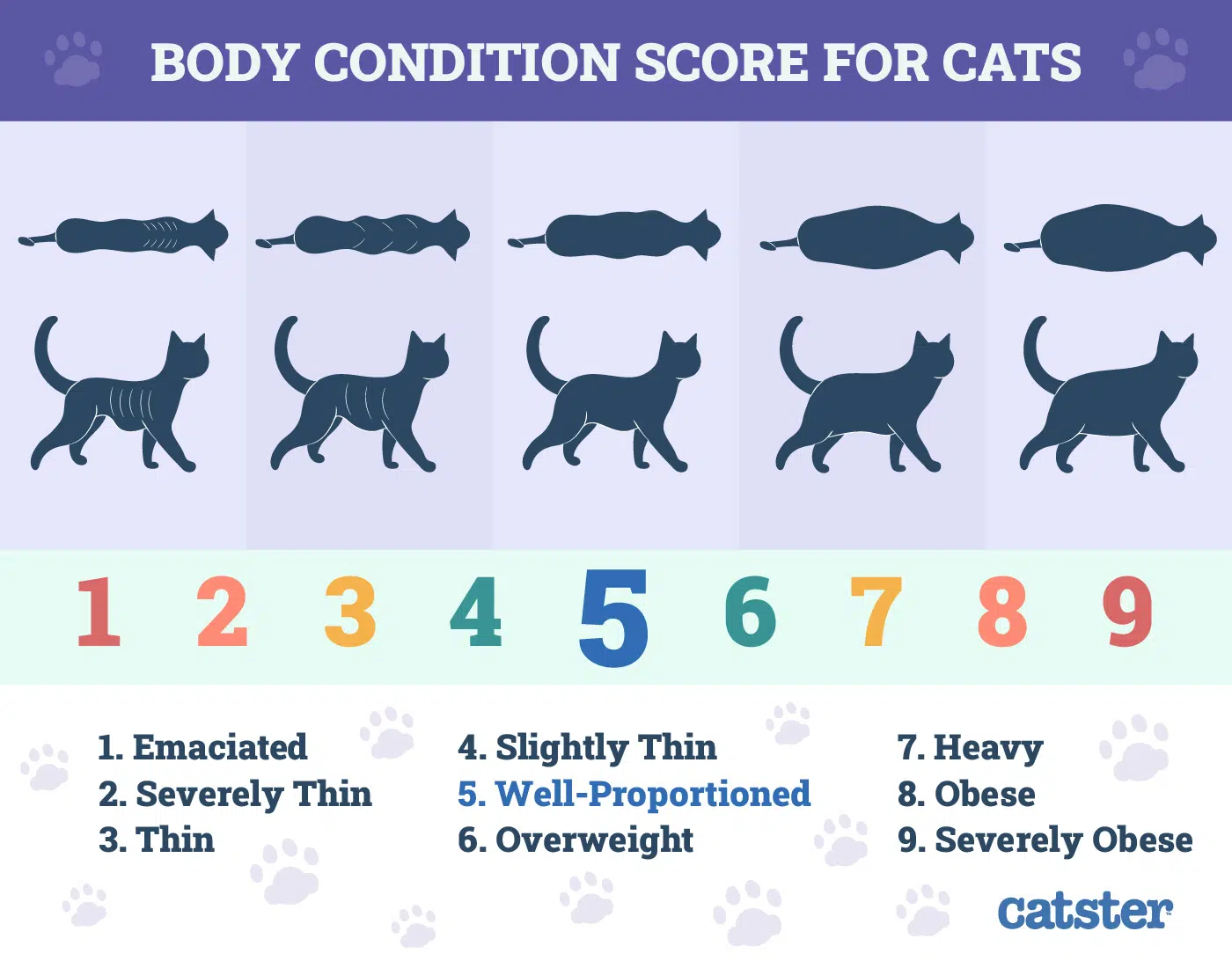
Cat Body Condition Score Healthy Weight
You are free to use this image but we do require you to link back to Catster.com for credit

Let’s look a little closer at what each number on both scales looks like.

  • 1/5 or 1/9: Protruding ribs, backbone, and pelvic bones. Clear loss of muscle mass and no palpable body fat.
  • 5/5 or 2/9: Visible rib, backbone, and pelvic bones. Minor muscle mass loss and no palpable body fat.
  • 2/5 or 3/9: Ribs can be felt easily and may be visible. Waistline is obvious, and there is not much abdominal fat.
  • 5/5 or 4/9: Ribs can be felt easily. Slight abdominal tuck and noticeable waistline behind the ribs.
  • 3/5 or 5/9: Ribs, pelvis, and spine are palpable. Thin fat layer present. Tummy tuck is obvious but not severe.
  • 5/5 or 6/9: Slight layer of fat on the ribs, spine, and pelvis, which makes them slightly more difficult to feel. Minimal tummy tuck and visible waistline.
  • 4/5 or 7/9: Ribs, spine, and pelvic bones not easily felt. Moderate fat covering. Waist poorly discernible with obvious abdominal rounding.
  • 5/5 or 8/9: Ribs, spine, and pelvic bones not palpable. Excess fat covering. Obvious rounding of the waist and notable abdominal fat pad. No tummy tuck.
  • 5/5 or 9/9: Ribs, spine, and pelvic bones not palpable. Abdominal distension and protruding waistline. Fat deposits present on the face and legs.

divider 1 paws

How Does It Work?

To assess your cat’s BCS, you will need to get hands on your cat for a palpation assessment as well as evaluate their silhouette from above and from the sides.

Palpation Assessment

You should easily be able to feel your cat’s ribs when gently running your thumbs on their backbone and spreading your hands across the ribcage. Cats at a healthy weight will have a thin layer of fat over their ribs and spine that’s not visible but tangible when feeling along their sides.

Tip
A good comparison to use when determining if the layer of fat is too much, too little, or just right is by using your knuckles. The ribs or spine of an underweight cat may protrude as the knuckles on the top of your hand do when you hold a fist. Now, flip your hand so the palm is open and resting on a table. If your cat’s spine looks like the fleshy pads opposite of your knuckles, they may be overweight. A cat at an ideal weight will feel like your knuckles when your hand is resting palm down on a flat surface.

Visual Assessment

Orange cat seen from above
Image By: MirasWonderland, Shutterstock

Next, assess your cat from above when they are standing. They should have a visible waist behind their ribs that tapers slightly towards their hips.

From the side, you should be able to see your cat’s abdomen tucked up behind their ribcage. Do they have a saggy belly, or does their abdomen slant upward between their ribs and hind legs?

If you are concerned or have questions about your cat’s health, you can also speak to a vet from the comfort of your own home to help make a plan. They can determine when an in-clinic vet visit should be made.

If you need to speak with a vet but can't get to one, head over to PangoVet. It's an online service where you can talk to a vet online and get the advice you need for your pet — all at an affordable price!

PangoVet_Mention-in-Content for PangoVet2 save money

divider 1 paws

Frequently Asked Questions

If my cat has a saggy tummy, does that make them fat?

Not necessarily. Both male and female cats have an abdominal flap along their bellies, known as a primordial pouch. Some pouches are more pronounced than others. Pouch size may have a genetic component, so they can vary from breed to breed and cat to cat. Even the healthiest and leanest cat could have a large pouch.

An overweight cat will have a round-shaped belly and extra padding around their ribs, while those at a healthy weight will have a swinging primordial pouch and a visible indentation at the waist when viewed from above.

How can I reduce my cat’s weight?

If your cat is overweight, you and your veterinary team should come up with a weight reduction plan together. Do not put an overweight or obese cat on a diet without first consulting with your vet. They will determine your cat’s ideal weight based on their body size and build. From there, they will provide daily caloric needs for your pet to help them lose weight in a healthy manner.

In addition to reducing caloric intake, your vet may recommend an exercise program to help your kitty fit. It may include things as simple as moving their food bowl upstairs or using feeding balls instead of bowls to make them work for their kibble. You’ll also want to implement daily play times using interactive toys like laser pointers and feather wands.

Losing weight isn’t an easy or quick process for cats, so don’t get discouraged if you don’t notice any huge changes in your pet’s BCS immediately. Cats can safely lose about half a pound monthly. Crash diets are to absolutely be avoided as they can cause serious life-threatening liver failure in cats.

Hepper NomNom - Spill Proof Elevated Cat Bowl
  • NO MESS - The 360° tray on this cat food and water bowl set has a raised design to catch and...
  • WHISKER FRIENDLY - Shallow and wide metal containers with flat bottoms ensure your kitty can enjoy...
  • CHEW-SAFE MATERIALS - Kittens and cats love chewing on silicone and soft rubber - but it's a choking...

Feeding your cat a high-quality diet is important for keeping them healthy and happy. But it goes beyond the food you choose; the dishes they use also matter. The Hepper NomNom Cat Bowl is our favorite for its unique, five-star design that protects from whisker fatigue and promotes good posture which also aids in better digestion. As an added bonus, it’s beautifully crafted and offers a modern take on the traditional cat bowl that fits seamlessly with all home stylings. Learn more about the NomNom by clicking here.

At Catster, we’ve admired Hepper for many years and decided to take a controlling ownership interest so that we could benefit from the outstanding designs of this cool cat company!


How often should I weigh my pet?

You should weigh or assess your cat’s BCS regularly to keep tabs on their weight. Knowing your pet’s baseline will help you catch unwanted weight gain early and address it before it gets out of control. Weigh your cat monthly if they’re on a weight-loss diet to keep track of their progress.

divider 1 paws

A Quick Reference Guide

Five Point Scale Nine Point Scale
1/5 – Very thin 1/9 – Emaciated
2/5 – Underweight 2/9 – Very thin
3/5 – Ideal weight 3/9 – Thin
4/5 – Overweight 4 or 5/9 – Ideal weight
5/5 – Obese 6/9 – Overweight
7/9 – Heavy
8/9 – Obese
9/9 – Severely obese

divider 1 paws

Conclusion

The Body Condition Score is a useful tool in determining your cat’s body fat level. Since so many health conditions are associated with being overweight and obese, it’s important to keep tabs on your cat’s weight and body fat level. If you have any concerns about your pet’s weight or BCS, don’t hesitate to contact your veterinarian for advice.


Featured Image Credit: Beach Creatives, Shutterstock

Want content like this delivered to you?

Sign Up For Our Newsletter

News, insights, expert advice, and everything cat

* By submitting, you agree to our Terms & Conditions and Privacy & Cookies Policy.


How useful was this post?

Click on a star to rate (you can leave written feedback after clicking submit)

Help us improve Catster for pet parents!

Your feedback really matters.

What did you like about this post? Also how can we improve it?

Join the conversation

Leave a Reply

You’re very welcome to leave a comment or question. Please know that all comments must meet our community guidelines, and your email address will NOT be published. Let’s have a positive and constructive conversation.


Catster's Digital Magazine is Back!

Vet-approved health & behavior advice

Real cat stories & community features

Chatting About the Rainbow Bridge, Euthanasia, and Laughter During Grief | Chatty Cattys, Episode 24

If you’ve ever felt the loss of a beloved cat, or are dreading the day when your pet crosses the rainbow bridge, you’ll...

The Simple Reasons Cats Refuse to Let Anyone Use the Bathroom Alone

Cats have an extraordinary talent for making themselves present in the most inconvenient places, and the bathroom ranks near the top of the...

A Paw-sitive Milestone: Canada Officially Becomes a Declaw-Free Nation

Canada has officially become a declaw-free nation. On May 25, 2026, a new regulation was filed in Ontario under the Provincial Animal Welfare...

The Surprisingly Simple Ways to Help a Cat With Hairballs

Cats spend an astonishing amount of time grooming. It is part hygiene routine, part comfort ritual, and part instinct that traces back generations....

More related

6 Tips for Sharing Your Home with Cats You Must Know

When we decide to welcome a cat into our home, we can expect a few changes to occur. Your bathroom will have a...

Costs of Treating Cat Injuries & Diseases (2026 Price Guide)

If you’re considering bringing a fluffy friend into your life, it’s essential to be clued up on the potential cost of treatment if...

Can Cats Eat Black & Green Olives? Vet-Verified Nutritional Science & Info

If you have ever been snacking on a jar of olives, you may notice your cat curiously sniffing whatever you’re snacking on. This...

Blind Cat Mr. Magoo Leaves Behind an Artistic Legacy

Just like humans, cats have special talents. For a Siamese cat named Mr. Magoo, that special talent was art. He’d dip his paws...

Keep reading

Do Cats Have Eyelashes? Vet-Reviewed Anatomy Facts & Conditions

Cat eyes are fascinating animals to observe, but have you ever wondered if your cat has eyelashes? If you ask this question, you’re likely going to get mixed answers. Some people say yes, and others are adamant that the answer...

Blue-eyed ragdoll close up

Can Cats Eat Chestnuts? Vet-Approved Diet Precautions & Advice

Do you have a furry friend at home and are curious if chestnuts are a safe snack for them? Wonder no more! Let’s explore whether cats can eat chestnuts and answer some other pressing questions about the safety of this...

Catster_Can Cats Eat Chestnuts_v1_Dec 4 2024

Does Baking Soda Kill Fleas on Cats? Vet-Approved Effectiveness & FAQ

Baking soda is an effective and inexpensive home remedy for several problems, and you may have heard that baking soda can kill fleas on cats. The idea is that baking soda creates an environment that the fleas cannot survive in...

baking soda in a glass bowl

Can Cats Eat Fish Sticks? Vet-Approved Nutritional Science & Info

Curiosity is a concept almost universally associated with cats, and unfortunately, cats tend to lead the charge with their mouths! Most cats are not shy about trying new foods. Fortunately, if you find your cat’s face first in your plate...

Can Cats Eat Fish Sticks

Why Do People Hate Cats? What Science Tells Us (Vet-Reviewed)

Cat lovers think that their favorite animals can generally do no wrong. People who adore felines often find them loving, attentive, playful, and adaptable. They love cats’ independence and sweet companionship and feel honored that such self-sufficient and intelligent creatures...

red flame point siamese in the grass

Why Do Cats Roll Around on Their Backs? 7 Vet-Reviewed Reasons (With Infographic)

Cats are peculiar creatures and usually march to the beat of their own drum. Unlike dogs, cats can be particular, especially regarding their bellies. When a dog rolls over on their back and exposes their belly, the dog likely wants...

Fluffy domestic cat stretching on the sofa

Should You Let Your Cat Outside? Pros & Cons of Indoor & Outdoor Cats

To let or not to let your cat outside—that is the question. For some cat parents, this is never a quandary, as their feline companions already spend most of their time outside, and getting them used to living cloistered in...

short-haired domestic cat sitting outside in fenced

Why Does My Cat Pee So Much? 7 Vet-Reviewed Reasons

Your cat’s bathroom habits generally won’t be at the forefront of your mind unless you already suspect that something is wrong. But when you observe your cat doing something unusual, it tends to stick with you. If your cat has...

ginger cat inside red grey enclosed litter box

Love Cats? So Do We! Join the Catster Community

Stay informed with expert pet care insights delivered straight to your inbox! Discover professional guidance on animal behavior, feeding tips, trusted product picks, and much more.


Sign up for the Catster Email Newsletter

Stay informed with expert pet care insights delivered straight to your inbox! Discover professional guidance on animal behavior, feeding tips, trusted product picks, and much more.
