Please Don’t Go! Separation Anxiety In Cats

Hi, I’m Dr. Lauren! Read my introduction to learn more about me and my two adventurous cats, Pancake and Tiller.
The stereotypical image of a cat as aloof and uncaring is one that has been perpetuated throughout media, anecdotes, and writing, leading to a long-standing belief that dogs are man's best friend, and cats simply don’t care.
Nothing could be farther from the truth. And the disservice this has done cats, is immense. Why, you ask?

Separation Anxiety in Cats: Is It Really a “Thing”?
Well, feline medicine has often taken a step back from canine medicine. For a long time, in fact, much of the veterinary profession’s lifetime, cats have been treated as dogs. But, we now know this is simply not true. Cats suffer their own unique diseases: hyperthyroidism, urinary blockages, feline hyperesthesia syndrome, and feline coronavirus, to name a few. Not to say that cats don’t also suffer from some of the same diseases as dogs (or maybe I should say dogs suffer from the same diseases as cats!).
In part, this inappropriate perception of aloofness is likely why separation anxiety in cats has been poorly recognized until recent years. And still isn’t well spoken about. Comparably, in dogs, and even humans, it’s a fairly well-known entity.
So, what is separation anxiety? To understand that, first you need to understand how attachment occurs in the first place. Attachment begins when the offspring stays close to its mother during early life. In part, this aids survival, though other functions are also possible, such as bonding, and socialization.
As veterinary students, we learned about separation anxiety in dogs, and the causes, the behavioural modification to correct it, and the medical treatments available. When it came to cats, as with most behaviors, we simply didn’t discuss it. Dogs were man’s best friends… cats were just… cats.
In practice, we still don’t often make the diagnosis of feline separation anxiety. I often joke about how Pancake sleeps 26 hours a day, but in truth, how do cats feel when owners leave? What about extremely bonded cats? Cats, more than dogs, are more likely to be raised as orphans, known as bottle babies, meaning that they sometimes form intense bonds with their early carers, in replacement of their mother.

Separation Anxiety In Theory vs Practice
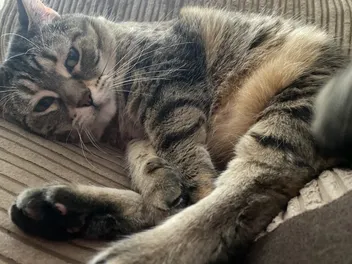
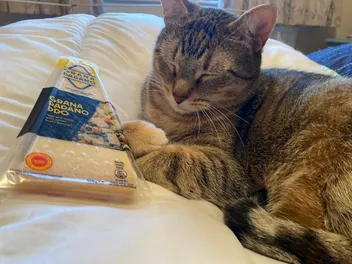
I’ve certainly worked with many patients who are quick to be described as upset when their owner leaves for a trip, and behave differently upon return. My own cats are much like this—hiding when they see the travel bags come out, and not sleeping in their normal spots. Just as I’m heading out the door, Pancake is notorious for doing a “you can’t touch me” and sitting just under the kitchen table, just out of reach. Whereas Tiller retreats to under the bed. On a normal day, they’d simply be asleep on the sofa, and the bed, respectively. So, certainly, they exhibit some mild forms of anxiety, though not enough to be classed as pathological.
New technology has also helped to make the behavior of cats more apparent, as we now have cameras for in-home use, to track what cats are doing, when we are not around. Some even dispense treats.
What Behaviors Are Recognized For Cats With Separation Anxiety?
Minimal research has been done on the topic, but studies have looked at owner-based questionnaires, to define the issue. One study of 136 cats reported behaviors can be quite varied, including things such as the following:
Inappropriate urination and defecation
Excessive vocalization
Destructiveness
Psychogenic grooming
Some other interesting findings also came from this particular study: female cats were more likely than males to defecate outside the box and to partake in overgrooming, whereas males were more likely to perform destructive behaviors. Inappropriate urination 75% of the time was done on the owner’s bed.
Therefore, separation anxiety only occurs, by definition, when prolonged, inappropriate physical responses occur to the physical departure of the cat’s owner. If your cat sits at the window and cries when you leave for a minute or two, then goes back to bed, it’s not likely to be considered separation anxiety.

If You Suspect Separation Anxiety In Your Cat, What Are Your Options?
The first thing to try and do is to get a video or videos of the behavior. This can help your vet confirm the suspicions.
Home cameras can help to document this.
Be aware of other household changes as well, and note these for discussion with your vet
Schedule an appointment with your vet; know that for some behavioral issues, further referral to a feline behaviorist may be advised. When booking any behavioral appointment, ask if there is any additional paperwork to fill out, as many vets will have questionnaires to fill out ahead of time. And do mention the specific behavior that you are concerned about, as sometimes additional appointment time is needed for behavioral issues.
Know that bloodwork and other diagnostics may be done to rule out other concerns. For example, the hyperactivity, and sometimes overgrooming, that can occur with hyperthyroidism can sometimes mimic some components of other issues. Testing can help to rule this out.
Know that behavioral issues can be difficult to treat, and generally, the longer it has been occurring, the harder it can be to treat. Sometimes, issues cannot be fully resolved, though other times, they can.
Be realistic about your expectations: what do you want to happen to the behavior? Are you willing and able to medicate your cat daily? Twice daily? Follow up with routine bloodwork, if needed? Knowing this can help your vet or behaviorist to find the best options for you and your cat.
Have you tried anything already for the issue, such as pheromone diffusers?
In the end, cats are not small dogs—but that doesn’t mean they don’t have similar issues that crop up, either. As an owner, you are best able to recognize these issues, and advocate for your cat!
This article is a part of Dr. Lauren, Pancake, and Tiller's series.
Expert cat care, straight to your inbox
News, insights, and useful advice, delivered to you.

No spam — unsubscribe anytime.
By signing up, you agree to our Terms & Conditions and Privacy & Cookies Policy.
How useful was this post?
Click a star to rate. You can leave written feedback afterwards. (We read all feedback.)
Dr. Lauren Demos DVM (Veterinarian)
As a veterinarian, Lauren is eager to share her experience in emergency medicine and cats, with our readers. She loves sharing helpful, real life tips for having cats as part of your life, and what to do in critical situations with your pets.
Lauren is a vet with over a ten years of experience in cats and dogs, along with infectious diseases. She enjoys teaching, and lectures for students, pet owners, and clinicians, on various topics.
Lauren received her degrees from Murdoch University, in Perth.