How to Do A Health Check At Home: Dr. Karyn's Guide (with Video)

Hi, I'm Dr. Karyn! Read my introduction to learn more about me and meet my five hilarious cats: Clutch, Cyril, Alex, Zelda, and Zazzles.
Just the other day I was working on an article for our canine counterpart, Dogster, called “How Do I Know If My Dog Is Healthy?” and it made me think about how I perform a basic health check on a cat. I had a flashback to the Covid lockdowns, and how we often relied on owners to examine their cats at home to help us decide if they needed to be brought into the vet clinic. In veterinary practice, these basic checks are something we do dozens of times a day, hundreds of times a week. But I started to think about how overwhelming it may be for someone who has never done one.
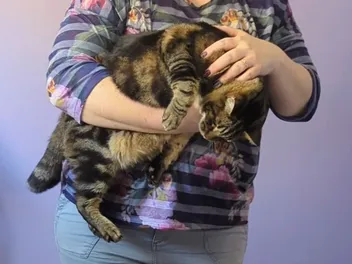
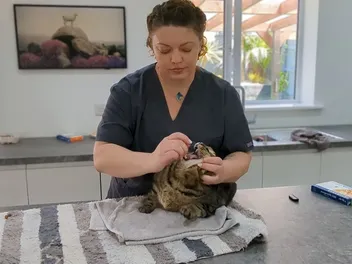
So, with the help of my somewhat willing volunteers, I am going to show you how to perform a basic physical examination of your cat at home using a checklist. This can be a useful tool for remote vet checks, but it’s also a great way to monitor health conditions and get a clearer idea of response to treatment.
Of course, a home health check is NOT a substitute for a complete veterinary examination, and there are limits to what we can measure outside the vet clinic. But feeling more confident about how to check your cat’s health at home can allow you to pick up potential problems sooner, which is particularly useful when dealing with a species that is notorious for hiding signs of illness and pain.

The Ten-Minute Health Check
Click here to download and print our health checklist!
You can use this checklist to help guide you through this basic examination and record what you find. It’s a good idea to fill out the checklist at, or just after, a check up at the vet. That way you will have an accurate weight measurement, and you can find out what your pet’s ideal weight is.
The only equipment you’re going to need is a watch/clock and a rectal thermometer, which you can purchase specifically or commandeer from your first aid supplies – just be sure to label it clearly and keep it separate from any human equipment!
TPR
Temperature, pulse, and respiration: the hallmark of examination, patient monitoring, and triage.
Heart Rate
We’re not using a stethoscope, and this does not replace a cardiac auscultation. We are simply measuring the heart rate. You can either take a reading over a full 60 seconds or for 15 seconds and multiply it by four. There are a few places that you can use to check your cat’s heart rate:
| Carotid artery - located in the jugular groove, either side of the trachea (windpipe) on the neck. | |
| Chest wall (left side) - on lean cats, you should be able to feel (or even see) your cat’s heart beating under their ribs around where their elbow is when they are standing. | |
| Femoral artery - this can be felt when your cat is standing up or lying down. Place your fingers in the groove between the thigh muscles just below your cat’s groin. |
Respiratory Rate
This will fluctuate a lot when your cat is awake, so wait for them to be asleep to take this reading. Fortunately, that is very easy when it comes to cats!
Temperature

Most cats will strongly object to having their temperature taken, and it’s not something you should risk harming them or yourself over. If you can’t get a thermometer in for a rectal temperature, have a feel of their ears, nose, and paw pads. Although this won’t give you an accurate temperature measurement, it can give you an idea of whether they feel warm or cold, in relation to the ambient temperature. For example, warm ears on a cold day may indicate a fever.
Always take the temperature last, as pulse and respiratory rate are likely to go up once that thermometer gets near their bottom, and be sure to use a personal lubricant or Vaseline on the thermometer!
Gums
Healthy gums should be salmon pink and feel moist to the touch. Many cats have dark brown or black pigment on their gums, making this a little harder to assess, but you should be able to find an area without pigmentation to use.
CRT
Capillary refill time (CRT) can give us an indication of blood pressure, anemia, or blood loss. Find a pink area of the gum and carefully push your finger against the gum so that it blanches white. Measure how long it takes for the color to return.
Normal CRT is around 1-2 seconds.

Ocular Exam
We’re not going to get too complicated with this one. These checks will just give us an idea if there is any pain or vision loss.
Eyes
Are they of equal size and appearance? Is there any redness or discoloration?
Pupils
Are they the same size? Do they constrict (get smaller) in the light and dilate (get larger) in the dark?

Dazzle
If you flash a torch/bright light into the eyes, do they close their eyes?
Menace
Hold one hand over one eye, and with the other hand, quickly approach the open eye as if you are going to hit it, but stop about 8 inches from the face – does the eye close? Repeat on the other side.
Comfort
Do they mind if you push gently on the eye over the eyelid?
Gastrointestinal System
Some basic questions to answer are:
Has your cat’s appetite been normal? Increased? Decreased?
Has there been any vomiting or diarrhea?
Is their abdomen comfortable and soft if you push on it, or does it seem tense, painful, or bloated?
Skin
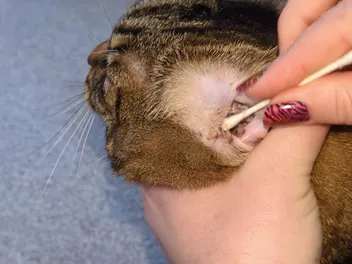
Skin problems can be quite involved, and if your cat has any obvious or significant skin issues, they will need a separate examination with your vet. In this situation, we’re just looking for any early or subtle signs of a problem (or lack of one!). Don’t forget to check the ears and feet.
You want to look for redness, greasy coat or skin, scabs, crusts, or bald patches. This is also a good time to feel over their body for any lumps or swellings. Use the diagram on the checklist to make notes of any lumps you find.
Musculoskeletal Exam

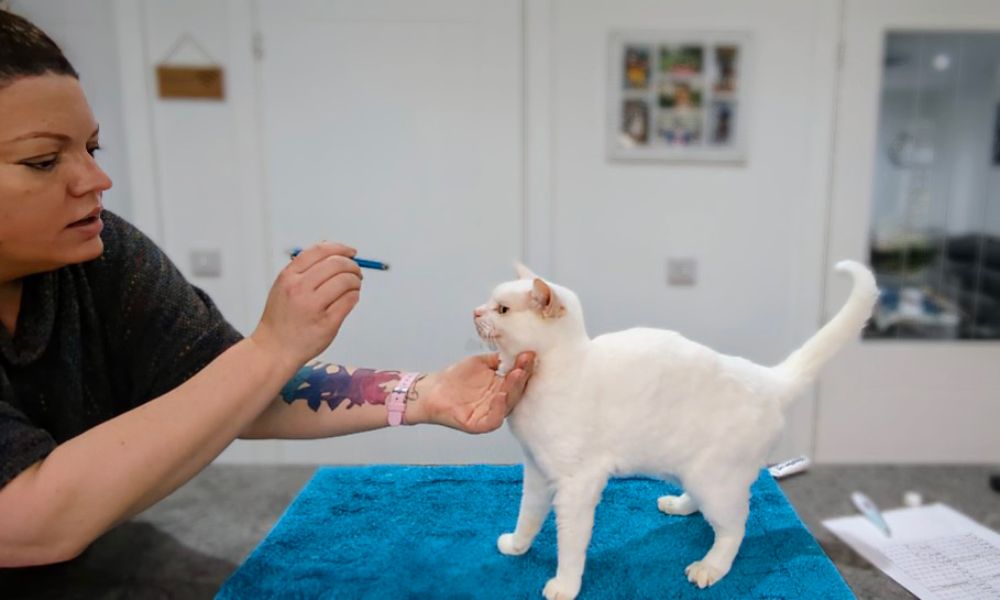
Cats are great at just getting on with their day, and this often results in owners getting the impression that they aren’t in any pain. The fact is that if your cat has any lameness or changes in how they walk (gait), it is a sign of pain or a neurological issue, so being able to check this at home can fast-track your cat to the treatment they need.
Be aware that cats aren’t always the most cooperative to this sort of examination, but do what you can!
Here are some things to look out for:
Gait
Is there any sign of lameness or unusual limb movements? Are they scraping the claws on any feet?
Neck
Carefully move your cat’s head to point up, down, left, and right, making note of any stiffness or pain.
Spine
Slowly run the palm of your hand over your cat’s back, using medium/firm pressure. Look for any flinching or turning of their head, and make notes on the diagram of any areas that seem to trigger a reaction.
Tail
Check for changes in position, pain, or swellings, and be sure to check upper and lower sides.

Limbs
Systematically work your way up from the toes to the shoulder and hip, gently squeezing along the limb, and flexing/extending each joint, watching your cat’s face as you do it. Most cats will growl if the pain is bad enough, but others may just turn their heads, tense their body, or hold their breath when you find an area of discomfort.
Make note of any suspect areas on the diagram. You might want to use a scale of 1-3 to rate reactions from mild to severe.
Conscious Proprioception (CP)
This is a quick way to get an idea of any neurological deficits/spinal issues affecting the hind legs. When you position the hind foot with the upper side of the toes facing the ground, the foot should reposition itself immediately. This is a postural reflex action. If there is a delay in the messages between the foot and the spine or the brain, this reflex can be delayed or absent. If there is a delay, try to measure how long it takes for the foot to return to its normal position.
And That’s It!
In less time than it would take to enjoy a cup of coffee, you’ve performed a basic health check on your cat. Perhaps it’s flagged up a problem you weren’t aware of, shown you how they are responding to some medication, or given you peace of mind that your pet is fighting fit.
Please remember this is just one part of monitoring your cat’s health, and is not a replacement for a check-up with your vet, but it may help to pinpoint a problem and help your vet decide what next steps are needed.
Happy health checking!
Don't forget: Click here to download and print our health checklist!

This article is a part of Dr. Karyn's series with her five hilarious cats.
Expert cat care, straight to your inbox
News, insights, and useful advice, delivered to you.

No spam — unsubscribe anytime.
By signing up, you agree to our Terms & Conditions and Privacy & Cookies Policy.
How useful was this post?
Click a star to rate. You can leave written feedback afterwards. (We read all feedback.)
Dr. Karyn Kanowski BVSc MRCVS (Veterinarian)
Dr. Karyn comes from Queensland, Australia, and has lived in the UK for the past 10 years. In 2010, she graduated from The University of Queensland School of Veterinary Science and also has a Bachelor’s degree in Zoology. She is passionate about using evidence, experience, and owner collaboration to provide the best solutions for pets, and believes in making reliable information about animal health accessible to all. Dr. Karyn shares her home with five cats, four dogs, and one husband. When she is not in the scrubs, she spends her time writing, gardening, and cleaning up pet hair!