How to Make a Vet Visit Less Stressful For Your Cat: 10 Tips From Dr. Lauren

Hi, I’m Dr. Lauren! Read my introduction to learn more about me and my two adventurous cats, Pancake and Tiller.
Dr. Lauren here! When's the last time your cat went into the vet?
The thought of a howling cat (“singing the song of their people”) is never pleasant. Believe me, I’ve been the person in the car with a Pancake howling so loud, that the people in the car next to me looked at me as if to say, “Are you ok? Do we need to call the police?” And once Pancake starts howling, Tiller picks up the refrain.
But do cats truly hide illness and/or injury? Yes, we vets spout this convention often, but only because it is true. Retinal lesions indicative of high blood pressure, palpable thyroid nodules in the neck, early dental cavities…all of these are things so easy to find in person, but impossible to find when our cats stay at home.
So, back to the visit. It’s tough. But it’s a necessary evil. That said, cats don’t understand that. Imagine if you were asked to visit your gynecologist, dentist, cardiologist, internist, GP, and urologist…all in one day. You’d probably have a guttural NO (or two) to utter, as well. Now imagine you were shoved in a box prior to leaving your house, jostled around, and had no say whatsoever in the matter. Not a pretty picture, right?
Believe me when I say: there are things we can do to make this better for cats.
A lot has been written and studied in the last decade or two about decreasing stress for pets, in particular cats, for vet visits: this can include very random to very useful items (think music composed specifically for cats!). But the purpose of this essay is to give you practical, easy things that anyone can do to help lessen the stress of vet visits for your cat.
Some are so simple, you might be surprised that you’re not already doing them.

First, Identify Your Cat’s Personality Type
Before doing anything, you need to decide what your cat’s personality type is around new situations: are they a Nervous Nellie? Or a Happy Harry?

Nervous Nellie
New things are scary! These cats hide, or hiss—not because they are mean, but because they are scared:
Don’t like change
Don’t like new people
Happy Harry (aka Dog-Cats)
The more stimulation and new things to look at, the better! These cats engage with the surroundings.
New person? Come, let me flirt with you!
Feed me and I’m your friend for life!
Obviously, these are generalizations, but they help develop a sense of what your cat wants.
A Nervous Nellie that wants to hide will probably like their cage covered with a blanket, things in the cage that smell or look familiar, and things to hide under. They probably don’t want bribes in the form of treats.
A Happy Harry probably would love to take a nap, on the other hand. And they likely don’t want to be fully covered, they want everyone to see their magnificent feline splendor!
Accommodate Your Cat’s Personality

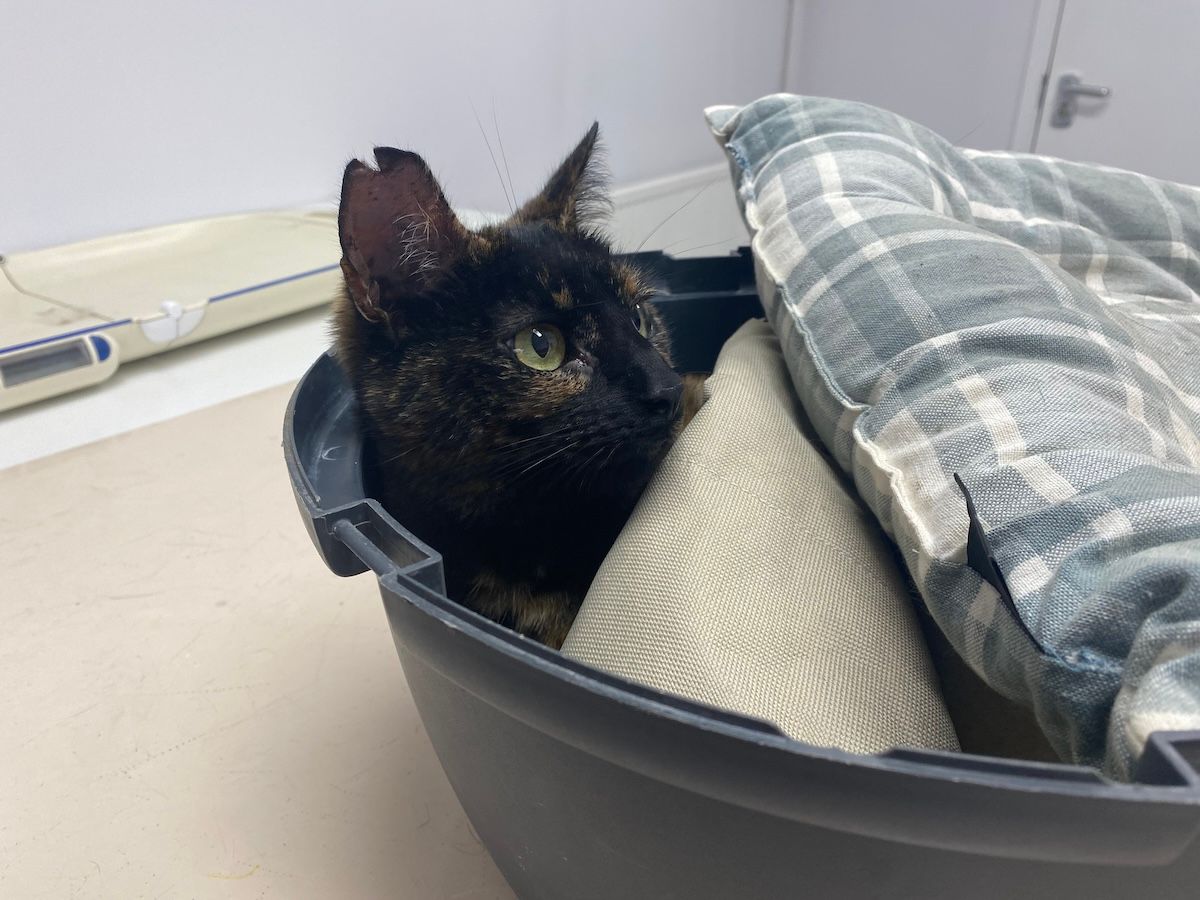
One of my recent patients, Freddie, is a great example. I met Freedie and her mom when they wanted a second opinion on how best to help her damaged ear. Freddie came in this week for her annual wellness, and while Freddie is happy to have attention, she likes having space to hide, feel safe, and decide how things happen on her terms. So, her mom piled blankets and cushions into the carrier, giving her great hiding opportunities, and had a nice big carrier that easily came apart, making things easy-breezy for Miss Freddie.
I don’t know that there is such a thing as a stress-free vet visit per se, but less stressful is a great goal.
The 10 Tips to Help Reduce A Cat's Stress at the Vet's
Tips for Everyone:
1. Find a good carrier.
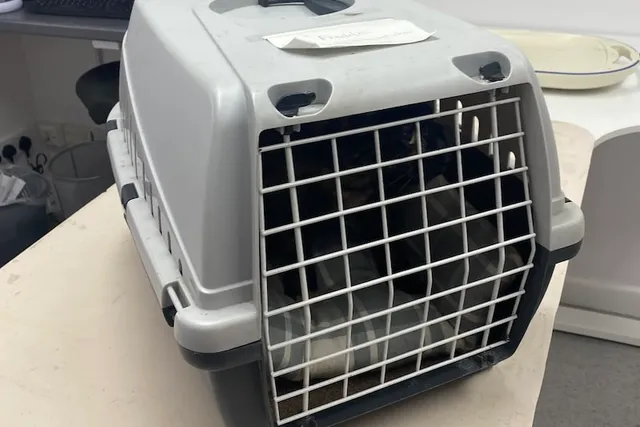
Something that easily fits your cat, that has at least two entrances/exits, that can be easily opened. Broken latches, or a single entrance, are difficult for most cats, and exacerbate the stress. Too, make sure it’s clean before you put your cat into it- would you prefer to travel in a dirty car, or one that is clean?

2. Let your cat get used to the carrier.
At home, leave the carrier out so it’s more a familiar place, than a strange item. Offer treats in the carrier.
3. Speaking of treats, bring them.
A familiar scent can go a long way to normalizing the experience.
4. If your cat won’t eat treats, try the magic that is Lick-E-Lix or Churus…
Most cats that won’t touch treats, will still devour this yogurt-consistency tube of cat deliciousness. I’ve watched people draw blood on cats without assistance, purely because they distracted the cat with a Lick-E-Lix or Churu.
5. Be calm yourself.
Cats pick up on our stress! Studies suggest that cats can recognize the facial expressions of at least a few emotions in humans.
6. Calming cat music.
Believe it or not, cats might appreciate music. Youtube has channels specifically for this, so consider it as an option.

Next Level Tips: Stepping Up The Calm
As I mentioned earlier, there are other options that are more recently coming into play. They might not be an option for every cat owner, but if they are available to you, and you can make use of them, I highly recommend it.
7. Pheromone sprays
Test them ahead of a vet visit, but a number of pheromone diffusers and sprays are now available to help decrease stress in cats.
8. Visit good clinics.
Some clinics have gone the extra mile to make cat friendly more than just a thought. There are various options, such as Cat Friendly Practices by the American Association of Feline Practitioners or Cat Friendly Clinics overseas, but regardless, these clinics have gone the extra mile to prove they want to make a cat’s visit comfortable.
9. Step it up even further: cat-only clinics and cat specialists actually exist.
Many cat specialists see both routine wellness and referral cases, and cat-only clinics remove all noise, scents, and the confusion that dogs can create for cats; having worked in cat only clinics for the second half of my career, I cannot recommend enough the benefits of a cat only clinic. Ask to visit your local one, if you can. The difference will leave you (and your cat) making biscuits.
10. Talk to your cat’s vet about sedation options!
There are newer options we have started using in cats in the last 5 years or so that make a huge difference for very anxious or stressed patients!
So, next time you set paw in the clinic, come prepared with these options, and see that bringing your cat into the clinic can not only be less stressful, but also potentially a positive experience. Both for their health, and your peace of mind. Know, too, that many of these can be applied to other stressful situations cats might experience: fireworks, visiting guests, and new pets.
This article is a part of Dr. Lauren, Pancake, and Tiller's series.
Expert cat care, straight to your inbox
News, insights, and useful advice, delivered to you.

No spam — unsubscribe anytime.
By signing up, you agree to our Terms & Conditions and Privacy & Cookies Policy.
How useful was this post?
Click a star to rate. You can leave written feedback afterwards. (We read all feedback.)
Dr. Lauren Demos DVM (Veterinarian)
As a veterinarian, Lauren is eager to share her experience in emergency medicine and cats, with our readers. She loves sharing helpful, real life tips for having cats as part of your life, and what to do in critical situations with your pets.
Lauren is a vet with over a ten years of experience in cats and dogs, along with infectious diseases. She enjoys teaching, and lectures for students, pet owners, and clinicians, on various topics.
Lauren received her degrees from Murdoch University, in Perth.