Can I Wash My Cat with Dr. Bronner’s? Vet-Verified Facts & Considerations


In this article
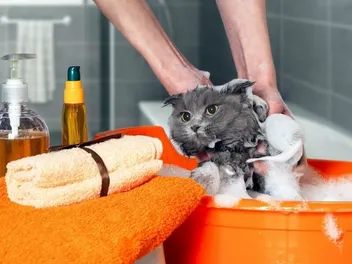
As all kitty owners know, cats and water typically don’t go together. However, what if your feline friend needs an emergency bath, and you don’t have any pet shampoo handy? In that case, using an unscented castile soap like Dr. Bronner’s is usually okay, as long as it is the Unscented Pure-Castile Liquid Soap, though we do not recommend it as your first choice for your cat.
In this article, we’ll discuss how to safely use Dr. Bronner’s to wash your cat, if necessary, and why we recommend that you should stick to pet shampoos instead. We’ll also let you know how often you should be bathing your cat in the first place.

Using Dr. Bronner’s to Wash Your Cat
Dr. Bronner’s is a well-known brand of organic, non-toxic cleaning products. Their castile soaps and shampoos are made of plant-based materials with no synthetic ingredients. It is very important to note that only the unscented variety of Dr. Bronner’s soaps can be used safely to wash your cat. We recommend you stick to the Unscented Baby Pure-Castile Soaps because although Dr. Bronner’s soaps come in many nice fragrances, several essential oils are used to provide fragrances to the shampoos, and although there is only a very low percentage of essential oils in the soap, you do not want to take unnecessary risks because essential oils are toxic to cats. Please be aware that even if you ensure your cat does not ingest the soap, it is well documented that the essential oil inhalation or direct contact with the skin can have detrimental effects on your cat’s health.
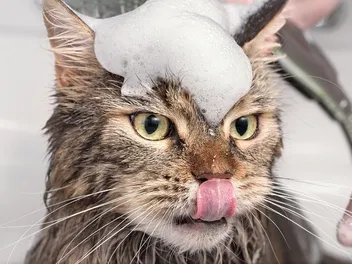
Like with any other shampoo, even if you use only the unscented version of Dr. Bonners Pure-Castile Soap, please don’t let your cat lick the soap off their body, and be sure to rinse it thoroughly. Be especially careful not to get the soap in your cat’s eyes while washing since Dr. Bronner’s is not a tear-free formula.
Dr. Bronner’s line of unscented Baby Pure-Castile Soaps can be found as a solid bar or as a liquid soap. Please ensure you dilute them with water. Avoid applying them directly to your cat’s coat, these are very concentrated products. You can find a reference to Lisa Bronner’s Dilutions Cheat Sheet here.
Why Dr. Bronner’s Shouldn’t Be Your Cat Shampoo of Choice
Dr. Bronner’s is a safe alternative to wash your cat in a pinch, but you shouldn’t use it for routine bathing. In fact, you shouldn’t be bathing your cat too frequently at all (unless it is a hairless breed), and especially not using any human products regularly. Cat skin and human skin are not the same regarding their pH, oil glands, and other components.
Shampoos designed for humans can strip the oils from your cat’s skin and hair when used frequently, drying them out. It can lead to irritation and skin issues. If due to their breed or for medical reasons your cat needs regular bathing, choose a shampoo formulated for pets or a medicated option prescribed by your veterinarian.
There are lots of pet shampoos to choose from, but some are much better than others. We love these two options created by Hepper, each offering something uniquely different. The Colloidal Oatmeal Pet Shampoo is an excellent choice for cats who require the occasional full bath, and the Waterless No-Rinse Dry Shampoo is perfect for felines that prefer to stay dry! Both are made with all-natural ingredients and pH-balanced formulas designed to gently lift away dirt and debris, leaving your cat's coat and skin soft and hydrated. Find out which is right for you in the table below.
| Image | Product | Details | |
|---|---|---|---|

|
Hepper Colloidal Oatmeal Pet Shampoo |
|
Check Price |

|
Hepper Waterless No Rinse Pet Shampoo |
|
Check Price |
At Catster, we’ve admired Hepper for many years and decided to take a controlling ownership interest so that we could benefit from the outstanding designs of this cool cat company!
How Often Should You Bathe Your Cat?
Fortunately, most cats don’t typically need baths as often as dogs, who delight in playing in the mud and rolling in poop. Cats are dedicated to keeping themselves clean by daily grooming and rarely need help from their human owners. Bathing your cat when they don’t need it may do more harm than good.
Some healthy cats may never need a bath. Regular brushing or a quick once over with a pet wipe is generally enough to complement their own natural hygienic habits. Cats who are overweight, elderly, or have mobility issues will most likely need help staying clean and free of mats.
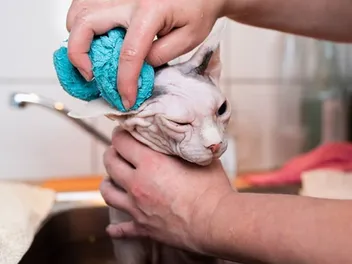
In addition, Sphynx and other hairless cats need to receive more frequent baths to keep their skin healthy. Sometimes, your cat will need to be bathed due to a medical condition. In those cases, you’ll need a medicated shampoo from your veterinarian to bathe your cat on a specific schedule depending on the treatment goal and your cat’s coat.
Please be aware that if you notice that your cat’s grooming habits change and they’re not keeping themselves clean, it could be a sign of a health problem. Therefore we recommend that you make an appointment with your veterinarian to investigate the situation further.


Conclusion
Generally, cats keep themselves clean enough to not need a bath from you, at least not a frequent one. But, if they get into something and you have an emergency, using Dr. Bronner’s unscented liquid soap is okay if you dilute it well and rinse it thoroughly. Like with any other product, please keep it out of your cat’s eyes.
Please ensure you do not use any of the scented products as they contain essential oils and those are toxic to cats.
Sources
Featured Image Credit: Pixel-Shot, Shutterstock
Expert cat care, straight to your inbox
News, insights, and useful advice, delivered to you.

No spam — unsubscribe anytime.
By signing up, you agree to our Terms & Conditions and Privacy & Cookies Policy.
How useful was this post?
Click a star to rate. You can leave written feedback afterwards. (We read all feedback.)
Elizabeth Gray is a lifelong lover of all creatures great and small. She got her first cat at 5 years old and at 14, she started working for her local veterinarian. Elizabeth spent more than 20 years working as a veterinary nurse before stepping away to become a stay-at-home mom to her daughter. Now, she is excited to share her hard-earned knowledge (literally--she has scars) with our readers. Elizabeth lives in Iowa with her family, including her two fur kids, Linnard, a husky mix and Algernon, the worldʻs most patient cat. When not writing, she enjoys reading, watching all sports, and spending time outdoors with her family.