Get

In Your Inbox

Catster is reader-supported. When you buy via links on our site, we may earn an affiliate commission at no cost to you. Learn more.

Do Neutered Cats Still Mate? Vet-Approved Facts

Share

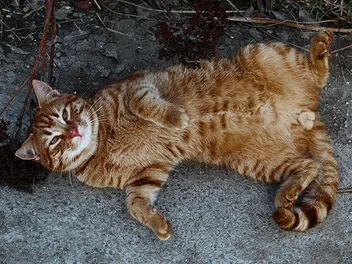
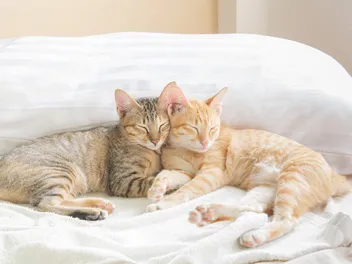
Close-Up Photography of Tabby Cats Laying

Neutering a cat involves surgically removing a cat’s reproductive organs to prevent them from reproducing. It is done by a veterinarian by the time most cats are around 4 months of age or sexually mature.

Owners may choose to get their cats neutered for various reasons, but usually to avoid unwanted pregnancies, decrease the risk of certain cancers, and to reduce hormonal behaviors. However, it can leave you wondering whether they can still mate or even have the urge to.

Although neutering can reduce a male cat’s urge to mate, they can still technically mate with female cats without resulting in pregnancy.

divider cats oct 2024

What Is Neutering in Cats?

Neutering refers to the castration of male cats when their testes are surgically removed. The term “neutering” is generally used for male cats, whereas “spaying” is used for female cats. If you do not want to be specific about the terms, it is simply called sterilization. In scientific terms, neutering is an orchidectomy.

Feline neutering is considered a routine procedure done by veterinarians around the world. Many disruptive behaviors in male cats are fueled by high testosterone levels. This includes increased roaming behavior, urine spraying, and persistent yowling. Unneutered male cats can get unspayed female cats pregnant, so sterilization is a common method used to prevent it. The neutering process doesn’t take very long, and cats can go back to their old routine after a few days of recovery.

You are free to use this image but we do require you to link back to Catster.com for credit

Can Cats Still Mate After Being Neutered?

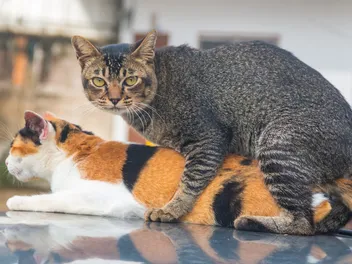
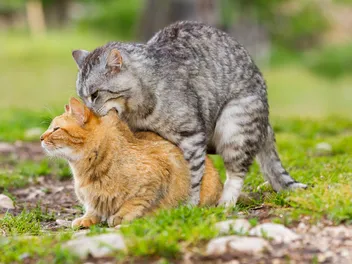
Yes, male cats can technically mate with female cats after they have been neutered. Neutering only removes a male cat’s testes and not their penis which is needed for penetration. Their testicles contain sperm and their primary source of testosterone which is responsible for sexual behavior and reproductive organ development. Without testes and sperm, neutered cats can no longer get female cats pregnant. However, he may still try to mate with her.

Do Neutered Cats Want to Mate?

Many neutered cats will still have the urge to mate after their procedure, as the testosterone hasn’t completely left their bodies yet. It can take several weeks before you notice a difference in your neutered cats’ sexual behaviors. Once they are no longer driven by testosterone, their urge to mate usually decreases.

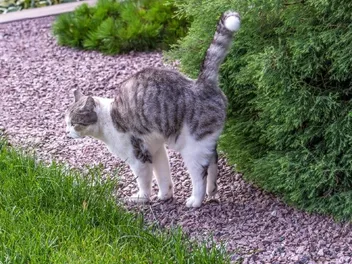
Your neutered male cat may spend less time urine spraying or desperately attempting to escape in search of a female cat. Many cat owners see this as a win, as a hormonal male cat can be destructive in the home, neighborhood, and to other cats.

yowling adult cat at the park
Image By: shymar27, Shutterstock

Do Spayed Female Cats Still Have the Urge to Mate?

Since female cats lack testes, their reproductive organs like ovaries and uterus are removed instead. This eliminates the risk of unwanted litter since a spayed cat can no longer become pregnant. This is true even if she mates with an unneutered male cat. Spaying does not prevent a female cat from being able to physically mate with a male but typically reduces the urge to.

The urge for unspayed female cats to mate isn’t as disruptive as it is in males aside from when they are in heat (estrus cycle). Female cats go into estrus once or twice a month and willingly seek out male cats to mate with. Once a female cat is spayed, she no longer goes into heat and doesn’t have a strong desire to mate anymore. In rare cases, leftover ovarian tissue can cause something known as Ovarian Remnant Syndrome, where a spayed cat continues to act as if she is in heat.

If you are concerned or have questions about your cat’s health, you can also speak to a vet from the comfort of your own home.

divider 1 paws

Final Thoughts

Both neutered and spayed cats can still technically mate, but the hormonal urges to do so will be reduced. This is because their reproductive organs have been removed. A neutered cat will not be able to get a female cat pregnant and usually experiences fewer urges to mate in the first place.


Featured Image Credit: Ninz Embalsado, Pexels.com

Want content like this delivered to you?

Sign Up For Our Newsletter

News, insights, expert advice, and everything cat

* By submitting, you agree to our Terms & Conditions and Privacy & Cookies Policy.


How useful was this post?

Click on a star to rate (you can leave written feedback after clicking submit)

Help us improve Catster for pet parents!

Your feedback really matters.

What did you like about this post? Also how can we improve it?

Join the conversation

5 Responses

  1. eliminate as in get some kind of cage and trap them I've got to eliminate them for my property the only thing I know is that get a hold of animal control somehow and get a cage or get them to travel help me I don't sure I can't do it by myself that mean

  2. my female cat was spayed in July of 2025 & there are 3-6 male cats hanging around my carport spraying & fighting with my neutered male. I can't even let my male outside cause the stray males here for my spayed female will viciously attack my male. I have had enuff! I don't know wut to do but I know wut I am about to do & that is eliminate these mean mean stray males.

    1. We hear how incredibly stressed and pushed to the limit you are; it is exhausting to feel like a prisoner in your own home and watch your neutered male be targeted by aggressive strays. While it feels like they are there for your spayed female, these intact males are likely fighting over the territory of your carport and food source, creating a high-tension "war zone" that is dangerous for your pets. We strongly urge you to reconsider "eliminating" them yourself, as harming animals can carry serious legal consequences and won't actually solve the problem—due to the "vacuum effect," new unneutered males will likely just move in to take their place. The most effective way to stop the spraying and fighting for good is to remove the biological drive by contacting a local TNR (Trap-Neuter-Return) group to have these specific males trapped and neutered, which drops their testosterone and ends the territorial aggression.

Leave a Reply

You’re very welcome to leave a comment or question. Please know that all comments must meet our community guidelines, and your email address will NOT be published. Let’s have a positive and constructive conversation.


Catster's Digital Magazine is Back!

Vet-approved health & behavior advice

Real cat stories & community features

Weird Cat Behaviors That Actually Make Perfect Sense

We have been sharing our lives with cats for thousands of years, yet we still find ourselves genuinely stumped by what they get...

The Dream of Talking to Cats Just Got Closer to Becoming a Reality

If you’ve ever wished your cat could simply tell you what they wanted, you’re not alone. From the meow that wakes you before...

Kizzy: The Feline Princess With a Purpose

We were first introduced to Miss Kizzy after she won a licky-treat challenge hosted by Professor Fluffovich, our resident feline research specialist. While...

Chatting With Sally About Mission Meow & Helping Cat Rescue Organizations Collaborate | Chatty Cattys, Episode 24

In this episode of Catster’s podcast, Chatty Cattys, Nicole and Dr. Karyn sit down with Sally Williams, the founder of Mission Meow, for...

More related

Could My Cat’s Swollen Face Be Cancer? Tumors, Cysts, & Lumps Explained (Vet Answer)

It can be pretty scary if your cat develops facial swelling, regardless of whether it is sudden. The first thing that comes to...

32 Cat Dad Jokes for the Funny Feline Father in Your Life

Dad jokes may not earn much appreciation from the audience, but few things give dads more pleasure than busting out a cleverly awful...

Do Cats Have Bones in Their Tails? Feline Anatomy Explained (Vet Verified)

A cat’s tail is a fascinating and finely tuned structure adapted for survival in the wild, and yes, it has bones. These are...

Can Cats Drink Coconut Water? Vet-Verified Nutrition Facts & FAQ

Coconut water is the clear liquid that is found inside young coconuts. It is packed with electrolytes and is known to offer benefits...

Keep reading

Are Tuxedo Cats Smarter Than Other Cats? Vet-Verified Facts & Info

Tuxedo cats are instantly recognizable by their distinctive black and white markings and have long been the subject of fascination among feline enthusiasts. The term doesn’t refer to a specific breed, but rather describes a color pattern found in a...

tuxedo cat resting on log

Maine Coon Cat Grooming – 6 Tips & Tricks

Maine Coons have arguably one of the most beautiful coats in the feline world. Their dense fur makes the lion-like cats appear more regal, but how do maintain it to keep it healthy and shiny? If you regularly groom a...

maine coon grooming

Is It Ok to Have Just One Cat? Vet-Verified Facts & Care Tips

Cats, although seemingly aloof, are social creatures that need to be around other cats or animals to live happy lives. Most cats love being around their humans and the attention they get, but there’s one question many cat owners have...

a woman holding a cat on her lap

Why Is My Cat Stalking Me? Vet-Approved Behavior Explanation

Cats stalk their prey, stalk their toys, and sometimes even stalk their food. However, what concerns many cat owners is when their cats decide to stalk them. You’re probably familiar with the behavior of a cat stalking and pouncing. They...

woman sitting beside her cat

Can Cats Get Strep Throat? Vet-Reviewed Signs, Treatment & Prevention

Cats, like all living things, are vulnerable to various diseases, including bacterial infections. But can cats get strep throat? Cats can contract different strains of Streptococcus, most commonly S. canis. However, in extremely rare cases, they can contract the strain...

Yawning, choking, coughing Cat close up

Are Lilacs Poisonous to Cats? Vet-Verified Facts & Info

If you love the look and smell of lilacs and tend to pick a few when out walking, you may be wondering if lilacs are poisonous to cats. You don’t have anything to worry about because the common lilac plant...

Catster_Are Lilacs Poisonous to Cats

Do Kittens Sleep a Lot? Vet-Reviewed Facts & FAQ

There’s nothing quite like the angelic and innocent sight of a sleeping kitten. Kittens of all breeds spend their days learning, growing, playing, eating, and snoozing, and they’ll spend the rest of their lives doing these same activities even as...

kittens sleeping

Why Does My Cat Eat My Hair? 9 Reasons for This Behavior & Vet-Approved Tips

If you find yourself asking “Why does my cat eat my hair?”, you’re not alone. Out of all the odd cat behaviors, your feline chewing on your hair is probably one of the strangest. Your hair is not a very...

cat sitting behind the man licking his head

Love Cats? So Do We! Join the Catster Community

Stay informed with expert pet care insights delivered straight to your inbox! Discover professional guidance on animal behavior, feeding tips, trusted product picks, and much more.


Sign up for the Catster Email Newsletter

Stay informed with expert pet care insights delivered straight to your inbox! Discover professional guidance on animal behavior, feeding tips, trusted product picks, and much more.