Can I Give My Cat Aspirin for Arthritis? Vet Reviewed Risks & Advice


In this article
Do not give your cat aspirin for arthritis without very clear and specific directions from your veterinarian. Aspirin can be deadly in cats. And the thing is, there are so many other medications specifically designed for cats that not only are less harmful but work better.
But before we get into that, this article will get into why I don’t recommend giving human drugs from your cabinets to cats, in general.

Human Drugs and Cats
The dose of a medication determines not only how effective it will be but how toxic it is. Too much medication—of any medication—can be devastating, even deadly. Conversely, too little of the medication can mean it doesn’t have any of the beneficial effects but can still have negative side effects.
Veterinarians spend a lot of time calculating the exact amount of drug your cat needs to be effective and, importantly, safe. Weight is one of the most important factors in determining how much medication to give. A small cat needs less medication than a big cat.
And cats are much smaller than humans! So, most of the time, human drugs are too potent and too much for our cats. Even if you manage to divide up a tablet into a tenth of its size, the amount of error in that estimation is too great.
It is very hard to guarantee you're not giving too much human medication to your cat.

The Amount of Medication Is Not Determined by the Size of a Pill
Furthermore, it is confusing because the size of a pill does not correlate with the amount of medication within it.
Medication is made in various concentrations. A can of orange juice concentrate has just as much orange in it as a pitcher but is much smaller. Concentrated small pills can have more medication than dilute large pills, making it very easy to give too much medication by accident.
How the Drug Is Made Determines Its Potency
Human medications, aspirin included, are formulated for human bodies to absorb. Cats are not humans. Their digestive tract is different. So they may not absorb the medication in the same way.
For example, the protective barrier that surrounds aspirin can mean that tablets sit in their stomach undigested, gathering on top of each other, until something triggers them to move on, be digested, and enter the system, all at the same toxic time.
How medication is absorbed by the body impacts how toxic it can be. And since human drugs are not designed for cats, they can cause problems.

Aspirin-Specific Dangers
Cats do not excrete aspirin as fast as humans, meaning it stays in their body longer than someone might expect. In fact, it can take two days for it to leave their system. As a result, it is very easy to overdose a cat on aspirin. If it is given too quickly, it can build up in the body to toxic levels internally.
If your vet prescribes aspirin for your cat, follow the dosing regimen very closely. Do not double up if you miss a dose. And carefully monitor your cat for side effects.
Aspirin is a non-steroidal anti-inflammatory drug (NSAID). They relieve pain by interrupting inflammation as it forms. Unfortunately, a side effect of that interrupting is they also interrupt some other functions of the body.
Importantly NSAIDs can interrupt the GI tract and the kidneys from working normally if they are too strong. So, if too much aspirin is in your cat’s system at the same time, it can injure the kidneys and the GI tract.
The safety margin of aspirin in cats is small and, therefore, dangerous.
Frequently Asked Questions (FAQs)
What is aspirin toxicity?
If your cat accidentally eats aspirin, they can have what is called aspirin toxicity. Several body systems can be affected, mainly the gastrointestinal tract, the liver, and/or the kidneys.
Bring them to a vet right away if you know your cat has ingested aspirin—and the earlier, the better!

How do I know if my cat has aspirin toxicity?
Below are some of the signs to watch out for in case of aspirin toxicity:
- Lethargy and depression
- Breathing too fast
- Seizures
- Coma
- Stomach ulcers
- Liver disease
- Gastrointestinal problems—vomiting, diarrhea
- Kidney disease
Seek veterinary advice if you’re concerned about your pet’s well-being.
Can my cat have aspirin with its other meds?
Other medications can compound the side effects of aspirin.
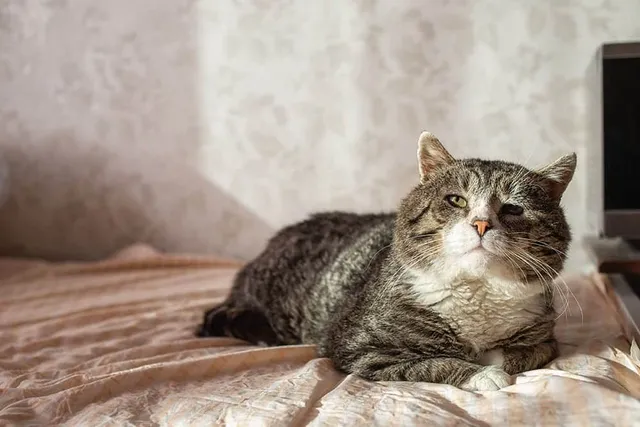
Arthritis is usually an old cat disease. And unfortunately, old cats often have more than one health problem. This can make giving aspirin even more dangerous, as complications from either the disease or other medications used to treat the disease can easily occur with aspirin.
Other medications that are in the same category of pain relief, NSAIDs, all have similar side effects. And if two different types are given, then the side effects are made that much worse. Many cats are on steroids. Steroids reduce inflammation, and are similar but not exactly like aspirin and NSAIDs. As a result, if aspirin and steroids are given together, they can have severe side effects.

Can my cat have aspirin with heart disease?
Many of the common heart medications used in cats can cause toxicities when used with aspirin or become less effective at helping the heart, which is also a very dangerous situation. Some examples of those heart medications are:
- Furosemide
- Spironolactone
- ACE inhibitors
Can my cat have aspirin with kidney disease?
Kidney disease is common in cats. And so, drugs that impact the kidneys need to be used with extra caution, like aspirin. Since one of aspirin’s main side effects is to the kidneys, it can be especially dangerous to cats with kidney disease.
Final Thoughts
Do not give your cat aspirin out of your cabinet. It just is not worth the risk. There is a potentially deadly risk, especially if you give it once a day because they take two days to process it. If you are worried about their painful arthritis, bring them to the vet for better drugs to manage the condition.
Featured Image Credit: Julia Cherk, Shutterstock
Expert cat care, straight to your inbox
News, insights, and useful advice, delivered to you.

No spam — unsubscribe anytime.
By signing up, you agree to our Terms & Conditions and Privacy & Cookies Policy.
How useful was this post?
Click a star to rate. You can leave written feedback afterwards. (We read all feedback.)
Christian started writing for a local newspaper as a teenager, and he's been involved in the publishing industry for most of his adult life. Combining his love of writing with a passion for animals, he is currently the Director of Editorial at Pangolia and the Editor-in-Chief at Catster.
Christian lives in the Philippines with his wife, son, and four rescue cats: Trixie, Chloe, Sparky, and Chopper.