How to Teach Your Cat to High Five: The Step-By-Step Guide


In this article
Looking to teach your cat how to high-five? Wondering exactly how to do it or if your cat is even able to perform such a cool trick? Well, you've come to the right place. The truth is that like dogs, cats can be trained to perform certain tricks or respond to behavioral commands.
And training is simpler than you may think. With a little bit of positive reinforcement and consistency, you can teach your cat to high-five in a matter of weeks. In this article, we're going to teach you how to do a high five as well as what not to do.

Pre-Training Tips
Before you start training your cat, it's important to note that the process of training your cat should be a fun interaction between you and your feline. So, before you start the training process, be sure that you create the right environment and present the training in a way that's enjoyable for the cat.
It's common for cats to be a bit apprehensive in some cases, though this may vary with each cat. But overall, both of you should have fun. So, how do you make it exciting? You do this by using what are referred to as " reinforcers". This is sometimes easier if understood as a "reward" or “pay: that a cat will receive when they perform as expected.
Most Common Reinforcers will usually fall into three categories:
Once your cat is trained to perform a specific command, consider mixing up your reward system so that your cat can learn that performing certain actions will result in something positive.

Establish Your "Markers"
Training markers or sounds that you establish to immediately let your cat know that it has performed a specific behavior correctly. For example, this can include the use of a clicker, hand claps, or simply saying "Yes" in an excited tone and then offering your cat a treat.
Choose the Best Times to Train
Cats can be finicky, so they won't always be as open to training as dogs may be. One of the best things that you can do when training your cat is to choose the appropriate time to perform the training. This is usually when the cat's in a good mood.
So, for example, if your cat hates baths, it's best not to try to initiate a training session right after bath time. Consider training your cat after mealtime or when the cat is playing with toys and in an excited mood.

The 4 Steps to Train Your Cat to High-Five

1. Show Your Hand
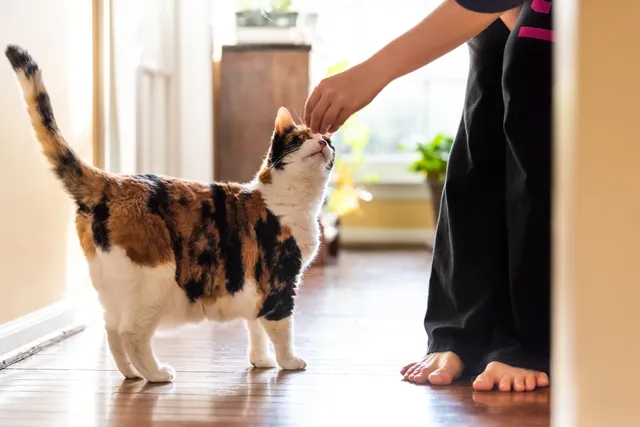
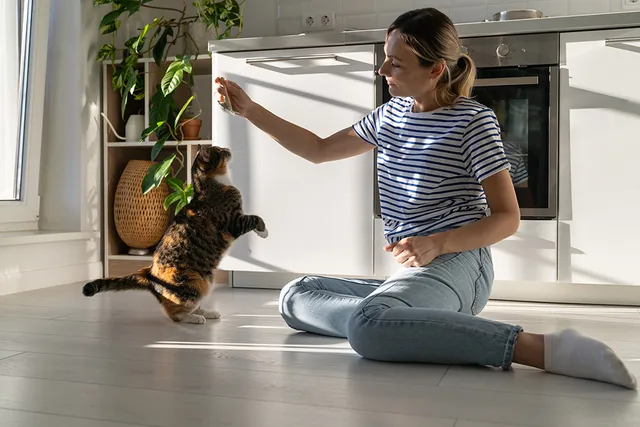
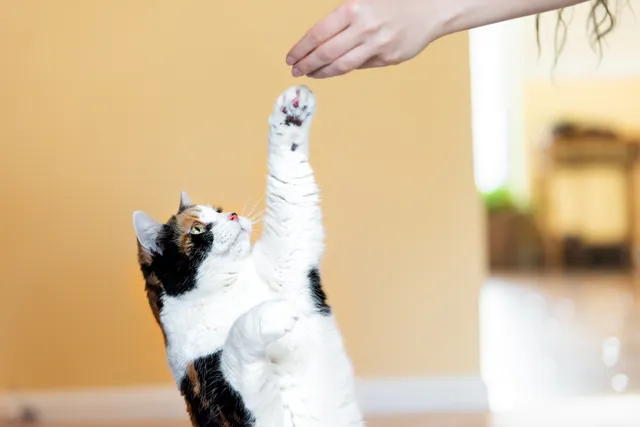
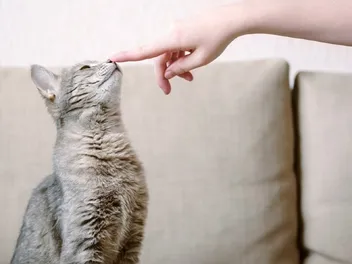
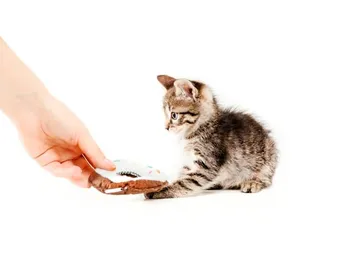
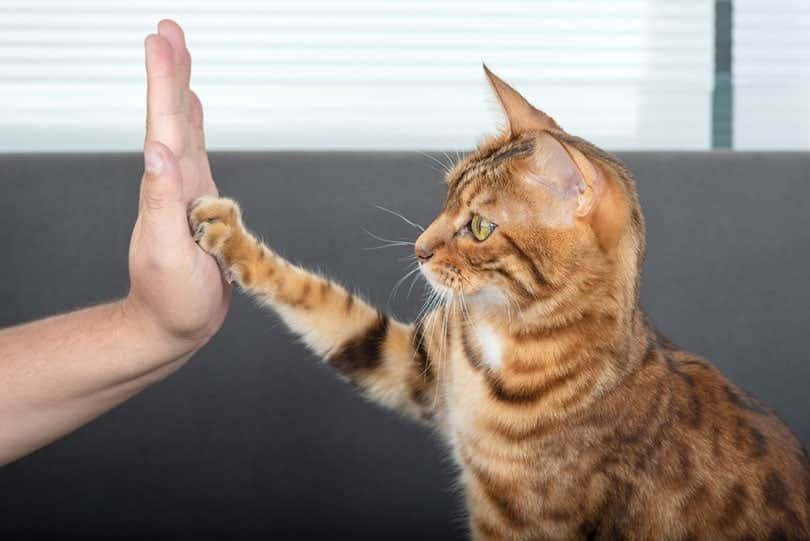
Like humans and dogs, cats use their paws to explore the world. To start things off, touch your cat's paw with your hand, say “yes” and then offer them a treat. After a few repetitions, place your hand “just out of reach”. Your cat will instinctively try to reach your hand, as long as it's not too far.
2. Wait
Stand there for a few seconds with your palm reached out and simply wait for your cat to touch it. Keep in mind that you may need to do this a few times before your cat reacts--but patience is key.
3. Use A Marker
As soon as your cat taps your hand, even slightly, use your marker. This will immediately let your cat know that it's performed a good job. Immediately after, offer your cat a reward, such as a head rub or a treat. Remember, the reinforcers will help your cat associate this activity with "good" things.
4. Move The Hand Up
Once your cat is consistently touching your hand you can start to gradually move your hand slightly up, continuing to move the hand until it is at the desired height. Most chose right above the cat’s head as the final height.
5. Remember That Repetition Is Important, but Quit While You Are Ahead
A huge mistake many novel trainers make is abusing the session. Cats have a short attention span and it is ideal to finish a training session positively before they lose interest. If you have a small progress, reinforce the cat and finish the session. Offer some playtime, some cuddles, or their meal. You can return later that day or tomorrow.
Practices to Avoid When Training Your Cat

Physical Punishment
There is never any reason to physically abuse or punish your cat in any way. Remember that cats never misbehave to spite you, they simply act on instinct and for a specific purpose. Their natural inclination is to simply try to solve a problem in the best way they know how to do it.
So, if you punish your kitten by striking it, rubbing its nose in its messes, putting it on the time out, or yelling, you'll find that you'll just make the cat fear you—and this is never good. Punishing animals is not only counter-productive, but it's completely inhumane.
Not Providing an Enriching Environment
Cats are natural hunters with strong instincts for exploration and discovery. When training your cat, it’s essential to provide plenty of mental stimulation and opportunities to satisfy their curiosity. If your cat seems distracted or unfocused during training, it’s likely because they’re bored or has excess energy that needs to be released. Engaging them in interactive play or activities beforehand can help them channel their energy and focus better during training sessions.
Looking for toys that will cater to the many needs of your cat? The Hepper Hi-lo Cat Scratcher is one of our favorite cat products, and it will encourage your cat to get active. Its clever three-angle design offers multiple ways for your cat to climb, stretch, and exercise. Made of a sturdy plywood base and a replacement cardboard insert, this scratcher is an option that cats can enjoy for years to come. If your cat requires a little encouragement for self-play, the Hepper Catnip Mice Toy Set is a fantastic choice for their instinctual needs. Made with natural, bite-resistant hessian fabric and filled with organic catnip. Cats can satisfy their natural prey instincts while getting the physical activity they need to thrive.
| Image | Product | Details | |
|---|---|---|---|

|
Hepper Hi-Lo Cat Scratcher |
|
Check Price |

|
Hepper Catnip Mice Toy Set |
|
Check Price |
At Catster, we've admired Hepper for many years, and decided to take a controlling ownership interest so that we could benefit from the outstanding designs of this cool cat company!
Avoid Negative Reinforcement
Negative reinforcement is often confused with “punishment” although they are not exactly the same. Negative reinforcement refers to a training approach that relies on the removal of something unpleasant to encourage a desired behavior. However, many techniques often labeled as negative reinforcement, such as forcing a cat into a position or using aversive tools like shock collars, are not only ineffective but can also cause fear and harm to your cat. These methods create stress and damage the bond between you and your pet.
Instead, focus on positive reinforcement by rewarding behaviors you want to encourage with treats, praise, or play. Positive reinforcement builds your cat's confidence, promotes trust, and creates a more enjoyable learning experience for both of you.

Wrapping Things Up
To wrap things up, yes, you can teach your cat to perform high-fives, verbalize, and so many other tricks. The key to success with these behaviors is simply breaking a behavior into small-sized, achievable steps, being consistent, and following up with rewards and reinforcers. Also, keep in mind that every cat is different.
Older cats may not be as inclined or eager to practice as a young kitten or adolescent cat, so just be patient. Remember to practice when your cat is more open to training, and whenever they show interest in interacting, and remember to quit the session while you are ahead!
See Also:
Sources
https://www.dailypaws.com/cats-kittens/cat-training/cat-training
https://felinefoster.org/cat-pawsitive-how-to-train-your-cat-to-high-five/
https://www.petsbest.com/blog/6-steps-to-teach-your-cat-to-high-five/
https://wagwalking.com/cat/training/train-your-cat-to-high-five
https://www.petful.com/behaviors/common-mistakes-new-cat-owners/
Featured Image Credit: Svetlana Rey, Shutterstock
Expert cat care, straight to your inbox
News, insights, and useful advice, delivered to you.

No spam — unsubscribe anytime.
By signing up, you agree to our Terms & Conditions and Privacy & Cookies Policy.
How useful was this post?
Click a star to rate. You can leave written feedback afterwards. (We read all feedback.)
Christian started writing for a local newspaper as a teenager, and he's been involved in the publishing industry for most of his adult life. Combining his love of writing with a passion for animals, he is currently the Director of Editorial at Pangolia and the Editor-in-Chief at Catster.
Christian lives in the Philippines with his wife, son, and four rescue cats: Trixie, Chloe, Sparky, and Chopper.