Chinese Mountain Cat Breed Info: Pictures, Temperament & Traits
Breed Overview
Height:
Weight:
Lifespan:
Colors:
Suitable for:
Temperament:
Cats are amazing creatures. It boggles the mind that your sweet little housecat and a ferocious tiger could be so closely related, and yet they are — and you’re reminded of that fact every time you catch your cat secretly stalking you.
The Chinese Mountain Cat is another species that brings this dichotomy into clear focus. It looks as cute and cuddly as your average housecat, but it’s completely wild — and can be quite ferocious.
Little is known about these cats, so you can be forgiven if you’ve never heard of them. In the guide below, we’ll fill you in on everything that you need to know about them.

About the Chinese Mountain Cat - Before You Welcome One Into Your Family...
Chinese Mountain Cats haven’t been studied for long, as they were first classified in 1892. However, they were only recognized as a valid species in 2017, as before that, they were generally considered a form of wildcat.
Little is known about these cats, as they are notorious for evading documentation. As a matter of fact, the first picture of a Chinese Mountain Cat in the wild wasn’t taken until 2007, and you can count on one hand the number of times that they’ve been filmed.
Despite their natural shyness, there are a few things that we know for sure about these animals. While scientists have had little luck learning about them, we have a fair amount of information from villagers and other people who encounter them with some regularity.

The Chinese Mountain Cat Appearance
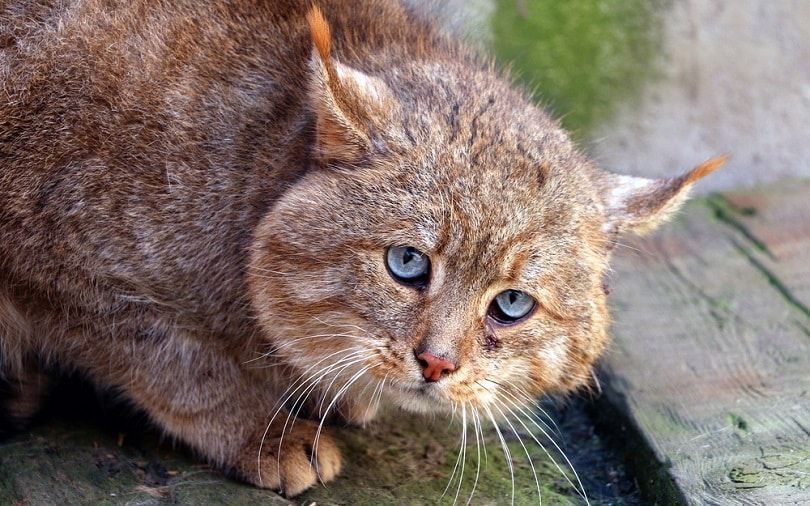
Chinese Mountain Cats are thick and stocky, with broad heads and bushy tails that make up nearly half of their body. They look something like a Bobcat, although they tend to be a bit smaller.
These cats have sandy fur with dark horizontal stripes. They’re usually streaked with white on their bellies, and they have black rings running down their legs and tails.
Their fur is thick with a double coat. This allows them to tolerate the extreme conditions that they often find themselves in, including both cold and heat. They also have to endure extreme winds, and their coats allow them to do this with ease.
They are often called “grass cats” because they so closely resemble the color of dry grass; they can virtually disappear in tall grass, making them formidable hunters indeed. Their fur also gets darker in the summer and grey in the winter, better helping them to blend in with their surroundings.
The fur on their feet can be extremely long, with tufts shooting out from between their pads. They also have tufts on their ears.
What Is Their Natural Habitat?
As you might expect given the name, Chinese Mountain Cats are only found in China. They live on the outskirts of the Tibetan Plateau, but they can thrive in a variety of areas, including grasslands, meadows, and forests.
However, as far as we know, they steer clear of deserts and heavily forested mountains. They’re also unlikely to be found at elevations greater than 5,000 meters.
The cat’s dense fur allows it to tolerate both extreme heat and cold, and these cats are usually found in wide-open spaces. This subjects them to fierce winds and other elements, but they handle it with ease.
They tend to rest in burrows when not actively hunting, and they give birth to their kittens there as well. It’s unknown whether they dig these burrows themselves or take them from animals that they’ve killed.
The Chinese Mountain Cat’s Behavior
These cats tend to be loners and only interact with other cats when they’re breeding or raising kittens. We don’t know how territorial they are, but given the wide area in which they’re found, it’s unlikely that there’s much need to fight over land.
They mate from January through March. Females give birth to 2-4 kittens per litter, and the kittens reach maturity at 7-8 months old. At this point, they leave their mother and achieve independence.
They tend to be nocturnal, hunting at night and spending their days hunkered down in their burrow. They primarily eat rodents, such as mole rats, voles, and pikas, but they’ll also snack on pheasants if the opportunity presents itself.
Chinese Mountain Cats hunt by listening for the rodent’s movements underground, then digging them out when they’ve located them. However, they can also stalk and pounce on their prey when the moment calls for it.

The Chinese Mountain Cat’s Current Status
Part of the reason that these animals are so difficult to track down and learn about is the fact that they’re currently considered “vulnerable,” which means their total population has fewer than 10,000 mature individuals.
There are many reasons for the breed’s decline, but the biggest is likely a push to eliminate the pika population. These small mammals are considered pests, as they can devastate crops, so farmers have tried to control or eradicate them, and they do this by poisoning them. Not only does this reduce the Chinese Mountain Cat’s food supply, but it also puts them at risk of being poisoned themselves if they eat a tainted pika.
These cats are also often hunted for their fur, as they are used to make hats, clothes, and other items by local villagers. It’s currently illegal to trade Chinese Mountain Cat fur, but their pelts are still popular on the black market.
The Chinese government has granted them protected status, which hopefully will lead to a rise in their population. However, many conservation groups say that they need more stringent protections, as the existing regulations do little to stop locals from killing them.
Final Thoughts
The Chinese Mountain Cat is an elusive beast to be sure, and little is known about them, despite the vast tracts of land that they call home.
What’s worse, we may never get the opportunity to truly explore what these beautiful animals have to offer, as they’re currently considered vulnerable to extinction due to the poisoning of one of their staple foods.
Hopefully, the existing protections that they’ve been granted will be sufficient to see their numbers return to their former glory, giving scientists a chance to study them more. If not, it will be yet another magnificent species lost in the shuffle.
Featured Image by: ylq, Shutterstock
Expert cat care, straight to your inbox
News, insights, and useful advice, delivered to you.

No spam — unsubscribe anytime.
By signing up, you agree to our Terms & Conditions and Privacy & Cookies Policy.
How useful was this post?
Click a star to rate. You can leave written feedback afterwards. (We read all feedback.)

Christian started writing for a local newspaper as a teenager, and he's been involved in the publishing industry for most of his adult life. Combining his love of writing with a passion for animals, he is currently the Director of Editorial at Pangolia and the Editor-in-Chief at Catster.
Christian lives in the Philippines with his wife, son, and four rescue cats: Trixie, Chloe, Sparky, and Chopper.