


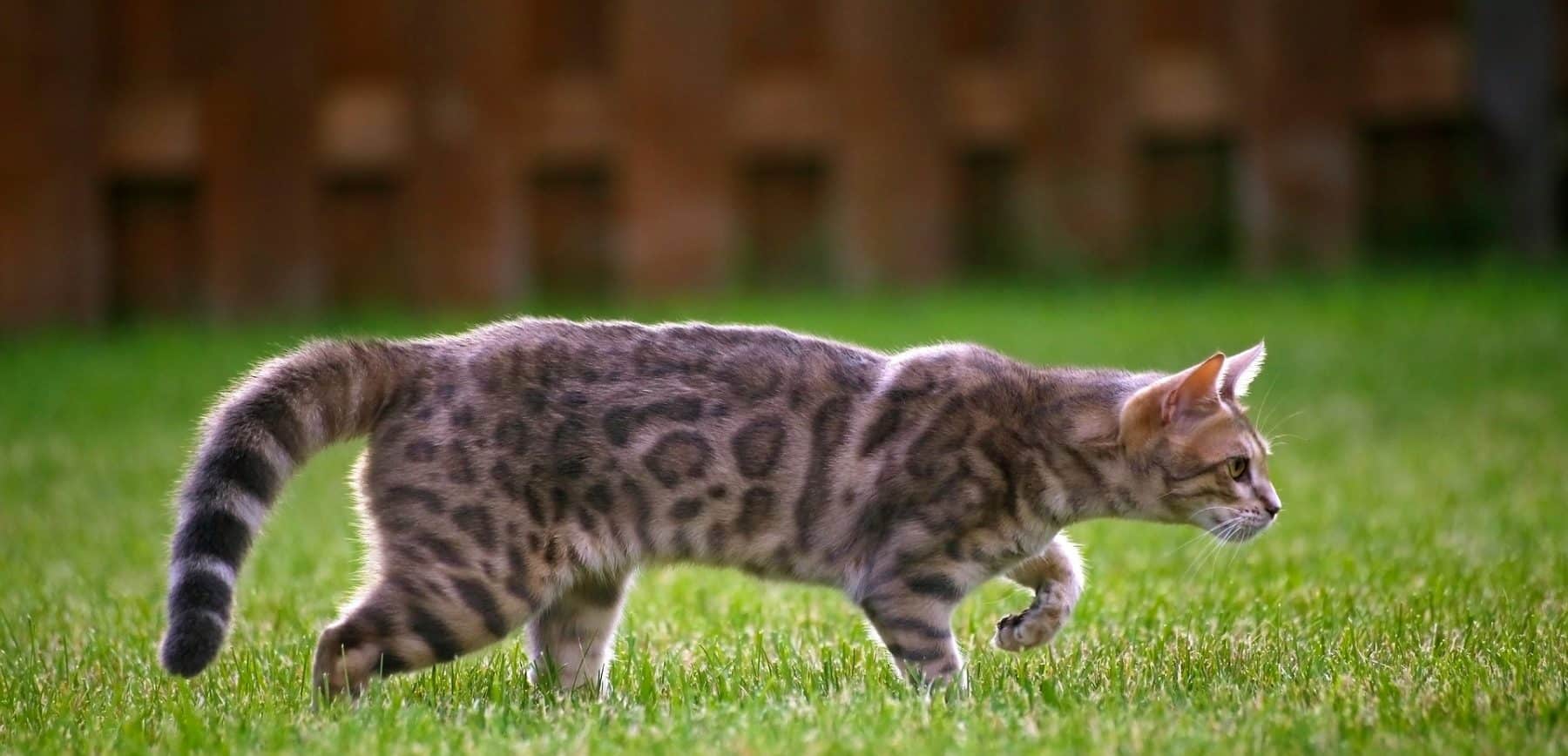
Bengal cats are trendy right now for being “the closest you can get to having a leopard in your house.” It’s hard to forget their striking spotted coats and lithe, flexible bodies once you’ve seen them for the first time. These cats are close to their wild home, with many specimens being within 10 generations of wild cats. With such a decorated background, it’s hard to avoid wondering if they can be dangerous if not cared for properly. As a general answer, no, Bengal cats are not inherently aggressive. Let’s dive into the details.

Are Bengal Cats Aggressive?
Aggression between cats and humans isn’t documented in Bengals. However, cat and other animal aggression has been noted in 16.6% of Bengals, according to a survey done comprising Bengal owners. While 16.6% may not seem like a high number, it may be too high of a number for some pet parents to risk.
Inter-animal aggression in cats is not uncommon, especially among cats who were rescued. The ASPCA reports that around 27% of cats surrendered to shelters are surrendered because they’re aggressive to either people or other animals.
Reputable Bengal breeders carefully select for confident, friendly cats, and kittens are usually well-socialized before adoption. However, there are no official breeding regulations that enforce temperament standards, so the quality of a Bengal’s behavior depends largely on the breeder’s practices and early-life socialization. Compared to unsocialized or feral cats, Bengals from responsible breeders are generally more comfortable around people, not because of genetic oversight, but due to selective breeding and positive early experiences.
Are Bengal Cats Dangerous?
Bengal cats are not inherently dangerous. They are considered fully domesticated, and any cat that has been removed from wild generations for at least five generations is not regulated by any state.
However, Bengals are a large breed of cat that comes with all the built-in weapons that cats have available to them. Poor training could result in a cat that is large and out of control; in theory, they could become dangerous if not cared for properly, but there’s no harm in owning them. The danger comes more from their physical size and specifications than any underlying predisposition.
What to Do if My Bengal Is Acting Aggressively
Dealing with aggression in cats starts by taking a look at what your cat’s problem is. When you identify what kind of aggression your cat is displaying, you can solve the problem at the root and stop your cat from being aggressive in the future.
There are several distinct forms of feline aggression, most commonly fear-based, territorial, and play-related, though others can occur depending on the cat’s environment and health. Most of the time, what we view as “aggression” between cats is simple play for them, and they don’t understand why we’re stopping them from having fun. Let’s dive into a few of these.
Fear Aggression
Fear aggression may happen when a cat feels threatened or trapped and chooses to fight rather than flee. Cats may act aggressively towards anything they find threatening, hoping that they can scare the aggressor off and make their escape.
Cats who are aggressive because they’re afraid may flatten their ears against their heads, crouch low to the ground with the tail tucked between their legs, hiss, and bare their teeth. If your cat shows fear-based aggression, focus on reducing the perceived threat and providing a safe retreat rather than punishment.
If your cat starts acting aggressively when new people come to visit, build your cat a safe room they can retreat to that people aren’t allowed into. If your cat starts acting aggressively when your toddler yanks on his tail, teach your kid not to pull your cat’s tail.

Maternal Aggression
Your cat may also act aggressively if she has recently had kittens. Her maternal instincts will tell her to keep any dangers away from her precious kittens, and she will fight to the death to protect them.
A mother cat may growl, hiss, or even try to bite people who come near her nest, even if she’s normally friendly. Give her space and let her come to you. She has a hard job raising her litter, and she needs you and your family to respect her need for space while she nurses.
Maternal aggression usually fades once the kittens have been weaned. If you find that a queen is aggressive when she has kittens, consider having her spayed to prevent future litters and stress.
Territorial Aggression
Cats are territorial animals that have many ways of announcing their presence and claiming an area. From claw marks to spraying, cats will make it known that they’ve decided a place is home.
When a cat feels their territory is being threatened, they may hiss, growl, and even stalk or chase the “intruder.” Usually, territorial aggression will fade as a cat gets used to sharing their territory with the people and animals that live there.
If your cat is displaying territorial aggression, consider getting a pheromone diffuser that will disperse friendly cat pheromones through your space. You won’t be able to smell it, but your cat will, and those diffuse chemical messages that help them feel safe and calm in their environment. If the territorial aggression doesn’t change after this, consider talking to a vet.
If you need to speak with a vet but can't get to one, head over to PangoVet. It's an online service where you can talk to a vet online and get the advice you need for your pet — all at an affordable price!


Play Aggression
Play aggression is not a real type of aggression per se, but it can be the preceding event for real aggression. If you remember how little kids like to wrestle and play fight, know that cats are similar.
Cats may stalk, chase, pounce, ambush, and even scratch and bite while playing. In many cases, this is all in good fun, and the cats are having a blast. However, play can escalate into real aggression.
Rough play can lead to your cat feeling overstimulated and being aggressive towards their confused playmate. While hand-based play can teach a cat to bite or scratch humans. Always redirect play to interactive toys such as wands or feather teasers, and end sessions before overstimulation.
Final Thoughts
Bengals are not naturally aggressive, but they are active, curious, and intelligent, requiring plenty of physical and mental stimulation. When these needs aren’t met, frustration can sometimes be mistaken for aggression. Aggression between cats or toward humans can almost always be managed by identifying the underlying cause, whether it’s fear, pain, or stress, and addressing it with patience and positive training.
With appropriate enrichment, socialization, and veterinary care, Bengals make affectionate, energetic, and loyal companions rather than aggressive pets.
Featured Image Credit: Jeannette1980, Pixabay
 Are Bengal Cats Aggressive?









