Sudden Cat Face Swelling: Causes, Treatments & FAQ (Vet Answer)

In this article
If you’re a pet parent, noticing that your cat has a swollen face all of a sudden can be alarming. If you have found that your cat’s face has substantial swelling, or if other clinical abnormalities are noted, it is best to immediately reach out to your veterinarian. Due to the different causes of facial swelling, treatment varies. So, if your pretty kitty has a puffy face, continue reading to learn more about how to correctly address facial swelling in your cat.

What Is Facial Swelling?
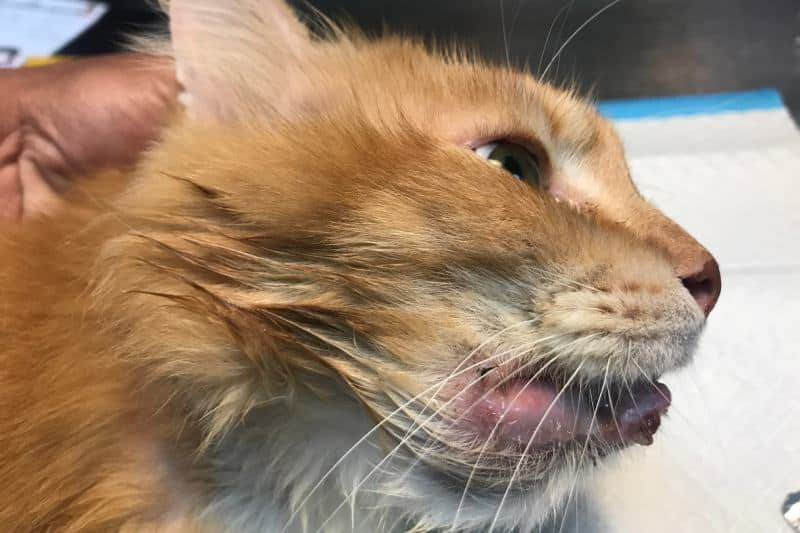
When it comes to cats, facial swelling is usually the first noticeable sign if there is inflammation under or within the skin. You will often see it around the nose or eyes, but it is also possible to see inflammation on the chin and cheeks. Plus, this swelling can either show up slowly over time or very suddenly, but either way, it’s a cause for concern.

What Are the Signs of Facial Swelling”
Cats experiencing facial swelling will often have an abnormally shaped face and can experience some of the following signs:
- Pronounced facial features
- Inability to open or close eyes or mouth
- Drooling
- Difficulty swallowing
- Discomfort
If you are concerned about the health and well-being of your pet, seek veterinary advice for the best course of action.
What Causes Sudden Swelling in a Cat's Face?
1. Tumors
Oral tumors can result in swelling of the face or portions of the oral cavity. Tumor growth rate can be slow or can occur quickly. Two common tumors impacting the oral cavity of a cat and leading to an abnormal appearance of the face are fibrosarcomas and squamous cell carcinomas. Fibrosarcomas are malignant tumors arising from connective tissue and are known for being locally invasive and aggressive. Removal of the affected area or debulking of the tumor may be beneficial as the growth is often painful.
Chemotherapy is not thought to be very effective against fibrosarcomas; however, radiation may be beneficial to slow the growth in some patients.
Squamous cell carcinomas are the most common oral tumor impacting cats. Similarly to the fibrosarcoma, these tumors are locally invasive. Surgical removal can be helpful for some patients. Chemotherapy and radiation may be pursued as well. In both types of cancer, additional pain control and antibiotics may be initiated to provide patient relief until quality of life becomes questioned.
2. Tooth Abscess
An abscessed tooth can lead to significant facial swelling, which often begins underneath the eye. Tooth root abscesses occur when bacteria enter the pulp of the tooth, typically secondary to a tooth fracture, and the tooth eventually dies. Infection and inflammatory cells infiltrate the area leading to swelling and often discharge. Abscessed teeth can also be the result of periodontal disease.
A physical examination should be performed by your veterinarian if significant swelling is noted or if there is history of dental concerns. Surgical removal of the affected tooth or a root canal will be necessary to cure the condition. In situations where surgery is not possible, antibiotics and pain medications may be given to improve the patient’s comfort, but reoccurrence is highly likely.

3. Wounds
Fighting and other forms of trauma can also lead to the formation of an abscess. An abscess occurs when bacteria is introduced under the skin and the skin quickly closes over the wound, trapping the bacteria. Abscesses can be very painful and can be warm to the touch. Cats with abscesses can be very painful, but due to their stoic nature, cats may not demonstrate their discomfort.
Systemic signs of illness may be seen including lethargy, fever, and inappetence. Often, these abscesses will have a visible scab or discharge visible on the skin and should be evaluated by a veterinarian. The veterinarian may need to open the abscess and perform a debridement depending on the severity of the abscess. Antibiotics and pain medications are usually prescribed.
4. Allergic Reaction/Anaphylaxis
An allergic reaction can certainly result in facial swelling. This can occur secondary to insect bites, vaccinations, medications, or other environmental allergens. Severe allergic reactions, anaphylaxis, can impact several different organ systems resulting in a variety of signs.
Signs of serious reactions include respiratory distress, vomiting/diarrhea, and cutaneous reactions like facial swelling and itchiness. Close monitoring of facial swelling is necessary to ensure that the swelling does not extend to the airways. Epinephrine, steroids, and antihistamines like Benadryl may be necessary to quickly address allergies and anaphylaxis.

5. Acetaminophen toxicosis
Tylenol or acetaminophen should never be administered to cats as it is very toxic. In addition to the development of liver damage and red blood cell changes, cats with acetaminophen toxicosis often experience facial swelling. Cats may also appear lethargic and have difficulties breathing because of oxygen depletion.
If Tylenol ingestion has recently occurred, it is important for decontamination to occur, which physically removes the undigested pills from the body. This is done by veterinarians in a controlled setting. Furthermore, hospitalization with intravenous fluids and blood transfusions may be necessary. Cats that do not receive care following ingestion of Tylenol can succumb to their illness.
6. Salivary Gland Problem
Cats have several salivary glands present along the face that help aid in the breakdown of food. In some situations, the salivary gland can become blocked, inflamed, develop tumors, or even become infected. When this occurs, swelling can be noted, most commonly right beneath the lower jaw.
Trauma to the salivary gland can result in saliva leaking out from the damaged ducts and glands, and accumulation of saliva can be noted underneath the skin forming a mucocele. Surgical intervention and antibiotic treatment may be necessary.

Diagnosing and Treating Facial Swelling in Cats
Cats experiencing facial swelling will benefit from a visit with your veterinarian. An urgent appointment should be scheduled if your cat is in pain, is not eating, has excessive swelling, or if other clinical signs are present. Your veterinarian will give your cat a thorough evaluation and will closely evaluate the face and oral cavity. Your cat’s temperature will be taken to see if a fever is present, which can be suggestive of an infection. Your vet will also ask questions regarding your cat’s history and lifestyle to better understand what could be going on.
To determine an underlying cause of the facial swelling, diagnostics may be necessary. Depending on where the swelling is located, a fine needle aspirate may be done to evaluate the cells making up the swollen tissue. This involves the introduction of a small needle into the swollen tissue, and gentle removal of cells that are then evaluated under the microscope. In cases of an abscess, blood and pus may be noted and the swollen area may be reduced if significant fluid is removed. A portion of the mass can also be removed, or biopsied, and studied closely. This can offer a more definitive diagnosis than a fine needle aspirate in certain cases. In other situations, imaging may be needed by way of a CT or radiograph.
Please note that treatment for facial swelling is 100% dependent on the underlying cause.

Frequently Asked Questions
Does My Cat Need to See a Veterinarian Right Away for Facial Swelling?
A visit to the vet would not be detrimental. In some cases, it may be appropriate to see your veterinarian on a non-urgent basis. Calling your veterinarian and describing your pet’s clinical signs will help the staff determine the urgency of an evaluation.
Is It Possible My Cat’s Facial Swelling Is From an Insect Sting?
Yes, it is possible that facial swelling may be the result of an insect sting. Close monitoring is recommended to ensure that the swelling does not extend into the airways, resulting in difficulty breathing.
Final Thoughts
Facial swelling in cats should be evaluated by your veterinarian, especially if the swelling is persistent, worsening, or if other clinical signs are noted. There are several different causes of facial swelling, and as a result, interventions vary. Your veterinarian will be an important asset when it comes to addressing facial swelling concerns. Care should be taken to closely observe your cat for worsening signs or failure to respond to treatment protocols.
Sources
https://vcahospitals.com/know-your-pet/tooth-root-abscess-in-cats
https://vcahospitals.com/know-your-pet/fibrosarcoma-and-feline-sarcoid
https://vcahospitals.com/know-your-pet/acetaminophen-toxicity-in-cats
https://www.petmd.com/cat/conditions/respiratory/c_ct_anaphylaxis
https://www.merckvetmanual.com/digestive-system/diseases-of-the-mouth-in-small-animals
https://www.petmd.com/cat/conditions/mouth/swelling-salivary-gland-cats
https://vcahospitals.com/know-your-pet/cytology-fine-needle-aspiration
Featured Image Credit: supanee sukanakintr, Shutterstock

Expert cat care, straight to your inbox
Vet-reviewed advice, behavior tips, and the best of Catster. Free, and you can unsubscribe anytime.
By signing up, you agree to our Terms & Conditions and Privacy & Cookies Policy.
Dr. Marti Dudley is a small animal veterinarian with a passion for preventative medicine and pet parent education. She enjoys being a resource for pet owners as she believes that having a team approach leads to the best possible care of pets. Dr. Dudley enjoys writing and has been able to use this skill as another avenue to educate pet owners outside of the traditional office setting.
Dr. Dudley has been practicing veterinary medicine since 2014. She has an interest in preventative care and emphasizes the importance of pet owner education. Dr. Dudley’s experience in veterinary medicine is broad, as she has worked as a general practitioner, which has allowed her to see and treat many different types of conditions.
Dr. Dudley received her bachelor’s degree in biology from Longwood University in Virginia. She earned her Doctor of Veterinary Medicine (DVM) degree from Ross University.
Join the conversation
Ask a question, share your story, or send private feedback.