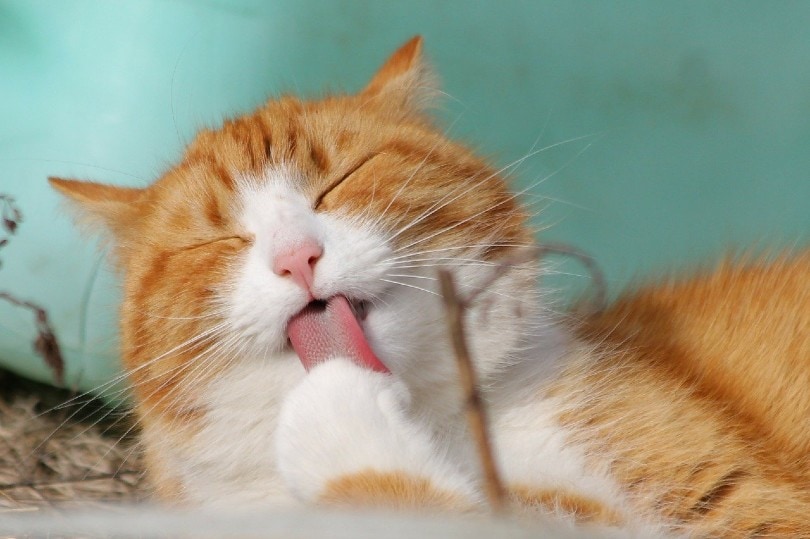
My Cat Licked Flea Medicine! Here's What to Do (Vet Answer)
In this article
Routine care for your cat will often include giving them a monthly or tri-monthly flea treatment. Thanks to modern medicine, this has never been easier, as flea medicine is now often found in topical form—where the medication can be applied directly to the skin and absorbed. This prevents the dreaded pilling of a cat, which has sparked many a funny meme and YouTube videos about the dreaded process.
However, that doesn’t mean that a topical application is always as straightforward as one might hope or expect. Cats are masters at causing trouble, and sometimes, applying flea medicine is no exception. In instances where the medication runs a bit, it is applied too far down on the body, or a cat scratches at it, they may also have the chance to ingest some of this medication.
Read on to learn about what to do if this happens.

Is It Dangerous if My Cat Licks Flea Medicine?
The answer is that it depends. In most instances, these medications have a fairly high safety margin, which means that licking or ingesting a small amount of the product shouldn’t cause problems for most cats. Further, this is only a concern when the product is still fresh or wet. Once it’s dry, licking it shouldn’t cause the same reaction. Except for the neurological signs, the signs listed below seem to relate to the taste of the medication rather than a reaction to the medication itself. However, if you have concerns, contact your vet or Animal Poison Control immediately.
What Signs Might I See if My Cat Licks or Eats Flea Medicine?
As mentioned, cats may lick feline-specific flea medicine after it has been applied on them. These products tend to taste bitter, and in those instances, you might see clinical signs, including the following:
- Drooling
- Lip smacking
- Frothing at the mouth
- Nausea or vomiting
- Neurological signs
How Do Topical Flea Medications Work?

The more modern forms of topical flea treatments are applied under the fur, directly to the cat’s skin. When doing so, make sure that you are using a cat-specific treatment, as some dog treatments can cause cats to get very ill, have a seizure, or even die!
Once applied to the skin, the medication spreads over the skin, and some products are also absorbed into the body. Often, this means the treatment will last for 30 days or longer.
Older flea medications may contain pyrethroids; flea treatments for dogs also often include these products. While they may be ok for dogs, they are definitely not okay for cats and can cause severe toxicity and even death in this species.
- Our Recommendations: Best Flea Treatments for Cats – Reviews & Top Picks
Please note: This article does not address pyrethroid-based flea medications because if your cat has contact with these products, they require immediate veterinary intervention to avoid life-threatening consequences. This article does highlight the need to ensure that your cat receives only cat-specific flea treatments.
Frequently Asked Questions (FAQs)
Why Did My Cat Lick the Flea Medicine?
Great question! Most cats like to be clean, fastidious creatures. Therefore, when we apply something foreign to their haircoat, it likely feels quite odd for them!
Further, the wet sensation of the liquid may cause them to want to lick their coat.
And finally, many of these products do have a smell. For cats, whose sense of smell is far better than ours, the smell is likely quite pungent and even offensive. To them, licking is the easy way to remedy the situation.

How Can I Prevent My Cat From Licking Flea Medication?
Placement of the medication is key. Begin by placing the medication high up enough on your cat’s body so that they do not have access to lick the medication. This generally means somewhere on the back of their neck or even the back of their head. However, cats can also get a hind foot up to scratch the area of flea medicine application, which can drag the product down the side of their neck to where they can lick it. Again, putting the medication high on the neck or head should still limit their ability to access any of the spillages. If you have two cats, it’s important to keep them apart until the medication has fully dried, as one cat might lick the product off the other. Also, some of these medications come in fairly large volumes. Rather than applying the entire vial in the same spot, it can help to apply the product in two or three locations, which will limit the chances of the medication running.
What Can I Do to Help My Cat if They Lick Flea Medication?
If they lick flea medication after it is applied, consider offering them a tasty treat or two to help take the taste out of their mouth. This can include offering some treats or something like tuna (assuming your cat isn’t allergic to fish!) to try and remove the bitter taste from the medication. In many instances, cats will refuse to eat the food in the heat of the moment, but it never hurts to offer.
Conclusion
In some instances, a cat that licks a cat-approved flea medicine might feel a bit nauseous or have a bad taste in their mouth. However, it is uncommon that eating a small amount of the medication will lead to major concerns. However, if something doesn’t look or feel right, don’t hesitate to reach out to your vet or to the Pet Poison Helpline.
Sources
Featured Image Credit: TeamK, Pixabay

Expert cat care, straight to your inbox
Vet-reviewed advice, behavior tips, and the best of Catster. Free, and you can unsubscribe anytime.
By signing up, you agree to our Terms & Conditions and Privacy & Cookies Policy.
Dr. Lauren Demos DVM (Veterinarian)
As a veterinarian, Lauren is eager to share her experience in emergency medicine and cats, with our readers. She loves sharing helpful, real life tips for having cats as part of your life, and what to do in critical situations with your pets.
Lauren is a vet with over a ten years of experience in cats and dogs, along with infectious diseases. She enjoys teaching, and lectures for students, pet owners, and clinicians, on various topics.
Lauren received her degrees from Murdoch University, in Perth.
Join the conversation
Ask a question, share your story, or send private feedback.