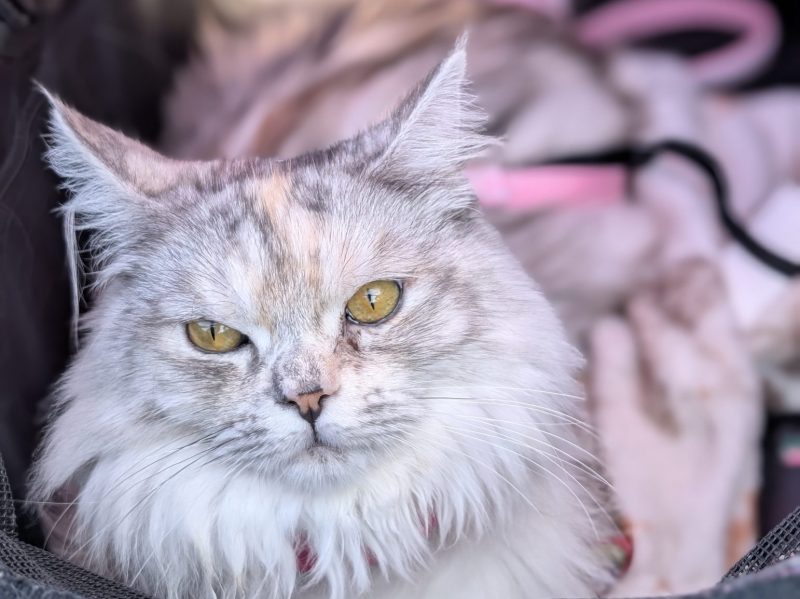
As cat owners, we’ve all heard theories about “tortitude”, friendly tabbies, and mischievous tuxedo cats, but just how true are these cat coat color stereotypes? Today, we’re taking a deep dive into the myths and facts about whether a cat’s fur color affects their personality. Read on to find out if your independent and sassy tortoiseshell or naughty tuxie are the way they are because of the color of their fur or other determining factors.

The 6 Cat Coat Color Stereotypes
1. Orange cat stereotypes are that they’re highly affectionate and friendly.
Orange cats are said to be the friendliest and most affectionate of all cats. Male gingers tend to be expressive, while their female counterparts are often considered to be demanding and particular.

2. Calicos and tortoiseshells stereotypes say they’re independent and sassy.
Some people swear up and down that cats with calico and tortoiseshell coloring are difficult. They have a reputation in the cat world for being sassy, strong-willed, fiery, and independent.
3. Black cat stereotypes say that they’re aggressive and mean.
We’re not sure if this stereotype is rooted in the “black cats are bringers of bad luck” myth, but there doesn’t appear to be any truth to it for most black cats, regardless.

4. White cat stereotypes are that they’re shy and aloof.
White cats are often seen as shy, timid, calm, and even unfriendly. Some people even go as far as saying white cats are snobby.
5. Tuxedo cat stereotypes say they’re mischief makers.
Black-and-white tuxedo cats, also known as tuxies, aren’t considered the smartest cats, but their very silly and mischievous nature makes up for it.

6. Tabby stereotypes are that they’re affectionate with everyone.
“Tabby” actually refers to a coat pattern and not a specific coloration, as you can have orange, gray, or brown tabbies. The stereotype for this pattern is that they’re affectionate and get along with everyone.

What Does Science Say About Fur Color & Its Influence on Personality?
You can listen to personal anecdotes from cat owners all day long about how all of their orange cats have always been friendly and affectionate, and all their calicos have been sassy and spunky. But what does the science actually say?
We reviewed three studies that attempted to look at whether a cat’s fur color influences their personality. Let’s take a closer look at their findings.
Study One: Journal of Applied Animal Welfare Science
A 2016 study explored the possible relationship between cat coat color and aggressive behaviors via an Internet-based survey. Researchers tallied results from 1,274 U.S.-based cat owners and found that sex-linked orange females (like torties and calicos), black and white cats, and gray and white cats were more aggressive toward their humans more often than other studied cats. These aggressive tendencies, including hissing, chasing, biting, and swatting, were more prevalent in three settings: during daily interactions, when they were handled, and during visits to the vet. Owners of solid-colored cats reported fewer instances of aggression.

Study Two: Animals (Basel)
A more recent study from 2022 took a more comprehensive look at coat color and overall personality traits. Researchers surveyed 211 cat owners from Mexico to determine how they perceived their cat’s personalities. The results showed that gray cats were more likely to be shy and intolerant, while orange cats were more trainable and friendly. Tabby-patterned cats were bold and active, while tricolor cats were more stubborn.
Study Three: The Journal of Veterinary Behavior
A study from 2016 surveyed 574 single-breed, registered cat owners and found a “significant association” between their pet’s behavior and the genetically distinct breed, coat colors, patterning, and eye colors. The study found that cat aggression was higher in tabbies, prey drive was more prevalent in orange cats, and separation anxiety was more likely to occur in Siamese and Tonkinese cats.
The Problem With These Studies
The problem with these studies is that there is much room for error. All studies were very small, especially when considering how many cat owners there are in the United States and Mexico alone (over 25% of American and 24% of Mexican households have cats). Additionally, because researchers had to rely on the cat owners’ responses to formulate their data, there’s room for error in how the owners interpret their cats’ moods and body language.

Does a Cat’s Breed Affect Personality?
While a cat’s coloring most likely does not affect their personality, their breed really does make a difference. Nearly half of behavioral differences between breeds can actually be attributed to hereditary factors.
A study from 2019 looked a little closer at the breed differences in heritable behavioral traits. Researchers found that there were substantial differences between breeds when it came to social behavior. British Shorthairs, for example, were less sociable toward people and less likely to look for human contact, while Korat and Devon Rex cats were most likely to be on the lookout for attention from their humans. Ragdolls are more likely than other breeds to be shy around strangers and new objects.
This study also found that breeds differ in non-social behaviors. Cornish Rex and Bengals were among the most active breeds, while Ragdolls and Birmans were the least active. Russian Blues tended to be the shyest around new objects and people. Oriental cats are more likely to develop stereotypies (prolonged, repetitive movements and sounds) and compulsive behaviors (e.g., excessive grooming).
This study shows that many of the behavioral traits studied are highly heritable and that personality factors (such as extraversion and aggression) can be genetically-correlated traits.
Final Thoughts
Cat behavior can be affected by many external and internal factors, but very few studies indicate that a cat’s coat color impacts personality traits. At the end of the day, every cat is unique, and aside from purebred cats whose personalities have been finely tuned over generations to produce specific personality traits, there doesn’t appear to be too much scientific evidence linking personality directly to color.
Featured Image Credit: evrymmnt, Shutterstock
 The 6 Cat Coat Color Stereotypes