Get

In Your Inbox

Catster is reader-supported. When you buy via links on our site, we may earn an affiliate commission at no cost to you. Learn more.

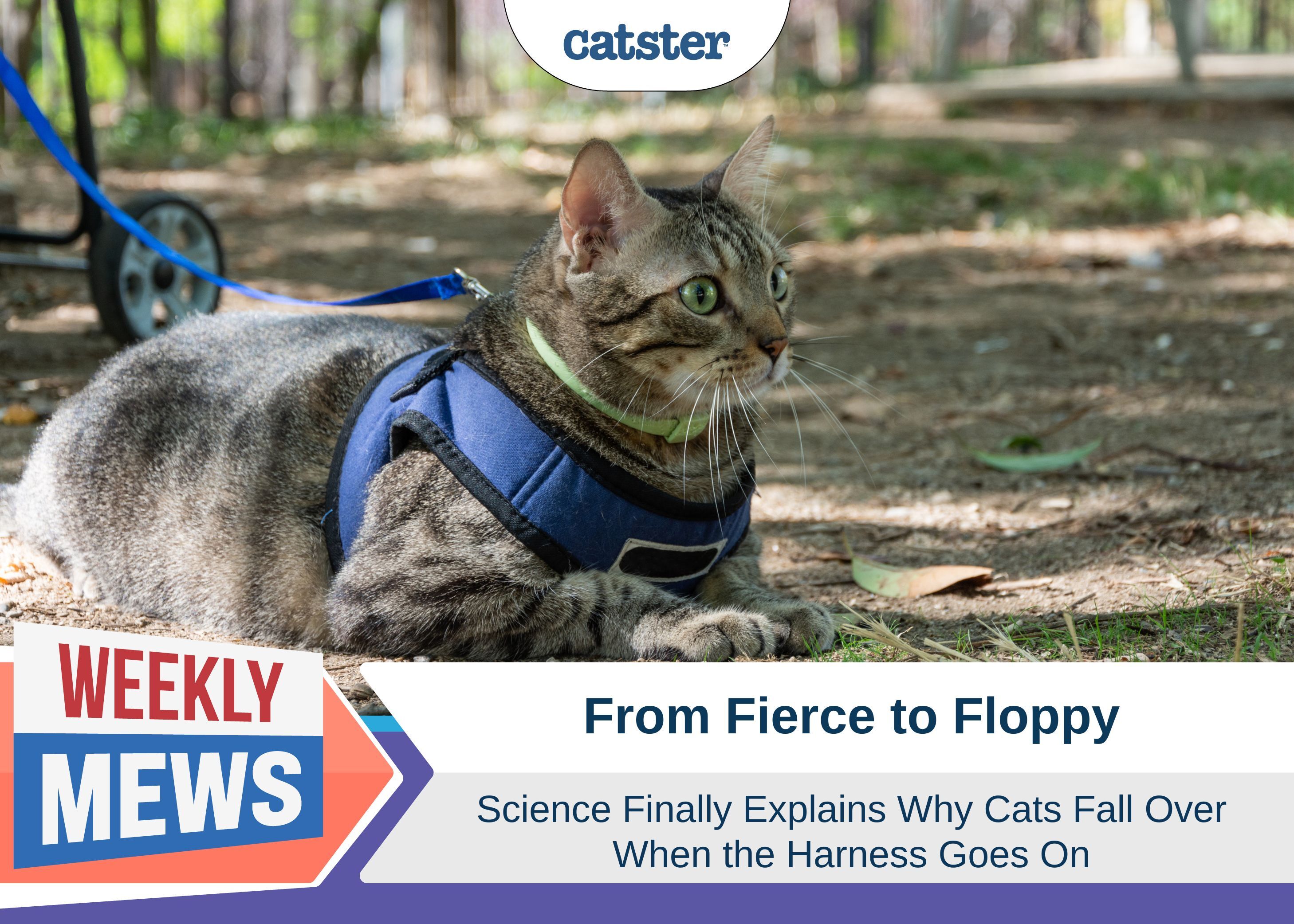
From Fierce to Floppy: Science Finally Explains Why Cats Fall Over in Harnesses
Share

Catster_Weekly Mews_from fierce to floppy cats in harnesses

We’ve all been guilty of it at one time or another. That moment of Schadenfreude when we see a cat do something uncoordinated or embarrassing. Perhaps it’s because it happens so rarely, or because it’s usually us, the bumbling humans, that are being silently mocked by feline onlookers. A more common opportunity for us to quietly enjoy the misfortune of our much-loved cat is when we first introduce them to a harness. Of course, there are those who take on this equipment with nary a hint of hesitation, but for others, the application of a harness renders the normally graceful and agile feline into a rigid, wobbly, or vertically challenged mess.

Over the years, many theories have been postulated to explain why a harness, vest, or jumper should rob a cat of their motor function, and to be fair, these theories seem quite reasonable. However, we recently learned of a study from 2012 that may actually explain the phenomenon.

Why a Harness Causes Cats to Fall Over: The Theories

Prior to our discovery, the leading theories explaining why harnesses make some cats fall over included:

Fight, Flight, and Freeze: The idea that a harness presents the cat with some unknown threat has many believing that the rigid response is part of their instinctive fight, flight, or freeze reaction to danger.

Pressure Points: This theory suggests that the harness stimulates certain pressure points that are commonly associated with a mother cat carrying her young. It may also trigger a ‘play dead’ reaction in response to being picked up by a predator.

The Wrong Fit: A harness that is too large or too small may interfere with movement.

*WARNING

The content discussed below includes a study that may be distressing to cat lovers. While we do not support the methods used, we acknowledge the impact it had on neurological research for both cats and humans. Although the methods and study design adhered to ethical guidelines, it is not an experiment we would endorse. It no doubt has many implications in neurological medicine for both humans and animals but does not make for pleasant reading.

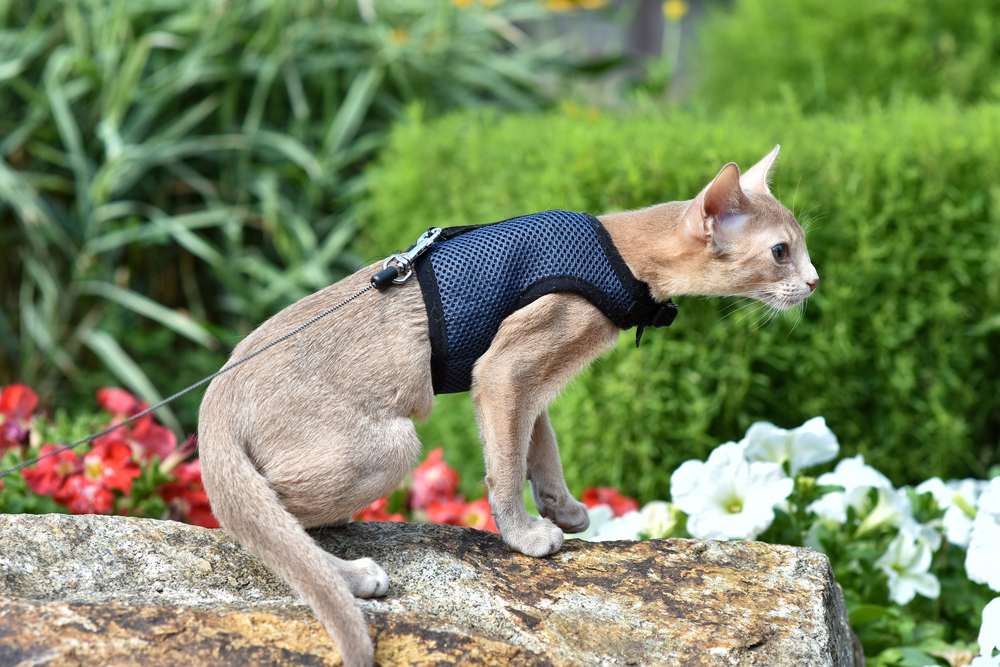
cat with harness sitting in the garden
Image Credit: Akifyeva S, Shutterstock

A Scientific Explanation

We know that cats are extraordinarily flexible, fast, agile, and acrobatic. From their preternaturally rapid reflexes to their ability to always land on their feet, feline mobility and coordination have always been the subject of curiosity. We recently uncovered a study* that looked into how much of that feline coordination comes from the brain, and how much is controlled by spinal reflexes alone, with some fascinating results.

By surgically separating the brain from the spinal cord, scientists found that cats could still walk on a treadmill with coordinated hind limb function when the appropriate motor nerves were electrically stimulated. The experiment proved that in addition to higher brain function, feline movement and coordination were governed by direct somatosensory feedback – that is, the body was able to maintain a balanced and coordinated gait based purely on touch.

The Sixth Sense (not that Sixth Sense)

This somatosensory feedback mechanism functions almost like a sixth sense, providing cats with an additional unconscious way to move and react to their environment, which explains how they can do the things they do. However, when we put something over their body, it would be the equivalent of placing a blindfold over their eyes. A cat is unlikely to be consciously aware of this sixth sense, but it will be a shock to the system when it is suddenly obscured. But, just as a cat will eventually adapt to a lack of sight, they will also adapt to their altered somatosensory input, and once they have learned to do this, it too becomes a reflex whenever the harness is put back on.

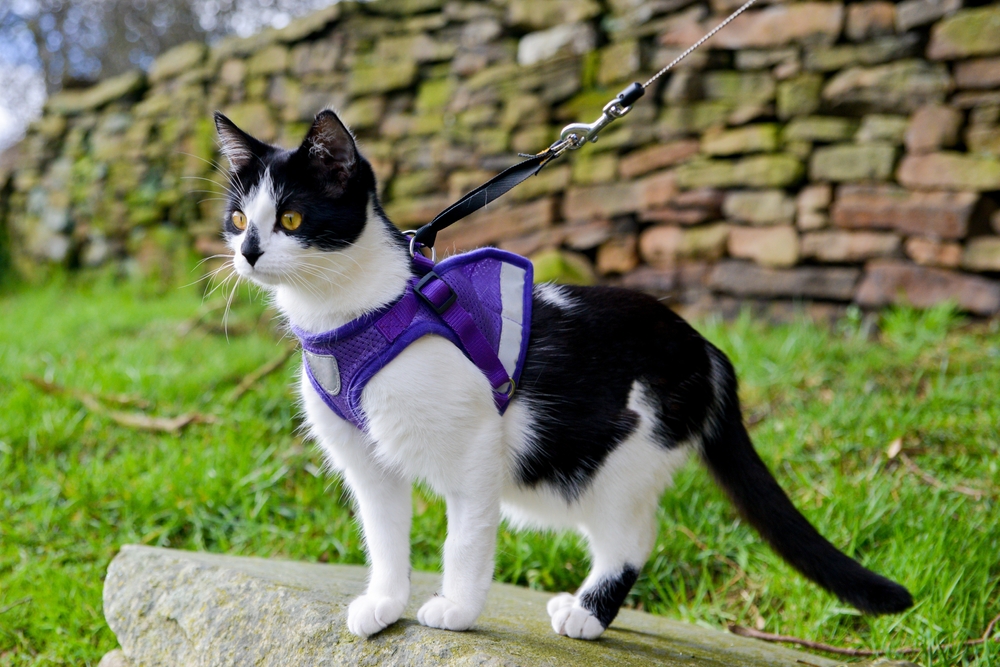
black cat with harness and leash in the forest with owner
Image Credit: alexgo.photography, Shutterstock

Is It Cruel to Put a Harness on My Cat?

Not at all. Unless your cat is particularly distressed by the harness or shows no sign of adjusting to wearing one, once your cat becomes accustomed to the harness, they should be able to enjoy their newfound (relative) freedom without impediment.

What you don’t want to do is:
  • not allow your cat enough time to get used to the harness
  • laugh at your cat – they are very sensitive creatures and know exactly whose shoes to poop in.

Did You Know? 

  • Our breaking news articles are featured in our weekly emails. Don’t miss out on the latest and sign up for our newsletter below!

Want content like this delivered to you?

Sign Up For Our Newsletter

News, insights, expert advice, and everything cat

* By submitting, you agree to our Terms & Conditions and Privacy & Cookies Policy.


How useful was this post?

Click on a star to rate (you can leave written feedback after clicking submit)

Help us improve Catster for pet parents!

Your feedback really matters.

What did you like about this post? Also how can we improve it?

Join the conversation

2 Responses

  1. This helps to explain why my female cat after she had been speyed. The vet out her in a kind of body garment to stop her investigating the operation site. When we got her home she did not appear to know how to walk She kept trying to walk backwards and rolling over as a result. She and I were both relieved when the vet said it was safe to remove the vest! But it took her a few days to recover her normal walking abilities rather than attempting to walk backwards!

    1. Hi Anne Olsson, thanks for sharing your story. We are happy to hear you found the post helpful. It is great to hear your cat is fully recovered from her surgery and can walk normally.

Leave a Reply

You’re very welcome to leave a comment or question. Please know that all comments must meet our community guidelines, and your email address will NOT be published. Let’s have a positive and constructive conversation.


Talk With A Vet Online

Peace of mind,
anywhere, anytime

Affordable vet advice

Ask Dr. Paola – Help! My Male Cat Gets Into Fights! (March 9, 2026)

Welcome to our “Ask Dr. Paola” series, where every Monday we bring expert advice straight from Dr. Paola Cuevas (MVZ) to help our...

Why Your Cat’s Poop Smells Like a Biohazard

Nobody enjoys litter box duty, but sometimes it gets unbearable. The smell hits you from across the room. You’re scooping faster, lighting candles,...

RIP Your Furniture? Not With This Guide to Cat Scratch Damage Control

Your couch looks like it survived a minor apocalypse. The curtains have mysterious vertical shreds. That new rug you splurged on is already...

Celebrating 15 Years as the Most Popular Resident of No. 10 Downing Street

For almost 300 years, a rather unassuming Georgian building of black bricks with a shiny black door has been the official residence and...

More related

Why Is My Cat Extra Clingy When I’m Pregnant? 4 Vet Verified Reasons

It is not uncommon for cats to act strangely around pregnant women. You may notice that your cat is extra clingy as your...

8 Best Brushes for Ragdoll Cats – 2026 Reviews & Top Picks

Ragdoll cats are large and fluffy felines. Their semi-long fur is a big hit with children and adults, but it can be challenging...

Ask Dr. Paola – Sudden Weight Loss, Sadness & Counter Sitting (March 24, 2025)

Welcome to our “Ask Dr. Paola” series, where every Monday we bring expert advice straight from Dr. Paola Cuevas (MVZ) to help our...

Is Cooked Chicken Good for Cats with Hyperthyroidism? Vet-Approved Benefits & Tips

Hyperthyroidism can be a heavy diagnosis to get your head around. Once you learn about an overactive thyroid, you realize that certain changes...

Keep reading

Can Cats Eat Mushrooms? Vet-Verified Facts, Risks & FAQ

If you’re cooking a delicious mushroom risotto, you might be surprised to find your cat brushing up against your legs and showing interest in your vegetarian dinner. You might even be tempted to give your cat a piece of mushroom,...

Can Cats Eat Mushrooms

How Much CBD Oil Should I Give My Cat for Anxiety? Optimal Dosing Chart

CBD has exploded in popularity recently, being touted as a miracle cure for a wide range of ailments that’s supposedly a more natural alternative to many pharmaceuticals. But CBD isn’t just for people. More and more CBD products are being...

cbd oil and cat on background

Does My Cat Have Asthma Or a Hairball? Vet-Approved Main Differrences

If your cat has been coughing and gagging, you may wonder about the possible causes, including asthma and hairballs, and if there’s a way to figure out the difference. While asthma and hairballs can cause cats to cough, the two...

vet giving medicine to a cat

Can Cats Eat Bok Choy? Nutriotional Facts & FAQ

Bok choy, or Chinese cabbage, is a vegetable that’s packed with nutrients and is incredibly healthy for humans and safe for cats. So, if you’re preparing a dish with bok choy and your curious cat nibbles on a piece of...

Can Cats Eat Bok Choy

Is Cyclamen Poisonous to Cats? Vet-Reviewed Houseplants Examined

Cyclamen is part of the primrose family and blooms sweet-smelling flowers that grow off long green stems above the leaves. This perennial plant dies down and is left with nothing but stubs during the summer months. Once fall comes around,...

Catster_Is Cyclamen Poisonous to Cats

Do Cats Get Lonely When You Go to Work? Vet-Reviewed Signs & Entertainment Tips

Many people have the view that cats are antisocial; however, that isn’t true. Cats are very affectionate creatures; they socialize in ways different from ours, and there are variations in how sociable cats are toward humans. While we show affection...

cat indoor_Melanie Hogue_Pixabay

Will Ammonia Keep Cats Away? Humane & Natural Alternatives

Even the most devoted animal lover doesn’t want cats trampling through their garden or defecating on their lawn. You can make many DIY cat repellants to keep cats out of undesired areas, and you may have read that spraying ammonia...

ammonia

Explaining Cat Behavior Problems: (With 9 Vet-Approved Solutions)

Veterinarians are regularly asked how to deal with certain cat behavior problems, such as peeing outside the litter box, attacking people, chasing other cats, and destroying furniture. While health conditions can lead to issues, problematic conduct is often an expression...

ginger tabby cat looking up meowing

Love Cats? So Do We! Join the Catster Community

Stay informed with expert pet care insights delivered straight to your inbox! Discover professional guidance on animal behavior, feeding tips, trusted product picks, and much more.


Sign up for the Catster Email Newsletter

Stay informed with expert pet care insights delivered straight to your inbox! Discover professional guidance on animal behavior, feeding tips, trusted product picks, and much more.