Get

In Your Inbox

Catster is reader-supported. When you buy via links on our site, we may earn an affiliate commission at no cost to you. Learn more.

Cats in Crochet Thinking Caps: How Hats Are Helping Neurological Studies
Share

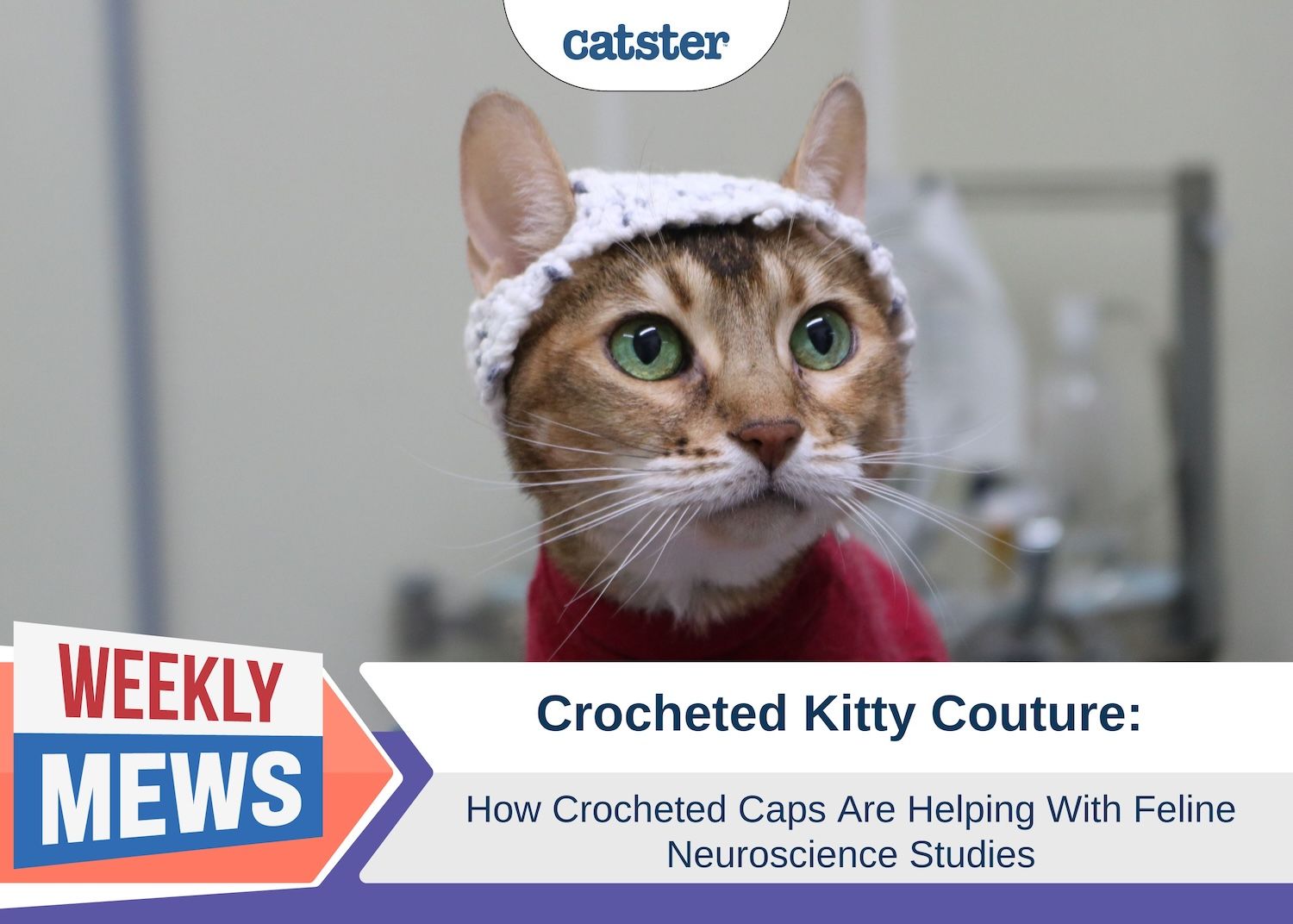
Weekly Mews crocheted kitty caps

Without the results of scientific research and experiments, the world would be filled with the ifs and maybes of untested hypotheses. Unfortunately, an overwhelming amount of scientific discoveries and breakthroughs have come at the expense of animals used in experiments. In a recent study of sensory processing in chronic pain at the University of Montreal, scientists came up with a clever way to measure the brain waves of cats using a non-invasive – and quite frankly, adorable – piece of equipment: a knitted cap.

Standard EEG set up
Standard EEG setup (Image Credit: Roman Zaiets, Shutterstock)

Putting Their Thinking Caps On

Electroencephalography (EEG) is a technique that uses electrodes to detect the electrical activity of the brain to assess function and neurological responses to certain stimuli. The electrodes need to remain in close contact with the patient’s skull, although direct contact with the skin is not necessarily required. For humans, this usually involves placing a network of electrodes onto the head either individually or attached in a net-like arrangement. It’s important that these electrodes stay quite still in order to obtain accurate readings, which is generally achieved by asking the patient not to move their head. But how does this work when your test subject is a cat?

In the past, the only way to obtain accurate EEG readings from cats was by placing electrodes under the skin under sedation or general anesthetic. This is problematic on a number of levels. The results obtained may be impacted by the effects of the sedative drugs, and of course there is the ethical consideration of performing an invasive procedure for scientific research.

Cat in study
Cat in study (Image Credit: A. Delsart et al, Journal of Neuroscience Methods)

Thanks to a team of scientists at The University of Montreal, there is now a rather nifty alternative. In a recent study, a group of cats with osteoarthritis were fitted with custom-made knitted caps housing the EEG electrodes. These caps allowed non-invasive readings of brain activity without the need for sedation. Instead, the cats were gently acclimated to the room, using positive reinforcement to train them to sit or lie down in one place with minimal restraint.

According to Aliénor Delsart, one of the researchers working on the study, the idea for the caps came about as they attempted to get the cats used to electrode placement.

“When you spend more time replacing them than recording signals you get creative. We had some cats who liked to shake their heads when we’d finished placing all the electrodes. We had already seen photos of cats wearing crochet caps (for purely aesthetic and cute purposes), so we thought it would be a good idea to try it to keep the electrodes in place during recording!”

And it certainly was!

Tabby Hat
Tabby Hat (Image Credit: A. Delsart et al, Journal of Neuroscience Methods)

Creative and Cruelty-Free

This is the first time this non-invasive technique has been used, with the primary focus being on how feasible the method is. Encouragingly, the results indicate that this non-invasive method performs very well in comparison to more traditional techniques, giving comparable responses to visual and olfactory (smell) stimuli. Using pre-established indicators of pain, the team were then able to assess the response of these arthritic cats to different forms of analgesia (pain relief).

Hopefully, the success of this study will open the door for more ethical and creative approaches to scientific research, allowing us to learn more about both human and veterinary medicine without the need to harm or sacrifice test subjects. They say that necessity is the mother of invention, and with this simple but ingenious invention, the team at Montreal have pulled off one heck of a hat trick.

Does this come in another color?
Does this come in another color? (Image Credit: A. Delsart et al, Journal of Neuroscience Methods)

Did You Know? 

  • Our breaking news articles are featured in our weekly emails. Don’t miss out on the latest and sign up for our newsletter below!

Want content like this delivered to you?

Sign Up For Our Newsletter

News, insights, expert advice, and everything cat

* By submitting, you agree to our Terms & Conditions and Privacy & Cookies Policy.


How useful was this post?

Click on a star to rate (you can leave written feedback after clicking submit)

Help us improve Catster for pet parents!

Your feedback really matters.

What did you like about this post? Also how can we improve it?

Join the conversation

One Response

  1. I find your weekly news enthralling, and finding different ways to help cats is wonderful, the special needs kitty was such a wonderful story and a happy ending, in my opinion our little cat has made our life so much more fulfilling and happier he is our world, thankyou for your dedication in your profession.

Leave a Reply

You’re very welcome to leave a comment or question. Please know that all comments must meet our community guidelines, and your email address will NOT be published. Let’s have a positive and constructive conversation.


Talk With A Vet Online

Peace of mind,
anywhere, anytime

Affordable vet advice

Ask Dr. Paola – Help! My Cat Suddenly Has Dandruff! (March 30, 2026)

Welcome to our “Ask Dr. Paola” series, where every Monday we bring expert advice straight from Dr. Paola Cuevas (MVZ) to help our...

Your Cat Keeps Vomiting After Eating: Here’s What’s Going On

Cats vomit. It’s one of the less glamorous facts of life with a feline, and most cat owners have cleaned up more than...

Ask Dr. Paola – Help! My Cat Gets Diarrhea from Wet Food! (March 23, 2026)

Welcome to our “Ask Dr. Paola” series, where every Monday we bring expert advice straight from Dr. Paola Cuevas (MVZ) to help our...

Cat Shampoo Alternatives That Are Already in Your House

If your cat has ever gotten into something disgusting and you’ve found yourself without cat shampoo, we’re here to help. Before you panic...

More related

Vet-Reviewed Tips for Being a Good Cat Foster Parent

Being a foster parent for cats living in shelters is one of the most rewarding things you can do if you’re a pet...

Can Cats Eat Asparagus? Vet-Reviewed Nutrition and Safety Explained

While you might love asparagus in risotto or as a side for your steak, should you be offering any leftover asparagus to your...

Is Coleus Toxic to Cats? Vet Approved Advice

Even if you don’t know it, you probably have seen beautiful coleus plants in people’s homes and gardens. These colorful plants are common...

Which Breeds Inspired Snowball the Cat? History of The Simpsons Cat

For over three decades, “The Simpsons” has been entertaining audiences around the world with its quirky humor and relatable characters. One of the...

Keep reading

How to Feed a Cat with a Cone: 5 Vet-Verified Tips

If your cat has just had surgery or is dealing with another medical condition, your vet may send you home with an Elizabethan collar or “cone” while they heal. Typically, the cones make your cat look like they’re wearing a...

British Shorthair cat with cone eating

Do Cats Need to Fast Before Having Surgery? What You Need to Know!

When a cat needs surgery, owners have several questions about how they can prepare them for the upcoming procedure. One of the most common questions is about fasting before surgery. In short, cats typically do need to fast before surgery...

cat and owner and vet

Will a Cat Only Purr for Humans? Do They Do it for Other Cats?

You may have heard that cats only purr for humans. Well, how true is that? As adorable of a sentiment as it is, cats do not purr for humans exclusively. Cats have been observed purring for other cats and even...

british shorthair cat yawning and purring

Will a Mother Cat Abandon Her Kittens if I Touch Them? Vet-Reviewed Facts

Many of us have some version of this childhood memory: we come across a kitten or kittens in our yard or a park that seem to be on their own. Every adult around us has different ideas on how to...

Adorable little tabby newborn kitten sleeping in woman hands

Can Cats Eat Garlic? Vet-Reviewed Risks & FAQ

Few foods are as popular and as potent as garlic. We use garlic to imbue its delicious, savory flavor into our foods, and millions love the bulbous, flowering plant. However, if you’re a cat owner, you might wonder if your...

Can Cats Eat Garlic

Can Cats Eat Lima Beans? Vet-Reviewed Precautions & Health Guidelines

Beans are a popular staple throughout the world, used in many dishes, and enjoyed for their flavor and high protein content. While the most popular beans tend to be black beans, soybeans, and pinto beans, other beans do exist and...

Can Cats Eat Lima Beans

Can You Put a Cat on a Leash? Is It Cruel? Vet Approved Facts, Pros & Cons

Our feline friends love to explore, and some inside kitties yearn to explore the great outdoors. However, it’s not always wise to open the door and let them roam (unless you have an enclosed outdoor space). We want our cats...

black cat with harness and leash in the forest with owner

Can Cats Eat Minnows? Vet-Reviewed Facts & FAQ

If you’re a cat owner, you may have wondered whether your feline friend can snack on minnows. It’s a valid question. After all, fish are a natural part of their diet, in the wild, right? The answer is yes, so...

Can Cats Eat Minnows

Love Cats? So Do We! Join the Catster Community

Stay informed with expert pet care insights delivered straight to your inbox! Discover professional guidance on animal behavior, feeding tips, trusted product picks, and much more.


Sign up for the Catster Email Newsletter

Stay informed with expert pet care insights delivered straight to your inbox! Discover professional guidance on animal behavior, feeding tips, trusted product picks, and much more.