How to Teach Your Kids to Approach Unfamiliar Cats: 8 Vet-Approved Tips


The world is full of unknowns, surprises, and unfamiliar territories to kids. Children do not perceive certain situations as threats unless taught, which goes for approaching unfamiliar cats or other animals. When a child sees a fluffy cat, the instinct may be to rush the cat and pick them up without knowing they could be scared and dangerous.
Teaching your kids how to approach unfamiliar cats is essential if you're a parent. In this article, we'll list eight tips for teaching your kids to approach unfamiliar cats safely.

Before You Start
Before we list the eight tips on teaching your kids to approach a cat safely, we must note that a child should never approach a cat or any other animal without being under adult supervision.
However, older children may be in this situation without an adult present. If you teach your kids these steps at a young age, they will remember what they’ve learned and can apply them to the situation as they mature.
The 8 Tips to Teach Your Kids to Approach Unfamiliar Cats
1. Ask if the Cat Is Friendly
If the cat has an owner, the first tip is to ask if the cat is friendly and if it’s okay to approach them. The owner will know the cat’s temperament and whether or not you can approach the feline safely. If the owner says the cat doesn’t like children or other people, abort the approach immediately.
If the owner says it’s okay to approach, you must show your child how to approach the cat. For starters, teach your child to kneel slowly and gently next to the cat and never hover over them; the cat may perceive this as a threat. Next, teach your child to slowly reach out a hand and let the cat come to them. If the cat sniffs, rubs the hand or head bumps, they’re curious and not feeling threatened.
2. Do Not Make Sudden Movements
If the cat sniffs their hand, teach your child to remain still and let the cat sniff as much as they want. It's important to teach your child to stay calm and not make sudden movements, as this will likely startle the cat, resulting in returning to square one. Remember, the calmer the child, the calmer the cat.

3. Observe the Cat’s Tail
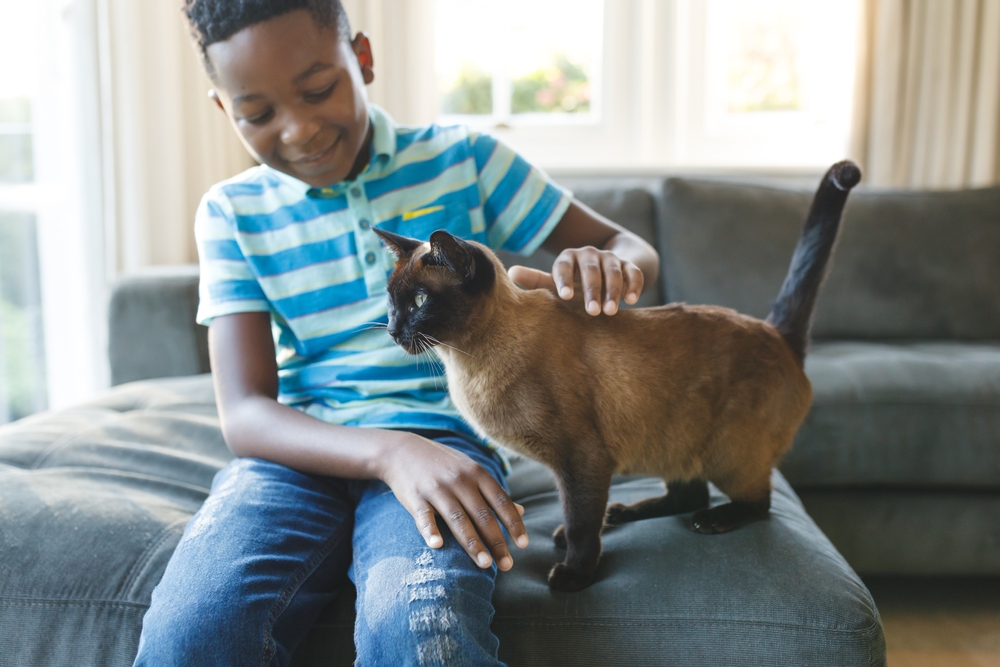
It’s a positive step if the cat rubs their face along the child’s hand or fingers with the tail standing straight up, which means the cat is content and is reacting positively.
If their tail is low to the ground, the cat is frightened and anxious, especially if the tail is between the cat’s legs. If their tail is wrapped around their body, the cat is likely in defense mode, frightened, or possibly not feeling well. If their tail is puffed up or flicking back and forth, it indicates both fear and aggression. It’s vital to teach your kid the different tail postures and what they mean to avoid approaching a cat who doesn’t want to interact.
4. Speak Softly
Young kids shout or yell when they get excited, and spotting a cat they want to pet may provoke excitement, making the cat afraid or anxious. You must also consider that a cat's hearing is much stronger than a human's.
Cats are sensitive to sounds, especially high-pitched sounds, and they have a hearing range of up to 64,000 Hz (humans can hear up to 23,000 Hz). If a kid yells, a cat will likely run for cover.

5. Don’t Stare
Teaching your child not to stare may be an arduous task, depending on your child’s age, but when dealing with an unfamiliar cat, it’s wise not to stare into the cat’s eyes. When someone stares into a cat’s eyes for a lengthy time, the cat may perceive the stare as aggression and find it threatening.
Instead, teach your child to look at the cat briefly but then look to the side. You can also teach your child to give long, slow blinks since cats consider it a friendly gesture.
6. Let the Cat Come to Your Kid
It’s vital to let the cat willingly come to you and your child instead of forcing the issue. If a cat approves after the initial hand sniff, they may come to your kid willingly because they’re giving a sign of approval and feel comfortable.
However, even if the cat reaches this stage, instruct your child to move slowly and not to make sudden movements; let the cat go at their own speed, and never force it.

7. Pet Gently
How a child pets a cat will make all the difference in the world. Kids must be taught to respect animals, and if a kid pets the cat in a rough manner, the cat will retaliate or flee. You should instruct your child to stroke the cat in the direction the fur goes and pet, not pat the cat.
Always discourage pulling the cat’s hair or tail; this is unacceptable, and the cat will show disapproval by batting, scratching, or biting. Every cat is different, but most cats enjoy being petted under the chin, the back of the head, and long strokes down the back.
Ensure you watch the tail and other body language for the cat’s approval. If the tail gets low to the ground or the ears are pulled back, instruct your child to stop.
8. Respect Boundaries
One of the most important things to teach children is to respect the boundaries of any animal. When approaching an unfamiliar cat, you must learn a cat’s body language to understand how the cat feels about the interaction.
Remember that the ears and tail positions are an excellent way to tell if the cat is saying, “Back off!” If the cat is showing signs of acceptance with the hand sniff and rubbing their face on the child’s hand, they are content. However, teach your child to be gentle and not make sudden movements or yell at the cat during this stage.

Conclusion
When it comes to pets, children need to be taught how to interact and respect the animals, whether they’re cats, dogs, pet birds, guinea pigs, or any other pet. Remember that the world is new to children, and they only learn through being taught right from wrong.
As tempting as it is to let your child run up to pet an unfamiliar cat, it’s best to teach boundaries and respect for the safety of your child and the cat. It’s unfair to put a cat or any other animal in a frightening situation, and a child must learn how to interact appropriately by following the eight tips above. Remember never to force the issue, and ensure you observe the cat’s body language.
See also:
Sources
Featured Image Credit: ANURAK PONGPATIMET, Shutterstock

Expert cat care, straight to your inbox
Vet-reviewed advice, behavior tips, and the best of Catster. Free, and you can unsubscribe anytime.
By signing up, you agree to our Terms & Conditions and Privacy & Cookies Policy.
Rachel Giordano is a Pensacola, Florida-based musician and writer. She lives with her partner and their two dogs, Sophie, a Boston Terrier, and Aero, a Border Collie/Sheltie mix. Rachel holds a Bachelor of Arts degree in communication and loves writing about all types of cat breeds. When she’s not writing about cats, she loves to write suspense/thriller novels. A musician by night and writer by day, she enjoys sharing her knowledge of the needs and requirements of our furry friends.
Join the conversation
Ask a question, share your story, or send private feedback.