How to Keep a Cat From Jumping Over a Gate: 8 Vet-Verified Tips


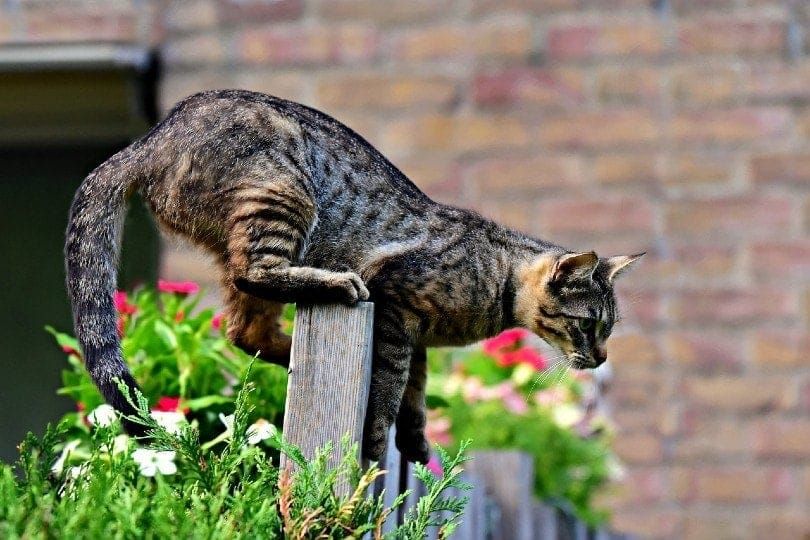
We love our cats, and their safety is our number one concern. Sometimes, it may feel like we care more about their safety than they do.
You have probably heard the phrase about how curiosity killed the cat. There is a kernel of truth to it, as cats are notoriously curious and often find themselves in trouble. Although the behavior is usually limited to silly things, such as getting their head stuck in a paper bag, there may be times when your cat finds themself in danger if they wander too far from home.
In these instances, keeping them in an enclosed area, such as a fenced-in part of your yard, is essential. So, how can you keep them from jumping over your gate? We have gathered eight ways to help you keep your frisky friend where they're supposed to be.

The 8 Tips to Keep a Cat From Jumping Over a Gate
1. Build a Taller Fence
| Cost: | Moderate/high |
| DIY Difficulty: | Medium |
As simplistic as it may sound, building a taller fence may be the solution to your problems. After all, if the fence is too high for your cat to jump over, then they're not getting out anytime soon. Just be sure that there are no secret tunnels your cat may be able to squeeze under.
A higher fence will also help keep other wild creatures from getting in and give you more privacy in your outdoor area. Although a fence may take significant time to build, it can be a worthwhile investment for its many benefits.

Pros
- Prevents cat from jumping over
- Keeps other creatures outside
Cons
- Time-consuming and costly to build
2. Construct a Roller Bar
| Cost: | Low |
| DIY Difficulty: | Easy |
A roller bar is a practical, easily installed device that can keep your cat in an enclosed area. The bar is installed at the top of the fence and works by rolling whenever the cat comes in contact with it. This prevents your cat from being able to pull themself to the top of the fence and jump over.
Roller bars can be purchased for a relatively low price or made with inexpensive materials, whichever you prefer. However, if the fence your cat is jumping over is low enough, they may be able to jump over it without landing on it, making the roller bar ineffective.
Pros
- Helps to keep the cat inside
- Easy to install
Cons
- The cat may be able to jump over it
3. Use an Oscillot®
| Cost: | Low |
| DIY Difficulty: | Easy |
An Oscillot® is similar to a roller bar but has a unique added feature. The Oscillot is a rolling bar with paddles, providing extra security to keep your cat within the borders of the fence.
Although the Oscillot® has added features to provide more protection, it still has the same downfall as the roller bar. If your cat can leap over the fence without touching it, the Oscillot may not work until you get a higher fence.
Pros
- Helps to keep the cat inside
- Easy to install
Cons
- The cat may be able to jump over it
4. Place Scat Mats Around the Fence
| Cost: | Low |
| DIY Difficulty: | Easy |
Scat mats are helpful tools to teach your cat boundaries. Whether you want to keep your cat off the countertops or away from the fence, placing a scat mat down can teach your cat to avoid the areas.
Scat mats are harmless, spiked mats that cause your cat discomfort when they walk on them. They do not cause any pain, but they cause enough discomfort that your cat will eventually learn to stay away from the areas where the mats are placed.
To put them around your fence, you can either lay them on the ground or attach them to the top of the fence. Either drilling the mats into the wood or using zip ties is enough.
However, some pet owners report that scat mats do not deter their cats at all. Some cats grow accustomed to them and are no longer put off by the spiky sensation. So, if your cat adapts to the scat mats, you may need to try something else.

Pros
- Available in different sizes and shapes
- Affordable
- Helpful training tool
Cons
- Does not deter all cats
5. Invest in a Catio
| Cost: | High |
| DIY Difficulty: | Difficult |
A catio can be an effective and adorable way to keep your cat enclosed. Plus, depending on the flair you add to it, it can be an entertaining enclosure for your feline friend!
Catios are enclosed outdoor spaces designed for your cat to enjoy some fresh air safely. They can be as small as a simple box attached to an outdoor window or as large as a greenhouse full of toys and perches to climb onto.
If you are planning on making a catio, it is important to know that it may take a lot of time, depending on how elaborate a catio you want to construct. The larger and more detailed the catio, the more time and money it will require to be made.
Pros
- Prevents cat from wandering
- Keeps other creatures out of your cat’s space
Cons
- Time-consuming and costly to build
6. Place Overhead Netting Around the Fence
| Cost: | Low |
| DIY Difficulty: | Easy |
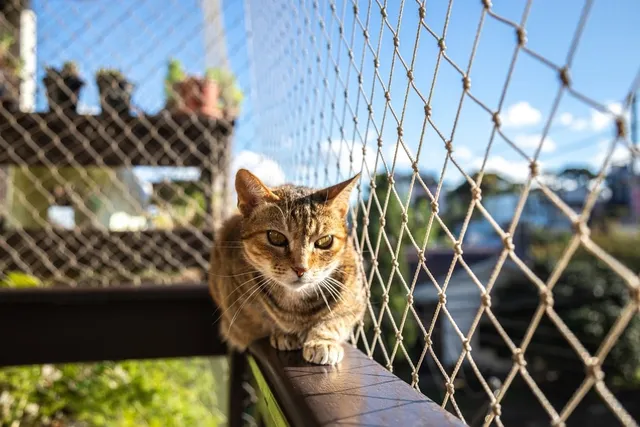
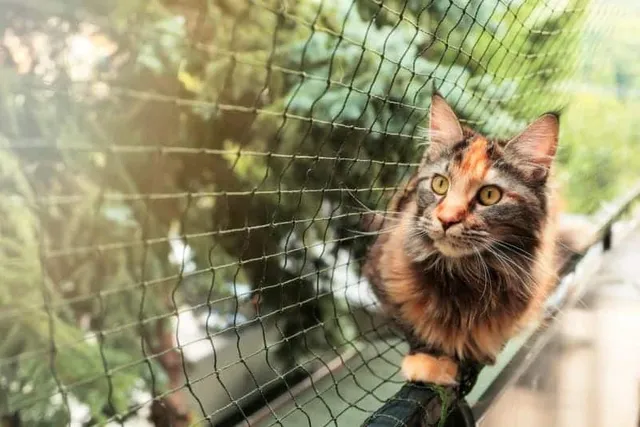
Overhead netting is an effective method for keeping your cat caged in. It is cheap and simple to install, making it a go-to choice for many cat owners. As an added benefit, the net helps to keep wild critters outside of your space just as much as it helps to keep your cat inside.
However, some pet owners may find that the overhead netting blocks their view of the outside or makes their outdoor space look unappealing. If you don’t want to deal with the obtrusiveness of overhead netting, another option on this list may be right for you.
Pros
- Prevents cat from jumping over
- Keeps other creatures out
Cons
- May look unappealing
7. Spray Cat Repellent
| Cost: | Low |
| DIY Difficulty: | Easy |
Spraying cat repellent around your fence is another option to keep your cat from escaping, and it could also help keep wild cats away from your property.
You can purchase cat-safe commercial repellents or make a homemade concoction. Regardless, it is simple to use and only requires a few sprays around the area to dissuade your cat from wandering.
However, remember that cat repellent does not physically prevent your cat from leaving. If your cat can withstand the scent of the repellent, they may ignore it entirely and continue jumping over the gate.

Pros
- Reduces desire to approach scented areas
- Affordable
- Easy to set up
Cons
- Does not physically prevent cat from leaving
- Must be confirmed as non-toxic to cats
8. Spay and/or Neuter Your Cat
| Cost: | Moderate |
| DIY Difficulty: | N/A |
If you have not already done so, spay or neuter your cat. It is an essential procedure for many reasons, with one of them being that it minimizes your cat’s desire to wander.
By reducing your cat’s need to wander, you may be able to keep them from jumping over the fence. They may become content to lounge around at home, where they are more comfortable, rather than explore the unknown.
However, this procedure does not guarantee that your cat will never escape again. If your cat continues to wander, you can supplement the surgery with another option on this list.
Pros
- Reduces desire to roam
- Combats various health concerns
- Prevents unwanted pregnancy
Cons
- Does not physically prevent cat from leaving

Conclusion
When our cats wander, we become understandably frightened. It’s scary not knowing where your furry friend has run off to! If you want to take steps to remedy the behavior, any one of these options could be a great start. Perhaps a single deterrent will work, or maybe you need to use several methods to keep your feline safe.
Featured Image Credit: MabelAmber, Pixabay
Expert cat care, straight to your inbox
News, insights, and useful advice, delivered to you.

No spam — unsubscribe anytime.
By signing up, you agree to our Terms & Conditions and Privacy & Cookies Policy.
How useful was this post?
Click a star to rate. You can leave written feedback afterwards. (We read all feedback.)
Cats are Jordyn’s passion. Whenever she has the opportunity she loves to learn about animals and share her knowledge with everyone. She is devoted to her sassy tabby cat named Jack and works hard to buy him his favorite treats and toys. Discovering new ways to better care for her cat is always on her to-do list, and she is eager to help pet parents everywhere. In Jordyn's spare time, she loves to write, read, and take long walks. She has a creative spirit, which often helps her to come up with funny cat names.