Does Your Cat Listen to You? Feline Behavior Explained (Vet-Reviewed)


In this article
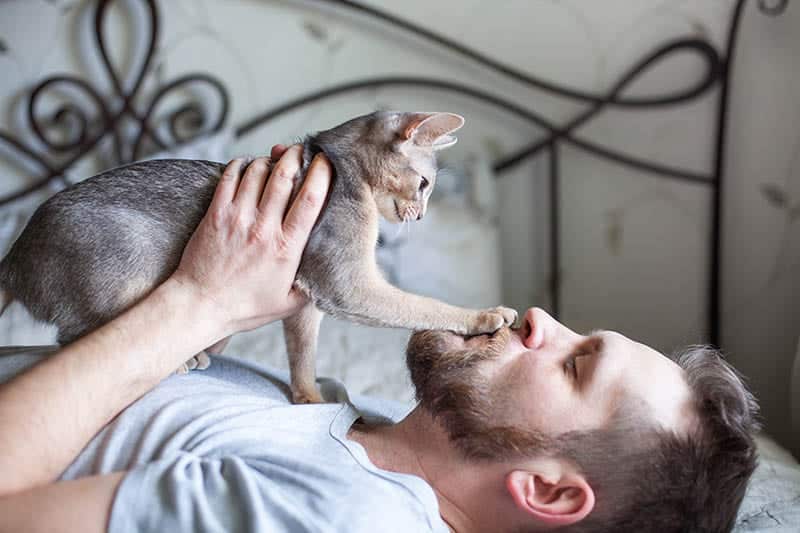
Felines have unique ways of showing you how much they love you. But one thing they don’t seem to do well is listen. This sets them apart from dogs, but it’s also partly what makes us love them!
Cats with no auditory issues are physiologically capable of hearing your voice. When it seems like they aren’t listening, it’s thought that they are ignoring us or are subtly communicating that they did hear us.
Let’s discuss the studies that have found that cats do indeed listen to their owners and why they sometimes choose to ignore them.

Do Cats Listen to Us?
They absolutely do. A 2022 study tested 16 cats by having their owners and strangers speak to them.1 The researchers used something called cat-directed speech, which is when you talk to your cat using short, repetitive phrases in a higher-pitched voice (considered a form of baby talk). They also had the strangers and owners talk to the cats using human-directed speech, which is how you would typically speak to another adult human.
The results showed that the cats did not react to human-directed speech from either the strangers or the owners. But they definitely reacted to cat-directed speech, though only from their owners.
In other words, your cat will likely ignore a stranger speaking to them but react when you talk to them in that specific voice you use only for your kitty.
So, science backs up the claim that our cats do indeed listen to us!

Does This Mean That Cats Can Recognize Our Voices?
A 2013 study used 20 cats to determine whether they recognize their owners’ voices.2 This was accomplished by using three strangers’ voices and their owners' voices, and the cats’ reactions to each voice were recorded.
The researchers found that the cats responded to their owners’ voices primarily through head and ear movements, particularly when their names were called. But these cats just weren’t interested in moving when any of the volunteers in the study called to them.
This tells us that your cat definitely recognizes your voice. While it might sometimes seem like your cat is ignoring you when you’re talking to them, they are actually probably listening. It’s important to learn to read your cat’s body language.
Do Cats Understand Us?
This is a bit trickier. For the most part, cats generally don’t understand what we’re saying. They will pick up on our tone and facial expressions and see that perhaps we are angry or happy but do not know what we’re actually saying.
The researchers from the 2013 study, which discovered that cats could distinguish their owners’ voices, conducted another study in 2019, which found that cats showed a stronger reaction when their name was called over other words.3 They reacted the same way as in the previous study with ear and head movements. Interestingly, though, the cats responded to their name the same way whether strangers or their owners said their names.
However, the researchers found that only 10% of cats actually moved when they were called—this should not be much of a surprise for anyone who owned a cat!

Why Do Dogs Seem to Listen Better Than Cats?
The domestication of cats was quite different from that of dogs. Cats were not domesticated to perform tasks or respond to commands. Instead, their presence was appreciated by humans because they were a small, friendly, tameable predator capable of controlling the populations of vermin and birds near planted crops. This contrasts them with dogs, which were domesticated to listen to commands and help hunter-gatherers track prey over long distances.
This means that cats weren’t domesticated to be easily trainable, nor were they supposed to perform a task with their humans. Dogs, on the other hand, had to interact with humans more and learn how to obey commands, and as such, they were more inclined to listen when being trained.
How to Communicate With Your Cat
Speaking to your cat throughout the day will strengthen your bond. Speak calmly and with a friendly voice while petting, grooming, and even feeding them. It doesn’t matter if they don’t understand what you’re saying; just hearing your voice will usually be a comfort.
Try to avoid sounding overly negative. Any form of punishment, including yelling or scolding harshly, will frighten your cat. If this happens frequently, your cat will become stressed and might even be afraid of you.
You should reward your cat whenever they listen to a command and for their positive behavior. This can be a treat, pets with an encouraging and happy tone, or even a short play session.

How to Understand What Your Cat Is Telling You
If you truly want to communicate with your cat, you should learn how to understand what they are trying to tell you. It can be super subtle, though, particularly compared to a dog’s body language.
The following signs can often (but not always) tell you about your cat's moods:
- Playful: Tail up, ears and whiskers pointing forward, semi-dilated pupils
- Content: Lying down or sitting, constricted pupils, still tail, ears pointing forward, half-closed eyes, purring
- Irritated or overstimulated: Dilated pupils, tail lashing or twitching, ears turned to the back, might growl or attempt to scratch, hissing
- Nervous and anxious: Airplane ears, dilated pupils, tail held low or tucked, slinking instead of walking, hissing
- Frightened: Arched back, fur along back and on tail standing on end, flat ears and whiskers, growling, yowling, hissing
- Angry: Constricted pupils, flattened ears, staring down, growling, yowling, lashing out

Frequently Asked Questions
How Do You Tell Your Cat That You Love Them?
Treating them with love and respect is paramount! You can slow-blink at your cat, which entails slowly closing your eyes, holding them closed for a second or two, and opening them. This tells your cat that you trust them.
Also, pet them, ensure they are fed well, and get them a cat tree and scratching posts. Spend time playing with them, grooming them, and petting them. All this combined is the best way to tell your cat that you love them.
Are Cats Talking to You When They Meow?
Absolutely! Cats only meow at people, not other adult cats. They say everything from “hello” to “feed me” or say that something is wrong.
Try to always respond to the meowing. Cats tend to meow for a good reason—though of course, some cats seem to like talking excessively. Double-check that something isn’t wrong before assuming that your cat is only meowing to hear the sound of their own voice.
How Many Words Can Cats Understand?
It’s believed that cats can understand approximately 20 to 40 words, and some cats might know more. But “knowing” words is based on their associations with them, not necessarily what they mean.
They will likely understand the positive words associated with positive outcomes, like “dinner.” The more certain words are repeated, the more your cat will recognize and possibly respond to them.


Conclusion
Cats do listen to us, but it might seem as though they are ignoring us or, with their usual subtlety, listening in a casual and non-committal way. Science has shown that cats do respond to their owners’ voices, but instead of running to us, they are more likely to stay exactly where they are.
But keep talking to your cat: It can only strengthen your bond, and the repetition of one word in conjunction with an action will help train your cat. Cats can indeed learn commands, but the real question is whether they will actually listen and obey (probably not).
See also:
Featured Image Credit: Oleg Ivanov, Unsplash
Expert cat care, straight to your inbox
News, insights, and useful advice, delivered to you.

No spam — unsubscribe anytime.
By signing up, you agree to our Terms & Conditions and Privacy & Cookies Policy.
How useful was this post?
Click a star to rate. You can leave written feedback afterwards. (We read all feedback.)
Kathryn was a librarian in a previous lifetime and is currently a pet writer. When she was a child, she hoped to work in ZOOs or with wildlife in some way, thanks to her all-consuming love for animals. Sadly, she's not strong in the sciences, so she fills her days with researching and writing about all kinds of animals and spends time playing with her adorable but very naughty tabby cat, Bella. Kathryn is hoping to add to her family in the near future – maybe another cat and a dog.