How to Tell If a Cat Is Going Into Labor: 6 Vet-Approved Signs to Look For


In this article
If your cat is expecting kittens, it can be an exciting time waiting for those adorable little bundles of fluff to arrive. You’ll want to make sure you have everything ready, so you should start watching for early signs of labor. The gestation period for cats is roughly 63-65 days long.
As the end of this period approaches, you can start looking for signs that your cat is going into labor. They can vary from cat to cat but follow a general pattern. We rounded up the six signs to look for so you can tell if your cat is going into labor and those sweet kittens are on their way!

The 6 Signs a Cat is Going Into Labor
1. Your cat will start to nest
As your cat prepares to give birth, she’ll need the perfect safe place where she can look after her kittens. A sure sign that a cat is about to give birth is that she starts to make herself a cozy nest. You can help by providing a box or a high-sided bed full of soft blankets for your cat to choose from. Remember that her opinion of the best place to start building her nest may differ from yours!
She’ll likely choose the place that she feels safest, and that may be in a corner of your bedroom, behind the couch, or another tucked-away spot. As long as her nest isn’t somewhere cold or completely inappropriate (like a bookshelf!), try to leave it where the mama cat has chosen.
Kittens can’t regulate their body temperature, so the nest must be somewhere warm and free of drafts. It’s also best that it’s off-access to other pets and kids, at least for the first week.
2. Her behavior may change
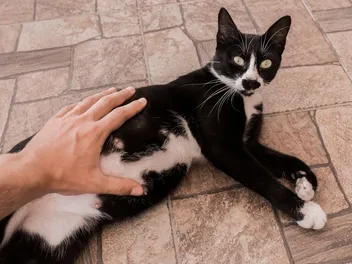
As your cat enters the last few weeks of her pregnancy, she may show a few temporary behavior changes. These can vary from cat to cat. Some cats will become much more solitary and spend time hiding in a quiet place.
Others will become far more affectionate and will always seek attention from their owners. Some cats will be restless and seem unable to settle. Keep an eye out for these changes, and do your best to accommodate whatever your cat seems to need!

3. Her mammary glands will get larger
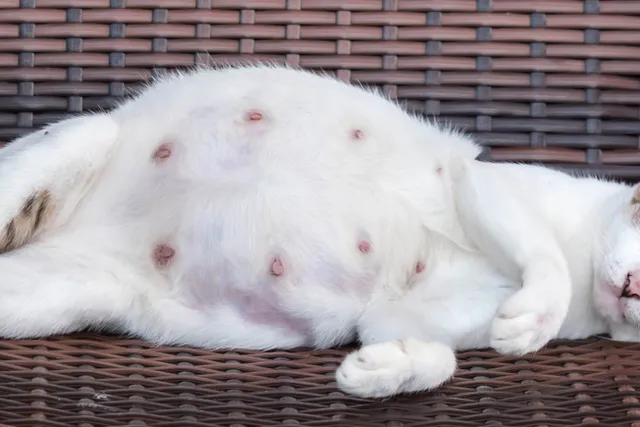
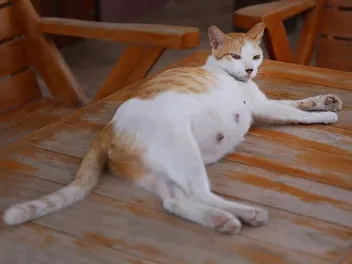
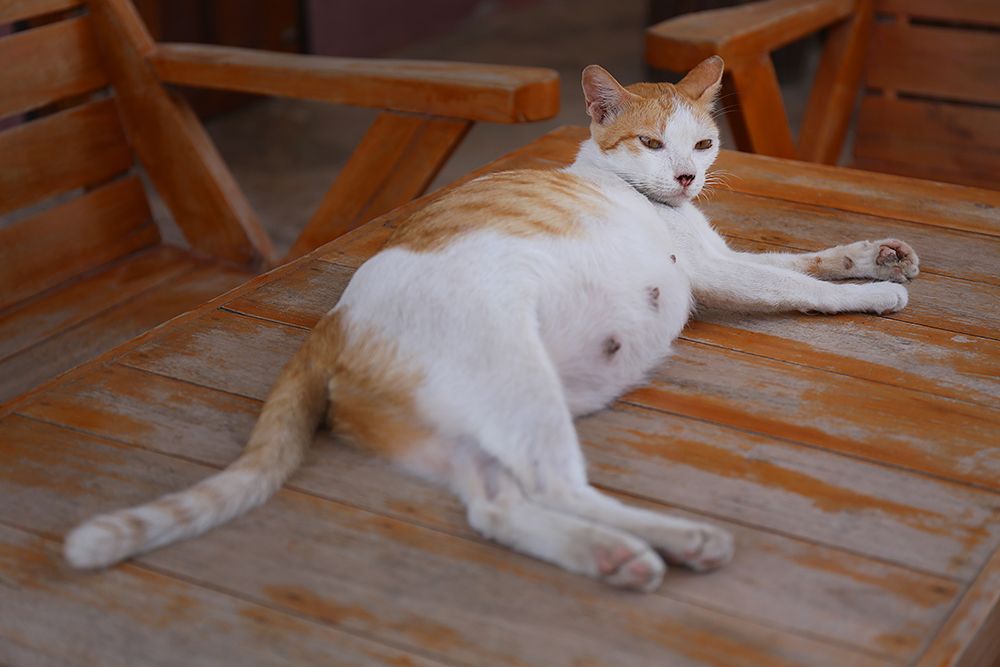
Around a week before your cat goes into labor, her mammary glands will get significantly larger. This indicates that she’s starting to produce milk. You may also see a little waxy “plug” on each nipple. This shows that milk production is up and running. Some cats lick these off, but don’t be tempted to touch them yourself.
The first milk contains the colostrum, also known as “liquid gold.” This vital milk contains antibodies and is only produced for the first 72 hours after birth. It will give her kittens a vital health boost and help their immune and digestive systems start functioning.
4. Her appetite will decrease
As your cat’s pregnancy progresses, it may be uncomfortable for her to eat as much. Before this, you may have noticed that she ate much more than usual! Her appetite may decrease dramatically in the week or so before she goes into labor. You can try offering her a palatable wet food in small portions to tempt her to eat a little.
Your cat’s appetite will likely increase rapidly as soon as her kittens are born! You can then free-feed her a nutritionally dense cat food to help her recover and produce enough milk to help the kittens grow big and strong.

5. Her temperature will drop
Around 1-2 days before your cat gives birth, her temperature will drop. The normal temperature range for cats is 100º to 102.5ºF (37.8-39ºC). As your cat is in the early stages of going into labor, her temperature will drop to around 99ºF(37.2ºC).
If your cat will let you, you can take her temperature by placing a thermometer under her armpit. Don’t worry if that’s impossible, as you’ll most likely see other signs indicating your cat’s labor is starting imminently.
6. She may start licking, making noise, and pacing
One of the final signs a cat is about to give birth is she will start to lick her genitals. As her waters break, she may start pacing and making a great deal of noise. These may be chirps, meows, or howls, depending on your cat’s personality.
While she’s in active labor, it’s best to leave her to her own devices as long as she’s in a safe place. Call a vet for advice if you’re concerned that she’s having problems or if something is wrong.

A Cat's Labor
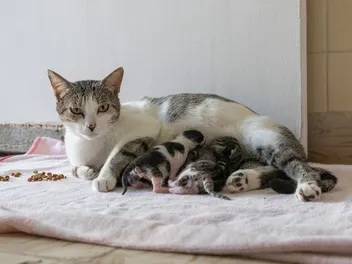
Once your cat’s contractions have started, you should expect the first kitten to be born within 30 minutes. The remaining kittens will likely be born every 10–60 minutes. After 4–16 hours, all the kittens should be born, but be prepared for it to take longer.
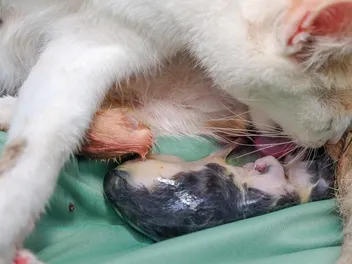
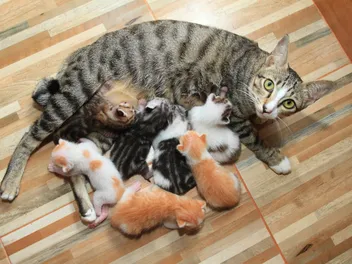
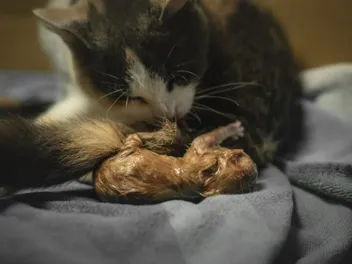
Your cat should tear away the amniotic sac from each kitten, helping them to breathe. She’ll also groom and start to feed the kittens that have already been born as she continues to give birth to the remaining kittens. Call a vet if your cat is straining for more than 30 minutes without a kitten being born or if she seems in pain.
Your cat should also pass a placenta for each kitten that’s been born. These may be passed after each kitten is born, or a few placentas may be passed together. It’s a good idea to make sure your cat has passed the same number of placentas as there are kittens.
A retained placenta can cause infections, and you should tell the vet if there aren’t the same number of placentas as kittens. Before too long, your cat should be ready to show you her new kittens!


Final Thoughts
Cats display several signs when they’re about to go into labor. In this article, we’ve listed some of the most common signs of impending labor. However, as each cat is an individual, you may not see all these signs in your cat. If you feel like your cat’s labor isn’t going as planned, or if you feel like she’s experiencing difficulty giving birth to her kittens, please take her to a vet promptly.
See also:
Featured Image Credit: Boy77, Shutterstock
Expert cat care, straight to your inbox
News, insights, and useful advice, delivered to you.

No spam — unsubscribe anytime.
By signing up, you agree to our Terms & Conditions and Privacy & Cookies Policy.
How useful was this post?
Click a star to rate. You can leave written feedback afterwards. (We read all feedback.)
Christian started writing for a local newspaper as a teenager, and he's been involved in the publishing industry for most of his adult life. Combining his love of writing with a passion for animals, he is currently the Director of Editorial at Pangolia and the Editor-in-Chief at Catster.
Christian lives in the Philippines with his wife, son, and four rescue cats: Trixie, Chloe, Sparky, and Chopper.