Get

In Your Inbox

Catster is reader-supported. When you buy via links on our site, we may earn an affiliate commission at no cost to you. Learn more.

Blue Burmese Cat: Info, Pictures, Facts & History

Share

Blue Burmese cat (Suphalak meaning fortunate, beautiful, and splendid appearance) walks in the paddock on a cloudy spring morning

Blue Burmese cats are gorgeous, medium-sized cats with muscular builds and distinctive round heads. They’re known for being almost dog-like due to their affectionate natures and tendency to follow people they love around. Burmese cats come in many shades, including sable, champagne, platinum, and gorgeous rich shades of gray, often referred to as blue.

They are relatively large cats, weighing up to 14 pounds, and they often live long lives; the average Burmese cat’s lifespan is around 18 years. While they may be the descendants of cats from the Thai-Burmese border area, the modern breed was developed in the US early in the 20th century.

Blue Burmese Cat Characteristics

Energy
+
A high-energy cat needs a lot of physical and mental stimulation to keep healthy and happy, while a low-energy cat needs minimal physical activity, but still needs mental stimulation. When choosing a cat, It’s important to ensure their energy levels match your lifestyle.
Trainability
+
Cats that are easy-to-train are more willing and skilled at quickly learning prompts and actions with minimal training. Harder-to-train cats are usually more stubborn or aloof and require a bit more patience and practice.
Health
+
Certain cat breeds are more prone to various genetic health problems, and some more than others. This doesn’t mean that every cat in those breeds will have these issues, but they do have an increased risk, so it’s important to understand and prepare for any additional needs they may require.
Lifespan
+
Due to their size or potential genetic health issues of a specific breed, some cats have shorter lifespans than others. Proper nutrition, exercise, mental stimulation, and hygiene also play an important role in your cat’s lifespan and quality of life.
Sociability
+
Some cat breeds are more social than others, both towards humans and other cats and animals. Cats that are more social have a tendency to rub up on strangers for scratches or jump on laps for cuddles, while cats that are less social shy away, hide, are more cautious, and even potentially aggressive. No matter the breed or gender, it’s important to socialize your cat and expose them to many different situations.

divider 2 cats

The Earliest Records of Blue Burmese Cats in History

The very first Burmese cat, Wong Mau, arrived in the US from Burma in 1930. Wong Mau had a dark brown coat and dark pointing. She also had a compact, muscular build and a relatively short tail. Wong Mau was given to Dr. Joseph Thompson, who then bred her with a Siamese cat, Tai Mau.

Some of the kittens resembled Wong Mau, and others took after their Siamese cat father. Thompson bred Wong Mau with one of the kittens, which resulted in a litter of compact brown cats—the breed’s founding generation.

Burmese cats are closely related to Siamese cats and tend to be lithe and graceful. But during Harrison Weir’s groundbreaking 1871 Crystal Palace cat show, two kitties with Burmese-cat-like characteristics were shown as Siamese cats, suggesting that cats with similar traits existed before Thompson’s intentional selection for dark, relatively muscular cats with round heads and golden eyes.
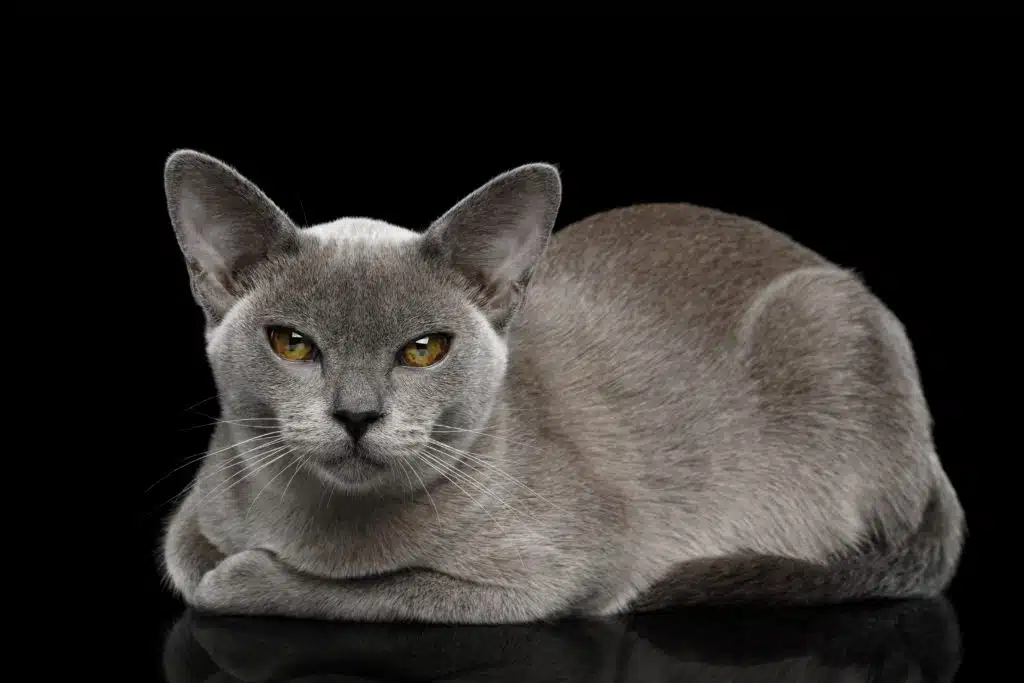
Blue Burmese Cat
Image Credit: Seregraff-Shutterstock

How Blue Burmese Cats Gained Popularity

Medium-sized, muscular, sable, pointed cats have most likely existed for centuries in Southeast Asia. Tonkinese cats, Siamese cats, and Burmese cats are all closely related and were considered one breed until cat fanciers began advocating for the three to be classified separately.

Burmese cats became incredibly popular once accepted by the CFA in the 1930s, leading to a fair amount of interbreeding with Siamese cats to produce enough kitties to keep up with demand. Burmese cats were the third most popular pedigree kitties in the US for a few years during the 1970s and began taking home serious wins in national competitions around the same time. Breeders started selecting for the round heads now associated with the breed in the 1970s. Originally, breeders selected exclusively for dark brown coats, but litters regularly popped up with lilac, champagne, and blue kittens.

Formal Recognition of Blue Burmese Cats

While Siamese cats were one of the earliest breeds to be recognized by a major cat fancy organization, Burmese cats were only accepted for registration by the Cat Fanciers’ Association (CFA) in 1936. Due to the amount of outcrossing with Siamese cats, the CFA decided to stop recognizing the breed in 1947.

The policy was reversed in 1957 when there were sufficient numbers of non-hybrid Burmese cats to proceed. Burmese cats were recognized by the Governing Council of the Cat Fancy (GCCF) in 1952 and The International Cat Association (TICA) in 1979.

Originally, only sable cats were recognized by the CFA. Still, due to the regular appearance of kittens with coloring similar to that seen in Siamese cats, the CFA began acknowledging lilac, champagne, and blue Burmese cats in 1979. However, they were initially categorized as Malayan cats. In 1984, the CFA decided to classify “Malayan cats” as dilute Burmese cats, effectively extending official recognition to blue, champagne, and lilac Burmese cats.

Cat ball divider 1

Top 3 Unique Facts About the Burmese Cat

1. Wong Mau Was Actually a Tonkinese Cat

While Wong Mau is now recognized as the mother of the Burmese cat breed, it turns out she was actually a Tonkinese Cat, as she had a mixture of Siamese cat and Burmese cat traits. Tonkinese cats come in more than 10 colors and are generally medium-sized, muscular kitties. Although the CFA only recognized them in 1984, they’ve been around for quite some time. They’re most likely the cats described in The Cat-Book Poems of Siam in 1358. During the 19th century, cat lovers in the UK referred to them as “chocolate Siamese cats.”


2. European Burmese Cats Are a Different but Related Breed

Burmese cats are closely related to European Burmese cats, a separate but similar breed that’s also related to Wong Mau. A few of Wong Mau’s descendants made their way to the UK, where they were bred with Siamese cats, creating cats who differ slightly from their relatives in the US. European Burmese cats come in more colors than Burmese cats, including red, cream, and various tortoiseshell combinations. They have slightly curved eyes and are less muscular than Burmese cats. European Burmese cats were elevated to championship status by the CFA in 2002.

Blue Burmese
Image Credit: ollie harridge, Flickr

3. Burmese Cats Have Been Around for Centuries

While modern pedigree Burmese cats can all trace their ancestry to Wong Mau, in the past, similar cats were relatively common in the area near the Thai-Burmese border. They reportedly lived in temples and were treated with profound respect. They are said to have been favored by Burmese kings and greatly valued in India.

US Army officers reported seeing kitties with Burmese cat-like characteristics in Thailand during the Second World War. During the 1960s and 1970s, several Burmese cats made their way to the US, but Wong Mau formed the true base for the creation of the modern pedigree breed.

divider 2 catsDo Blue Burmese Cats Make Good Pets?

Burmese cats generally make wonderful pets, as they’re quite loving and easygoing. They are playful and often become quite attached to their companions. Many follow their favorite people from room to room, and others have regular “conversations” with human family members. Most get along well with dogs and other cats. While they tend to enjoy the attention, they aren’t a particularly active breed.

Their short, soft coats only require a little grooming. A good brushing once a week is generally sufficient. Regular at-home dental care and claw trims are also required. They do best when eating high-quality cat food that adheres to the American Association of Feed Control Officials (AAFCO) nutritional guidelines for feline nutrition.

divider 3 paws

Conclusion

Burmese cats haven’t been around as an official breed for terribly long; the CFA only recognized them in 1936, and the blue variant only got the nod decades later! These muscular, charming kitties trace their ancestry back to a cat from Burma who became the breed’s founding mother.

Blue Burmese cats are typically loving, sweet, and affectionate and make absolutely wonderful pets! Often described as dog-like, they’re known for following their owners around the house. While they enjoy playing games, they’re also happy just hanging out and being mellow as long as their favorite people are nearby.


Featured Image Credit: alybaba, Shutterstock

Want content like this delivered to you?

Sign Up For Our Newsletter

News, insights, expert advice, and everything cat

* By submitting, you agree to our Terms & Conditions and Privacy & Cookies Policy.


How useful was this post?

Click on a star to rate (you can leave written feedback after clicking submit)

Help us improve Catster for pet parents!

Your feedback really matters.

What did you like about this post? Also how can we improve it?

Join the conversation

Leave a Reply

You’re very welcome to leave a comment or question. Please know that all comments must meet our community guidelines, and your email address will NOT be published. Let’s have a positive and constructive conversation.


Talk With A Vet Online

Peace of mind,
anywhere, anytime

Affordable vet advice

Ask Dr. Paola – Help! My Cat Suddenly Has Dandruff! (March 30, 2026)

Welcome to our “Ask Dr. Paola” series, where every Monday we bring expert advice straight from Dr. Paola Cuevas (MVZ) to help our...

Your Cat Keeps Vomiting After Eating: Here’s What’s Going On

Cats vomit. It’s one of the less glamorous facts of life with a feline, and most cat owners have cleaned up more than...

Ask Dr. Paola – Help! My Cat Gets Diarrhea from Wet Food! (March 23, 2026)

Welcome to our “Ask Dr. Paola” series, where every Monday we bring expert advice straight from Dr. Paola Cuevas (MVZ) to help our...

Cat Shampoo Alternatives That Are Already in Your House

If your cat has ever gotten into something disgusting and you’ve found yourself without cat shampoo, we’re here to help. Before you panic...

More related

Why Does My Cat Sleep Between My Legs? 5 Reasons for This Behavior

We’re never going to understand our cats and their quirky behavior! If your cat loves to snuggle up for a nap between your...

10 Best Cat Carriers in 2026 – Reviews & Top Picks

Traveling with your cat can be stressful, especially if your cat has high anxiety while traveling. When you have to load up your...

Do Cats Have an Evening Routine? Vet Approved Facts & FAQ

Cats are creatures of habit, and they love routine. That’s why they know when dinnertime is approaching and will let you know if...

Magical Disappearing Cats: Zazzles & Alex’s Vanishing Acts

Hi, I’m Dr. Karyn! Read my introduction to learn more about me and meet my five hilarious cats: Clutch, Cyril, Alex, Zelda, and...

Keep reading

Cat Peeing in Front of the Litter Box? 14 Vet-Reviewed Solutions to Try

Discovering a little puddle of cat pee in front of the litter box can be frustrating, but your cat is not doing this on purpose! When we dig deeper into the reasons that cats pee in front of, instead of...

Bengal cat sitting aside of a litter box staring at it

7 Most Annoying Sounds Cats Make: Possible Causes & Prevention Tips

Cats are adorable pets and can be some of the best companions and roommates. They look cute and can make cute sounds. In fact, some studies show that a cat’s purring may have therapeutic effects 1. However, there’s no denying...

Ginger tabby young cat sitting on a wooden floor looks up

Can Cats Eat Roast Beef? Vet Reviewed Benefits & Concerns

It is difficult to ignore the urge to spoil our pets. After all, we do it all the time for ourselves, so we want to give our lovely cat a tasty treat from our plate. But before you give human...

Can Cats Eat Roast Beef

Can Cats Eat Baby Food? Vet-Reviewed Facts & FAQ

Your cat is your baby. But if you recently brought a human bundle of joy home, you may be tempted to share some nutritious baby food with your feline friend. Can your cat safely consume baby food? It depends. While...

Can Cats Eat Baby Food

Why Does My Cat Eat So Fast? Vet-Approved Feline Facts & FAQ

Do you ever watch your cat scarf down their food and wonder why they eat so fast? There might be a reason for their speedy eating habits—cats are hardwired to eat quickly to protect their food from predators. In the...

maine coon cat eating

How to Speak Cat: Vet-Verified Ways of Communicating with your Kitty

Think your cat can’t talk to you and you can’t talk back? Learn how to speak cat by paying attention to your cat’s body language and vocalizations....
young cat owner playing with her pet at home

How To Read a Cat’s Body Language: 5 Vet-Reviewed Moods & Signals

While cats can’t use words to tell us how they’re feeling, most are expert communicators who rely on different types of vocalization, body language, and chemical cues to tell humans and other cats how they feel. Cats use their tails,...

A cat looking at something far away

How Cold Is Too Cold for Cats? Vet-Reviewed Facts & FAQ

It’s easy to overestimate a cat’s tolerance for the cold. When they walk around sporting several inches of insulating fluff and act nonchalant in frigid outdoor weather, who can blame you? The outdoors is what many cats call home, and...

Neva Masquerade cat in the snow

Love Cats? So Do We! Join the Catster Community

Stay informed with expert pet care insights delivered straight to your inbox! Discover professional guidance on animal behavior, feeding tips, trusted product picks, and much more.


Sign up for the Catster Email Newsletter

Stay informed with expert pet care insights delivered straight to your inbox! Discover professional guidance on animal behavior, feeding tips, trusted product picks, and much more.