Can Cats Recover From Hind Leg Paralysis? (Vet Answer)

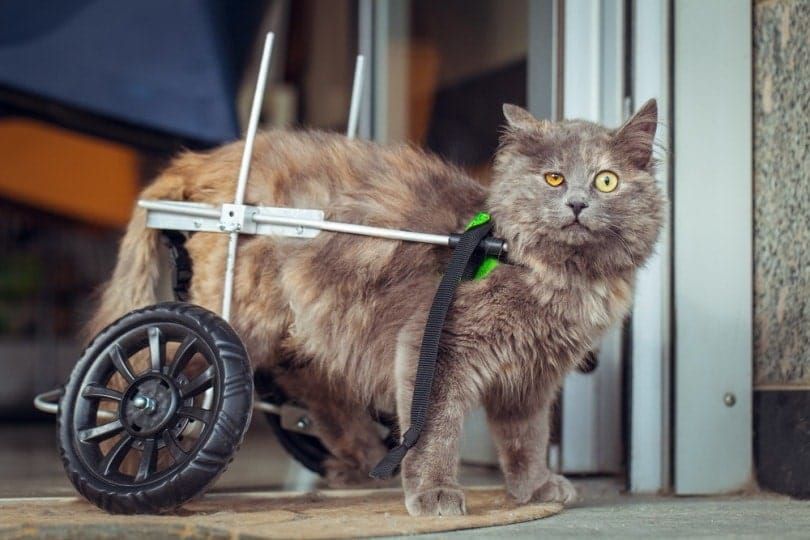
If you have a cat with hind limb paralysis, you would do anything to help them get better. But in the face of this devastating condition, the uncertainties may seem overwhelming, and you might wonder: Will my cat be able to walk again?
In general, the prognosis for felines suffering from hind leg paralysis is, unfortunately, poor. However, depending on the underlying cause of your cat’s paralysis and the severity of their signs, recovery is possible.
The following article will discuss hind leg paralysis in felines, including the causes, diagnosis, and treatment options available for this condition. We will also review general prognostic information associated with hind limb paralysis to help guide you through what this condition may mean for your favorite feline.

What Is Hind Leg Paralysis?
Paralysis is the partial or complete loss of voluntary motor function in affected parts of the body. Paresis is a similar term that may be used to describe weakness or reduced motor function in certain areas of the body. Hind leg paresis or paralysis may be unilateral (affecting one back leg) or bilateral (affecting both back legs).
Causes of Hind Limb Paralysis in Felines
There is a wide range of potential causes of hind leg paresis and paralysis in cats, including the following conditions:
- Trauma: Trauma, such as being hit by a car, may result in intervertebral disc extrusion, vertebral fractures, or vertebral luxations, all of which may lead to paralysis.
- Aortic thromboembolism: In cats with aortic thromboembolism (ATE), a thrombus, or blood clot, typically forms in the heart and ultimately lodges in the terminal aorta. Heart disease is the leading cause of ATE in felines, and affected cats will typically have acutely painful, paralyzed hind limbs that are cool to the touch. Older male cats are most frequently affected by this condition.
- Cancer: Cancer affecting the spine or spinal cord is relatively common in felines, with lymphosarcoma being the most frequently diagnosed type of tumor.
- Intervertebral disc disease (IVDD): IVDD most frequently affects middle-aged to older cats, and its symptom onset is often gradual.
- Congenital abnormality of the spinal cord: Spina bifida is a congenital condition, seen primarily in Manx cats, that causes paresis or paralysis, which is noted shortly after birth.
- Diabetic neuropathy: Weakness affecting the hind limbs can be seen in cases of uncontrolled diabetes mellitus in affected felines.
- Infectious and inflammatory disease: Infectious inflammatory conditions represent approximately 30% of diseases affecting the feline spinal cord and include feline infectious peritonitis (FIP), cryptococcus, toxoplasmosis, feline leukemia, and feline immunodeficiency virus.
- Fibrocartilaginous embolic myelopathy (FCE): In felines affected by this condition, material from an intervertebral disc obstructs a spinal cord vessel, most frequently leading to asymmetric or unilateral signs.
How Is Hind Leg Paralysis Diagnosed?
If you are concerned about paresis or paralysis in your cat, veterinary attention should be sought right away. a veterinarian will obtain a thorough history regarding your cat’s signs, as well as perform a complete physical exam, including both neurologic and orthopedic evaluations. Based on their findings, diagnostic testing may be recommended and can include the following tests:
- Blood tests: A complete blood count, blood chemistry, and specific tests for infectious diseases may be considered to evaluate hind limb paralysis in cats. Results may be normal in cases of paralysis resulting from neurologic or orthopedic conditions; however, blood work may provide evidence for the presence of inflammatory conditions (such as FIP or toxoplasmosis). Evaluation of cerebrospinal fluid (CSF) may also be considered to further evaluate for possible inflammatory conditions in affected felines.
- X-rays and abdominal ultrasound: X-rays may be performed to evaluate the chest, abdomen, or spine and will frequently be recommended in cases of hind limb paralysis resulting from trauma. Imaging, such as X-rays and ultrasound, may also help screen for evidence of cancer.
- Computed tomography and magnetic resonance imaging: Advanced imaging, such as computed tomography (CT) and magnetic resonance imaging (MRI), may be recommended for evaluation of the spinal cord, as well as for more detailed imaging of tissues or bone.
Treatment for Hind Limb Paralysis in Cats

Treatment for feline hind limb paralysis largely depends on the underlying cause. Initial treatment for this condition will often involve stabilization with intravenous fluids and pain medication, if appropriate. Certain causes of paralysis, including trauma, IVDD, and cancer, may benefit from surgery as a primary treatment modality.
Cases of hind limb paralysis resulting from ATE in cats are most often secondary to heart disease. Effective treatment for these cases will involve addressing the underlying heart condition, in addition to supportive care for the resulting paralysis.
If cats survive the immediate period following the onset of hind limb paralysis, nursing care will also be an important component of treatment. Nursing care of affected felines will likely encompass keeping them clean and dry, providing a soft or padded surface, turning them regularly to prevent pressure sores, and helping them to urinate, if needed.
What Is the Prognosis and Recovery Period for Felines With Hind Leg Paralysis?
Similar to the treatment of hind limb paralysis, the prognosis for this condition will depend on its underlying cause. Cats affected by IVDD can have a positive prognosis following surgery, with one study noting significant improvement in clinical signs within 2 weeks of surgical decompression of the spinal cord.
Felines diagnosed with FCE tend to have a more guarded prognosis. However, for those that can recover, improvement is typically noted within 2–6 weeks of the onset of signs.
In cats with paralysis secondary to spinal cord trauma, deep pain perception is an important prognostic indicator—felines without deep pain perception are considered unlikely to recover. The prognosis for hind limb paralysis secondary to spinal cord trauma, cancer, FIP, and aortic thromboembolism is generally considered to be guarded to poor.
If you are concerned or have questions about your cat's health, you can also speak to a vet from the comfort of your own home to help make a plan. They can determine when an in-clinic vet visit should be made.
Conclusion
In summary, while cats affected by hind limb paralysis can recover, unfortunately, the overall prognosis for paralyzed felines is poor. A veterinarian will be the individual best able to provide recommendations and prognostic information specific to your cat to help you to navigate this concerning condition with confidence.
Sources
Featured Image Credit: Morrowind, Shutterstock
Expert cat care, straight to your inbox
News, insights, and useful advice, delivered to you.

No spam — unsubscribe anytime.
By signing up, you agree to our Terms & Conditions and Privacy & Cookies Policy.
How useful was this post?
Click a star to rate. You can leave written feedback afterwards. (We read all feedback.)
Dr. Leigh Wilder DVM (Veterinarian)
Leigh is a veterinarian with almost 10 years of experience in the US. She has loved animals since she was a child, and grew up caring for hamsters, guinea pigs, rats, fish, and dogs. Leigh received her Doctor of Veterinary Medicine degree from the University of Minnesota and has worked in both small animal clinical practice and shelter medicine since graduation. Leigh enjoys small animal preventative medicine and surgery and loves helping pet owners by sharing her knowledge. Outside of work Leigh enjoys spending time with her family, reading, and traveling.