Cat Food: Why It Pays to Get It Right
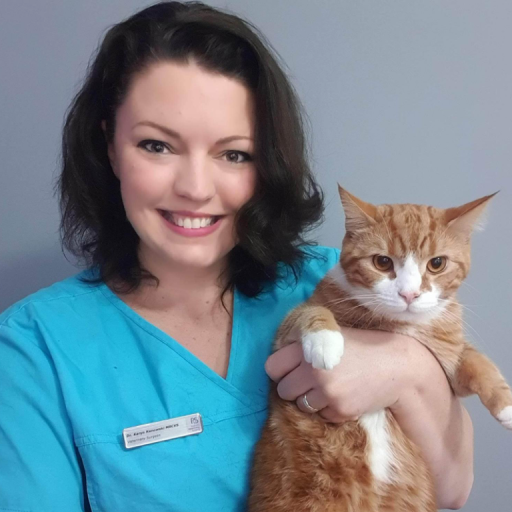
Hi, I'm Dr. Karyn! Read my introduction to learn more about me and meet my five hilarious cats: Clutch, Cyril, Alex, Zelda, and Zazzles.
One of the most common questions I get asked by pet owners is: What Is The Best Food For My Cat? The honest answer is that there is no one food that is the best. The best food for your cat might be the worst option for the cat living next door.
There are literally hundreds of different pet food brands and varieties because every cat is different, every household is different, and every budget is different. So, how do you make the right choice for your cat?
The first thing to know is that I would rarely classify any cat food as “bad”, but some are definitely better than others. Provided that you are purchasing FDA and AAFCO-compliant cat food from a reputable source, you are purchasing a product that has been tested as safe for cats. But just like with human food, being “safe to eat” does not necessarily equate to “good for you.”
The overriding benefit of feeding your cat a commercial diet over a home-prepared food is that they have undergone analysis to ensure they contain the appropriate balance of fats, protein, amino acids, vitamins, and minerals. This can be achieved with homemade foods, but it does require a lot more planning. So today, I’m just going to focus on commercial, aka store-bought, cat food.

There Are So Many Options - How Do I Choose?

One of the simplest pieces of advice for choosing the best food for your cat is to select the highest quality food you can afford. This obviously implies that the better the quality, the higher the price, but I don’t necessarily agree that the most expensive food is always the best food, and it certainly might not be the best food for your cat.
So how do we know which food to choose? I like to ask a few questions to narrow down our choices.
What life stage is your cat? Kitten, young adult, mature adult, or senior?
How active is your cat?
Is your cat overweight or underweight?
Does your cat have any health conditions or potential health issues due to their breed or genetics?
Does your cat have any allergies?
Does your cat go outdoors or are they strictly an indoor cat?
Do you have a preference for wet food or dry food?
How concerned are you about litter box odor?
What is your budget?
Wet vs. Dry

Which is best? Again, it depends on your cat. Some argue that wet food is better for hydration and kidney health, while others recommend dry food for dental health. Both and neither is right.
Dry food is only good for teeth if it is a large-size kibble designed to get cats chewing the food, otherwise there is actually very little chewing involved with dry food.
Wet food is usually around 80% moisture, so it can be a good way to boost your cat’s hydration, but the flipside is that cats that eat dry food tend to drink more water, whereas cats on a wet food diet rarely visit the water bowl unless there is a problem.
Some cats prefer wet food over dry, some seem to vomit or regurgitate dry food, others don’t tolerate wet food too well. So the decision to feed wet or dry, or a combination of the two, is one for you and your cat to decide.

Raw Feeding
This is something that has gained popularity over recent years, and there is a right and wrong way to do it. Cats fed a raw diet are at a higher risk of being infected with internal parasites and pathogens, but this risk is minimized with appropriate preparation and storage.
Again, the best way to make sure your cat’s raw diet contains the right balance of nutrients is to source it from a reputable pet food provider. Just feeding your cat raw meat alone will lead to serious nutrient deficiencies and can be dangerous.
Why Does Price Matter?
What this comes down to is the quality of the protein (meat) used, how much “other” ingredients are included, and how mass produced the product is.
As you can imagine, a cat food made from high quality veal, with minimal additives, which is produced in smaller batches to allow for stricter quality control procedures, is going to cost a lot more than foods that are based primarily on meat meal and carbohydrates, and mass-produced in large batches. Again, these foods are safe, they’re just not as good.
Another thing to watch out for are foods that look appealing. When commercial cat food is prepared, it usually undergoes heat treatment to eliminate any potential pathogens, and this process leeches most of the natural pigments from food. This is why you’ll often notice that premium and veterinary diets are a sea of brown and beige. If you see bright oranges, reds, or greens in your cat’s food, it’s because of artificial coloring, and that’s done to appeal to us, not to our cats.
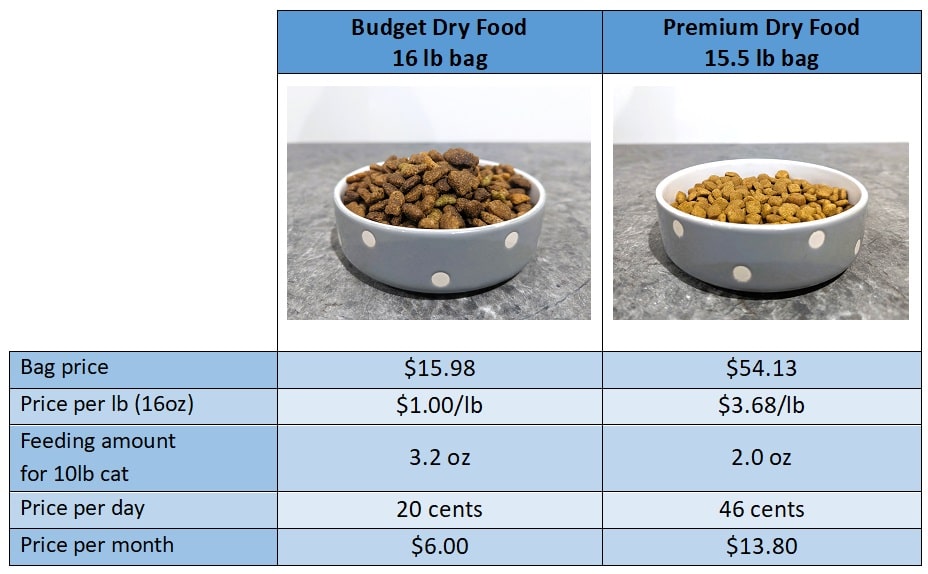
To give you an example, here’s a comparison between two dry cat foods.
The one on the right is a premium brand often recommended by vets (it is also one that I feed my own cats).
On the left is a popular brand stocked by pet stores and supermarkets. Both are certified as safe for cats, and there is no danger in feeding your cat the food on the left, unless they don’t tolerate it well. But it does give you an idea of what you’re paying for.
| Budget Dry Food Ingredients | Premium Dry Food Ingredients |
| Ground Yellow Corn, Corn Gluten Meal, Poultry By-Product Meal, Soybean Meal, Animal Fat Preserved With Mixed-Tocopherols, Liver Flavor, Meat And Bone Meal, Ocean Fish Meal, Phosphoric Acid, Calcium Carbonate, Potassium Chloride, Salt, Choline Chloride, Salmon Meal, Tuna Meal, Shrimp Meal, Dehydrated Seaweed Meal, Taurine, Minerals (Zinc Sulfate, Ferrous Sulfate, Manganese Sulfate, Copper Sulfate, Calcium Iodate, Sodium Selenite), Vitamins [Vitamin E Supplement, Niacin (Vitamin B-3), Vitamin A Supplement, Calcium Pantothenate (Vitamin B-5), Thiamine Mononitrate (Vitamin B-1), Riboflavin Supplement (Vitamin B-2), Vitamin B-12 Supplement, Pyridoxine Hydrochloride (Vitamin B-6), Folic Acid (Vitamin B-9), Vitamin D-3 Supplement, Biotin (Vitamin B-7), Menadione Sodium Bisulfite Complex (Vitamin K)], Yellow 5, Dl-Methionine, L-Tryptophan, Red 40, Blue 2. | Dehydrated poultry protein, rice, maize, vegetable fibers, wheat, vegetable protein isolate*, animal fats, hydrolysed animal proteins, maize gluten, beet pulp, yeasts and parts thereof, minerals, soya oil, fructo-oligo-saccharides, fish oil, psyllium husks and seeds (0.5%). Vitamin A: 14000 IU, Vitamin D3: 700 IU, E1 (Iron): 33 mg, E2 (Iodine): 3.3 mg, E4 (Copper): 10 mg, E5 (Manganese): 43 mg, E6 (Zinc): 129 mg, E8 (Selenium): 0.07 mg |
This Isn’t a Guilt Trip!
Let me be clear: I am not trying to make you feel guilty if your cats are on a lower budget food. You are not putting them in danger, you are not a bad cat parent. And if your cat is happy and healthy and thriving, then there is no reason to fix something that isn’t broken.
But I see a lot of otherwise healthy cats that are always hungry, and passing a lot of loose and smelly poops, and most of the time, this can be addressed with a change in diet. That doesn’t mean you need to start buying the most expensive food in the shop, but you may want to spend just a little bit more.
It All Comes Out in the Box
The litter box, that is. Just like with us, when our cats eat foods that contain a lot of additives and ingredients that are surplus to requirement, we see the results at the other end. If your cat farts a lot, poops more than once or twice a day, and clears a room when they use the litter box, it’s a sign that they aren’t digesting their food well. This could mean that they have a health problem, or it may just be a sign that they aren’t eating the right food for them.
My home office doubles as our cat room, and the litter boxes are right beside my desk. With five cats, litter box odor and hygiene are a priority for me. Because of the type of food my cats eat, and the type of litter we use, their poop only smells for a minute or two. So if I’m not in the room at the moment they go, I don’t notice any smell—and I have quite the sensitive nose.
So I do spend a bit more on food and litter, but if you’re not spending the day sitting next to a litter box, you can probably get away with spending a little less.
Price vs. Value
One major consideration when choosing the right food for your cat is price. Obviously, the higher quality foods cost more, BUT most of the time, you also feed a lot less.
If you take the food examples we looked at earlier, the amount of the budget food needed to feed a 10-pound cat is around ¾ to 1 cup per day. The same sized cat would need ½ to ¾ of a cup per day of the premium brand. It will still cost you more, but each pound of food will last twice as long.
If you saw my video on Scatter Feeding, you might have noticed that I took one scoop of food from the bag. That scoop measures just over 1 cup, and that is for all five cats. Yes, a single cup for five cats, twice a day, which works out to about half a cup per cat per day. They don’t go hungry, and they’re all in good body condition. With the exception of Cyril; he really skews the figures!
Hey Dr Karyn - what’s the best food for my cat?
Sorry folks, there is no right answer. But hopefully, this will help guide you to find the right food for your cat and your budget. Consider your cat’s age, health, and preferences. Work out what features are important to you, spend some time looking over the ingredients, and find the best product within your budget that your cat enjoys eating.
Talk to your vet and make sure there aren’t any other specific needs you should be addressing for your cat, and use tools like body condition scoring to ensure that your cat is on the right amount of food too - overfeeding leads to overspending, and overweight cats.
Next time, I’ll talk to you about how to choose the right cat litter, another feature that is important for me in my office/cat latrine!
This article is a part of Dr. Karyn's series with her five hilarious cats.


Expert cat care, straight to your inbox
Vet-reviewed advice, behavior tips, and the best of Catster. Free, and you can unsubscribe anytime.
By signing up, you agree to our Terms & Conditions and Privacy & Cookies Policy.
Dr. Karyn Kanowski BVSc MRCVS (Veterinarian)
Dr. Karyn comes from Queensland, Australia, and has lived in the UK for the past 10 years. In 2010, she graduated from The University of Queensland School of Veterinary Science and also has a Bachelor’s degree in Zoology. She is passionate about using evidence, experience, and owner collaboration to provide the best solutions for pets, and believes in making reliable information about animal health accessible to all. Dr. Karyn shares her home with five cats, four dogs, and one husband. When she is not in the scrubs, she spends her time writing, gardening, and cleaning up pet hair!
Join the conversation
Ask a question, share your story, or send private feedback.