8 Household Items That Are Toxic to Cats (Vet Answer)

Yes, some cats have a propensity for laziness. But all cats are inquisitive creatures by nature, and you can bet that your cat has explored every corner of the home at some point in time. Unfortunately, many household plants, items, cleaning products, and foods are harmful to cats. It can be hard, or even impossible, to train a cat not to eat things.
Therefore, preventing their access to them is important; this may involve either keeping harmful items locked away or not keeping them in the house at all. But first, you need to know what to be careful of. Below is a summary of the eight most common household items that can be toxic to cats.

The 8 Household Items That Are Toxic to Cats
1. Lilies

Unfortunately, lily toxicity in cats is relatively common. These plants are striking, readily available in many parts of the world, and very popular. However, they are also extremely dangerous to cats. All parts of the lily, including the stems, leaves, and flowers, are toxic to cats.
Easter lilies (Lilium longiflorum), Stargazer lilies (Lilium Stargazer hybrid), and Asiatic lilies (Lilium asiaticum) seem to be the most hazardous. The toxin in lilies has not yet been identified, but we do know that it can cause life-threatening kidney disease. Some cats can make a recovery, but others remain in lifelong kidney failure or even need to be euthanized.
If you have a cat, never keep lilies in your house or garden—the risks are too high.
2. Human Medications

Many medications used to make people feel better do the opposite to cats. Remember, these drugs and medications were designed for (and studied in) humans. The physiology of cats, as well as their significantly lesser body weight, means that they cannot metabolize human medications. The most common over-the-counter medications that are harmful to cats are paracetamol (Tylenol), aspirin, and ibuprofen (Advil). These are common brand names only—many other brands exist.
You may need to keep these pain relief medications in the house for your own use, but always keep them stowed away in a lockable cabinet or cupboard.
3. Car Antifreeze

Ethylene glycol is the active ingredient in most automotive antifreeze products. Antifreeze works by stopping the water in your engine's cooling system from freezing during the winter months. Antifreeze is odorless and sweet-tasting. It is also extremely harmful to cats—as little as one-eighth of a teaspoon can cause toxicity. Initially, cats appear lethargic, uncoordinated, and often vomit—these are the signs of being “drunk” as antifreeze is technically a type of alcohol.
Shortly after this, cats appear to improve, which can trick owners into thinking everything is okay. Then, 12–24 hours after ingestion, kidney damage begins, and irreversible kidney failure may occur.
4. Batteries and Magnets

We don’t fully understand why a cat would eat a metal object, but it happens. Button batteries, also known as coin batteries or button cells, can pose a problem to cats if they get stuck in the esophagus or stomach. Magnets can also be problematic, particularly if two are ingested. Why? A magnet sitting in one loop of the bowel can attract a magnet elsewhere in the bowels, pulling these loops of intestines together. Each magnet will then be pressed with great force against the wall of the intestine in an effort to stay attached to the other magnet.
This leads to perforation of the intestines; food then escapes the bowels and causes infection in the abdomen, which is life-threatening.
5. String and Hair Ties

Some fabric materials can be harmful to cats. Cats love string because they see it as prey; it gives them a chance to express some of their feline instincts. However, if a cat eats a long enough piece of string, it can act as what vets call a “linear foreign body”. These are long pieces of fabric that get stuck in the digestive tract, causing bunching of the bowels as they contract in an effort to pass the material.
Hair ties, on the other hand, are more perplexing. For reasons largely unknown, many cats will eat hair ties. These can sit in the stomach and accumulate (if the cat keeps eating them) until they form a blockage. Ingested string and hair ties should be removed either surgically or endoscopically (camera-guided).
6. Foods

We’re not here to tell you that you can’t have chocolate in your home—just that you should keep it away from your cat. In addition to chocolate, which causes vomiting, diarrhea, heart problems, and seizures, there are other foods that must be kept away from your cat. Garlic and onions cause anemia. Grapes and raisins can cause kidney problems. Alcohol, raw eggs, and raw meat should all be avoided too.
7. Cleaning products

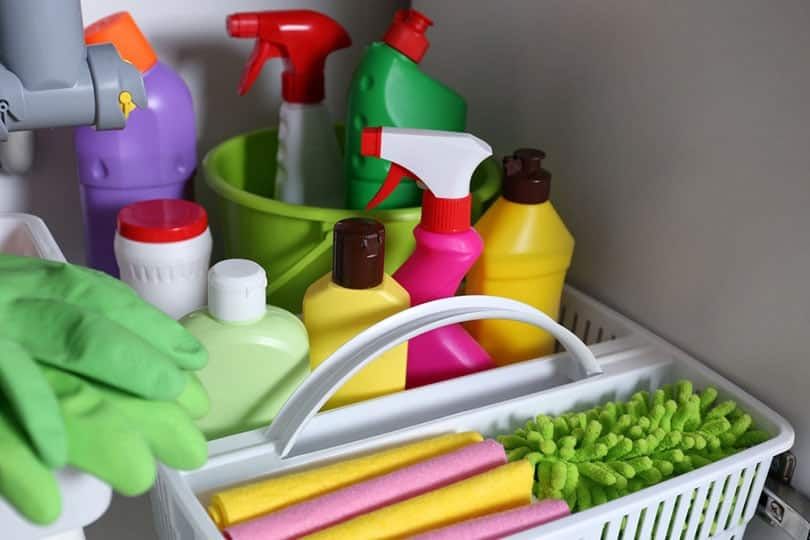
Just about every cleaning product you can think of can be harmful to your cat. These are highly chemical formulas that were not designed with cats in mind. Again, we’re not here to tell you that you can’t clean your house, but that you should use caution when you use cleaning products. Bleach, oven cleaner, detergent, mold-removal liquids, ammonia-hydroxide—all of these and more can cause a wide range of ailments in your cat if licked or eaten.
If you are using these products, make sure your cat is kept away until the product is completely dry; ensure that any spills are cleaned up and that the bottles are kept sealed.
8. Rat Bait

Rat bait, known in the vet world as a rodenticide, can cause life-threatening bleeding disorders if eaten by your cat. Rodenticides are designed to kill rats: the rat nibbles on the bait and then develops a blood clotting disorder. The problem lies in the fact that rat bait can cause this same clotting disorder in cats.
Most cats have enough reserve of clotting factors to be okay for two days after ingestion, but then, as they start to bleed (often internally), they show signs of being unwell. If you have a cat (or dog), we recommend using rat traps and repellents instead of baits.
If you are concerned about the health and well-being of your pet, we recommend getting in touch with a vet for guidance.
Conclusion
Keeping your cat away from potentially harmful household items can seem like a daunting task. The purpose of the above list is not to instill fear, but to familiarize you with common materials, foods, and objects that pose a health risk to cats. Some of these, such as medications, magnets, and food, are reasonable to keep at home while exercising caution. Others, including lilies and rat bait, should probably be avoided altogether.
Different items will cause different signs of illness, so if you have any concerns about your cat’s health, do not hesitate to contact a veterinarian.
Sources
Featured Image Credit: New Africa, Shutterstock
Expert cat care, straight to your inbox
News, insights, and useful advice, delivered to you.

No spam — unsubscribe anytime.
By signing up, you agree to our Terms & Conditions and Privacy & Cookies Policy.
How useful was this post?
Click a star to rate. You can leave written feedback afterwards. (We read all feedback.)
Dr. Joe Mallat DVM (Veterinarian)
Joe is a veterinarian from Sydney, Australia. When he's not at his office, he enjoys cooking, exercising, and exploring the wilderness in Australia. He has worked for 2 years at a mixed-species practice on the mid-north coast of New South Wales, treating animals of all sizes. His areas of particular interest include internal medicine, wound management and oncology. Joe's love for the profession comes not only from helping cats, but also from helping their parents and working with wonderful teams of people.
Joe completed his Bachelor of Veterinary Biology and Doctor of Veterinary Medicine at the University of Sydney in 2020.