In this article
View 3 More +If you’re planning on adding a new kitten to your family, you might be researching to see which breed will suit you best. Maybe you’re drawn to the wild and natural looks of the Siberian Cat and Maine Coon, with their long coats and robust, athletic builds.
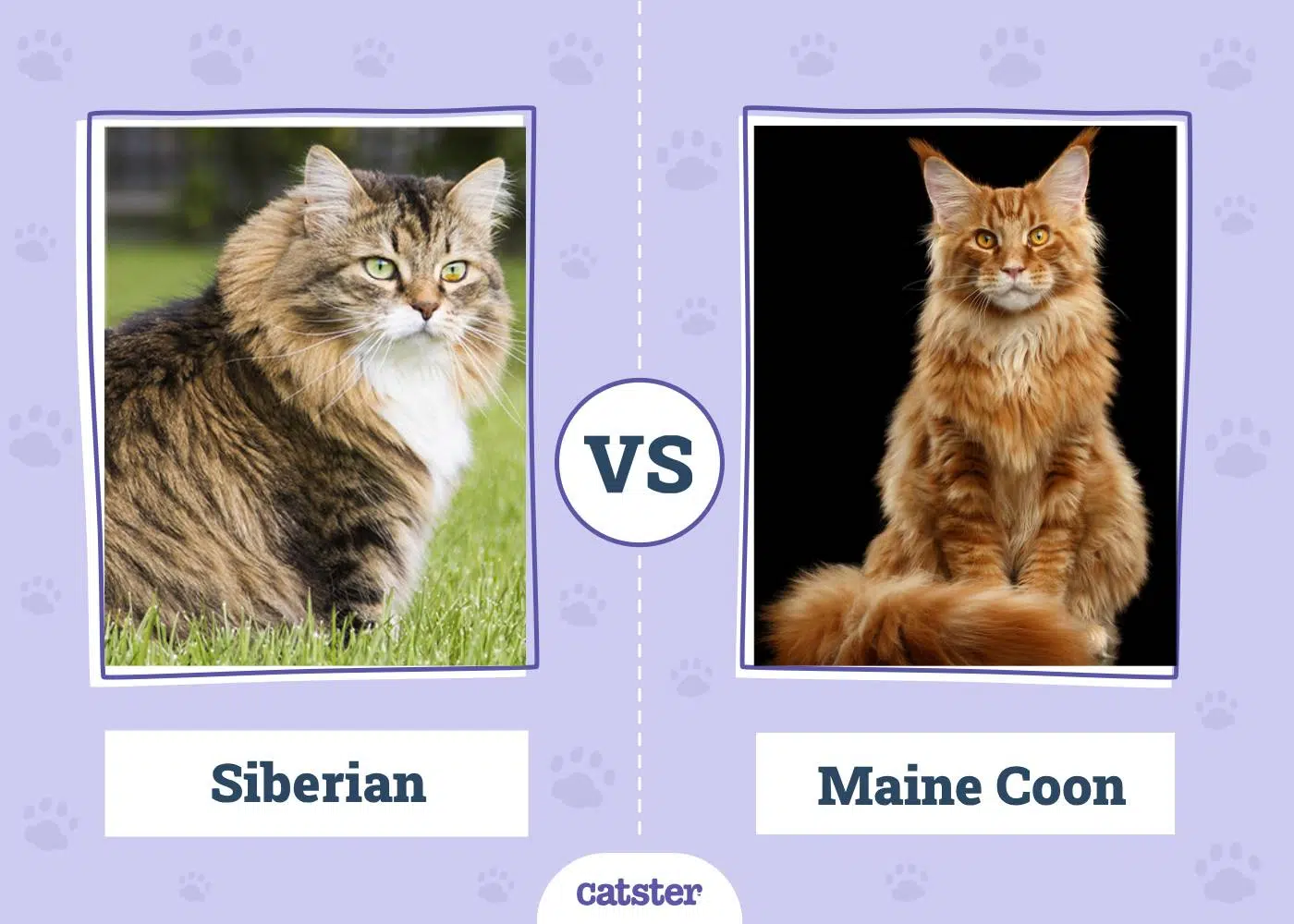
While they may look similar at first glance, there are significant differences between the two breeds. If you sat them down side by side, it would be easy to see that the Maine Coon is significantly larger, and the chunky cats are one of the largest breeds of domesticated cats.
We’ll tell you everything that you need to know about both breeds so you can decide which of them is going to join your family!

Siberian Cat vs. Maine Coon: Visual Differences

At a Glance
- Average Height: 9–13 inches
- Average Weight: 8–15 pounds
- Lifespan: 11–17 years
- Grooming Needs: Moderate
- Family-friendly: Yes
- Other pet-friendly: Yes
- Trainability: Intelligent
- Average height (adult): 10–16 inches
- Average weight (adult): 11–26 pounds
- Lifespan: 12–15 years
- Exercise: Moderately active
- Grooming needs: Medium
- Family-friendly: Yes
- Other pet-friendly: Yes
- Trainability: High

Siberian Cat Breed Overview
Siberian Cats are also sometimes called Siberian Forest Cats. Their history can be traced back to the subarctic forests of Siberia, where they evolved as a naturally occurring breed without any intervention from humans. The first written references to longhaired cats resembling Siberians date back to around the 11th century.
They have been a popular breed in Russia since the 17th century. Russian fairy tales refer to the Siberian Cat, and they were thought to be magical animals that protected children. They were first seen in the U.S. as late as the 1990s and didn’t arrive in the U.K. until 2002.

Personality & Character
Siberian cats are loyal and intelligent. They love human company and often make a point of being in the same room as their families. Their affectionate and laidback nature means they also enjoy hanging out with children and other pets. They have a playful streak, and it’s a good idea to keep your house well stocked with toys for them to entertain themselves with!
Due to their background, Siberian cats love being outdoors. A Siberian is never happier than when they’re up a tree, watching the world go by. Unlike many breeds, most Siberians adore water, so don’t be surprised if you see your cat playing in puddles or ponds or investigating the shower!
Health & Care
Siberian Cats have a dense triple-layered coat for keeping them warm during a Siberian winter! This includes an undercoat, a middle coat, and a water-resistant outer coat. They can have a thicker ruff or frill of hair around their necks, as well as thick tails, britches, and ear tufts.
Their fur is waterproof, and while it doesn’t tend to tangle, they’ll need regular grooming approximately every 1–2 weeks to make sure any shed hair is removed and to prevent mats and dirt from settling in. Siberians shed their coats in the fall and spring, so at those times, you’ll groom them more often to keep on top of the extra fur!
Some breeders refer to the Siberian Cat as hypoallergenic. While no cat breed is completely hypoallergenic, Siberians may produce lower levels of the “Fel d 1” cat allergens compared to some other breeds, though this varies by individual cat.
Siberian cats are, on the whole, a healthy breed, but they can suffer from several health conditions.
- Hypertrophic cardiomyopathy
- Polycystic kidney disease
- Erythrocyte pyruvate kinase deficiency

Breeding
You should always take the time to find a reputable breeder who specializes in Siberians. Make sure to ask them about the risk of health conditions, including the results of any cardiac screening and genetic tests that they’ve had carried out on the parent cats.
Color
Siberians come in a huge range of different colors, including solid colors like black, white, or blue, a range of tabby patterns, colorpoint, and even lynx colorpoint. Their eyes can be gold, green, copper, or blue. Some cats may have two differently colored eyes.
Suitability
Siberian cats suit families looking for a breed that loves interacting with their human family members but isn’t overly demanding in how much attention they need from you. Siberians are usually playful and affectionate, but they will be happy to relax while you’re busy.
Their laid-back character makes them an excellent choice for busy, multi-pet households. They have lovely personalities and are less likely to trigger cat allergies than other breeds, though this is not guaranteed. They’re healthier than many other purebred cats, but they can suffer from heart disease if not carefully bred by an experienced breeder.
- Loves human company
- Affectionate, kind, and playful
- Generally healthy
- Good with kids
- Enjoys living with other pets
- Coat needs a great deal of maintenance
- Expensive to buy
- Will shed twice a year

Maine Coon Breed Overview
The charismatic Maine Coon is one of the largest breeds of domestic cats, with males weighing up to 26 pounds. This American breed is often likened to a dog in terms of personality. They love human company and usually hang out wherever their favorite humans are.
Maine Coon cats can be traced back to 19th-century Maine, where they were used as ship’s cats due to their exceptional hunting skills. The first record of a Maine Coon cat was in 1861 and referred to a black-and-white cat. Their name is thought to derive from the ringed tail of the original Maine Coons, which resembled raccoon tails.

Personality & Character
The outstanding personality of the Maine Coon is one of the main reasons they have exploded in popularity over recent years. They love hanging out with people, but they’re not overly vocal about demanding attention.
They’re playful enough to love learning tricks, and they can make great companions for kids. They’ll be happy to play fetch, learn to sit, and more. They also get along well with dogs, possibly because their personality can resemble that of their canine friend in more ways than one!
Maine Coons love their families, but they can be standoffish with strangers. They love to spend time outdoors and often explore their surroundings if safely supervised.
Health & Care
Maine Coons have a thick double coat that is thick and shaggy. It’s longer on the stomach and back than anywhere else, and they often have a ruff around their neck. Their ears are much hairier than those of other breeds. Their coats need grooming biweekly, but most Maine Coons enjoy being brushed, and it will be an easy task.
They shed a little year-round and will shed more twice a year as their seasonal coat changes come through. Maine Coons can suffer from a wider range of health conditions than other breeds, partly because very few cats of this breed were left in the 1900s, so the gene pool was significantly reduced.
- Hip dysplasia
- Feline hypertrophic cardiomyopathy
- Spinal muscular atrophy

Breeding
Maine Coons are now a popular breed, so you should find plenty of reputable breeders to choose from. Many of the health conditions that Maine Coons suffer from can be tested for, and you should ask any breeder for information on the genetic tests that they’ve had carried out on the parent cats.
Color
Maine Coons can come in a wide range of colors, including solid colors like black, red, and cream, tabby patterns like mackerel and classic tabby, and bi-color, part-color, shaded, and smoke.
Maine Coons can have green-gold, gold, green, copper, or blue eyes. Cats with white fur may have odd-colored eyes.
Suitability
Maine Coons are a great choice for families who want an affectionate yet independent cat. They love being involved in family life, but they’re also happy to do their own thing when you’re busy or away from the house. They love learning tricks, interacting with kids and other pets, and playing in water.
You may need to invest in larger or sturdier accessories for your Maine Coon cat, as once fully grown, they won’t fit in a regular-sized cat bed and can easily topple a cat tree that’s been designed for lighter felines! They can suffer from a higher incidence of health problems than some other breeds, so bear in mind that you may need to budget for higher-than-average vet bills.
- Great with kids
- Suitable for multi-pet households
- Affectionate and laidback
- Adaptable
- Enjoy walking on a leash
- Relatively low-maintenance grooming
- Can be left alone
- Easy to train
- Expensive to buy
- Can suffer from health problems
- Independent

Price of Siberian Cats vs. Maine Coon
So, how much are Siberian Cats? They are still a rare breed, so you should expect to pay anywhere from $1,000-$2,000. For Maine Coons, you can pay $500-$1,500.
With both breeds, it’s essential to take your time and find a reputable breeder who can answer all your questions about health tests, facilities, and their breeding program. They should be able to provide you with references from previous customers, as well as show you the genetic test results for both parent cats. If possible, it’s always a good idea to visit a breeder to meet both parent cats and their kittens in person.

Siberian Cat vs. Maine Coon: Which Breed Is Right for You?

Now you should have a better idea of whether the Siberian Cat or the Maine Coon is going to suit you and your family better. They’re both affectionate and outgoing cats with plenty of love to give to their families.
The Siberian Cat can be a little more outgoing when it comes to strangers, with the Maine Coon preferring to sit back and wait rather than interact with people they don’t yet know and trust. They’re both playful breeds with a love of water and the outdoors.
Maine Coons are much larger and can suffer from a higher incidence of health conditions. Siberian Cats are smaller than Maine Coons, and while some people with allergies report better tolerance, allergen levels vary by individual cat, and no breed is guaranteed to be suitable for allergy sufferers.
Whether either of these breeds will be the perfect fit for your family is a question only you can answer. However, now that you know more about their appearance, personality, and health, you’re in a great place to make that choice!
Featured Image Credit: Left – Massimo Cattaneo, Shutterstock | Right – Seregraff, Shutterstock