Why Does My Cat Meow When I Sneeze? Vet-Reviewed Facts & Funny Videos


In this article
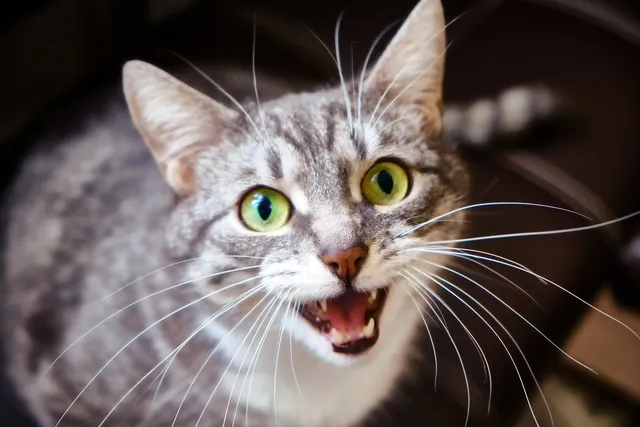
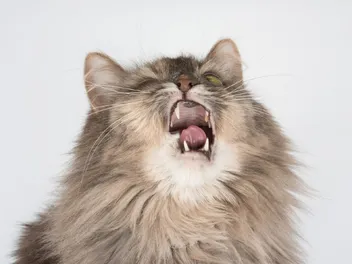
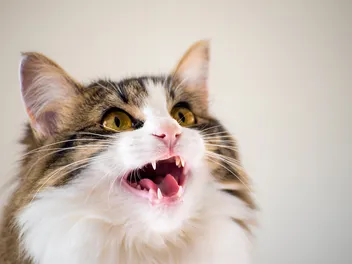
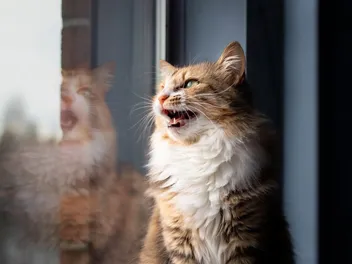
Most cats are devoted to their humans; they commonly hang out and spend lots of time with their favorite people. Some cats meow in response to their owners’ sneezes; if yours does, it may have led you to wonder, "Why do cats meow when you sneeze?" Cats sometimes meow or vocalize in return when people sneeze because they’re annoyed or startled, but they frequently do it just as a way of acknowledging their human’s situation. There is a good chance that this was a learned behavior reinforced by their owner’s attention right after their meow or vocalization.

What Does A Cat’s Meow Mean?
Interestingly, cats almost only meow to humans, not other cats. When cats are kittens, they will meow to their mothers for help. As they mature in the wild, the instinct to meow slowly disappears.
Domesticated cats, on the other hand, retain their instinct to meow. This may be because they are cared for by humans. In other words, they are constantly babied and nurtured by their human owners, and they certainly don't mind it.
Most of the time, a cat's meow means that they want something. Whether it's attention, food, or outdoor time, cats meow to communicate a need. Meows can also mean that the cat is excited to see you, almost like they say, “Welcome home!” whenever you get home from work.
More negatively, meows can show that your cat is lonely or ill. Older cats meow more when they get confused or anxious. Similarly, young and old cats can meow to their human owner to show annoyance or that they're startled, which is likely the case when your cat meows after a sneeze.

Cats and Loud Noises
Even though cats are domesticated, they are hunters at heart. This allowed their ears to evolve so that they were highly sensitive to even the slightest noise. Their sensitive ears help them hear faraway prey.
At the same time, smaller cats, like the regular house cat, can be prey for larger animals. This makes them very keen on situations that they perceive as dangerous. In other words, cats are likely to run away whenever they feel that they are in danger.
Because of cats' sensitive ears and predisposition to run away in frightening situations, sneezes are quite an experience for your kitty. Whenever you sneeze, the muscles in their middle ear contract. This lessens the sound emissions to protect their inner ear.
Many cats perceive this phenomenon differently. Some get excited, while others get scared. As a result, there are quite a few responses that a cat can give whenever you sneeze. Even though some reactions are positive, most are negative because sneezes are often loud and sudden, scaring most cats.
Top 4 Common Responses to Sneezes
While many cats meow when their humans sneeze, their responses can vary. Some cats just get angry, and others appear more interested in expressing their concern.
1. Annoyed Cats
Cats are especially known for their sassy behavior. Whether you are petting them the wrong way, disrupting their nap, or not feeding them enough snacks, cats are quick to show you that they are displeased and annoyed with your behavior.
Much like anger, annoyance is often expressed in humans through grunts or sounds of disapproval. Cats are similar, and they sometimes meow whenever they are annoyed. The sounds are likely distinguishable to other cats, but to the human ear, the meows often sound the same.
Whenever you sneeze, you may disrupt the cat’s nap or relaxation time. Instead of getting startled, they become annoyed by the loud noise. This causes them to meow their disapproval for the annoying noise you put them through. How dare you!
The cat in the video wants their owner to settle down so they can go back to lounging in peace.
2. Scared Cats
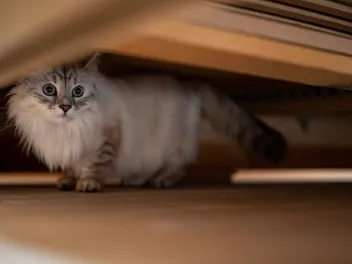
Whenever you get startled by something, you may shout or jump back. Cats are the same way. Whenever they get scared, they meow in response. Even though someone sneezing does not cause most humans to jump, the same cannot be said about cats.
Cats like for their life to be pretty quiet and simple. Anything out of the ordinary tends to incite a fight or flight response. This is especially true if the abnormal behavior is loud, like a sneeze. Since sneezes are not the most common sound for a cat to hear, they get startled whenever you sneeze, causing them to let out an exclamatory meow.
The chances are that your cat isn't really scared of you. They're just surprised to hear you sneeze. You have probably been startled a time or two by an extra loud sneeze yourself. The meow is just your cat's way of saying they didn't see your sneeze coming.
Cats have incredibly acute hearing, and noises that seem normal to people can easily startle them. Scared cats sometimes move past meowing in response to sneezes and immediately shift into high gear.
3. Sympathetic Cats
Cats are brilliant creatures. Even though we can't communicate with them, they are good at picking up on behavior patterns and responses. Since their entire world is within your house, they have a lot of time to pick up on behaviors and responses, such as when you sneeze.
Interestingly, there are a lot of studies that show cats like to imitate human behavior. They will take on human habits and cat-ify them. This is an exciting phenomenon that many types of domesticated animals display with their owners.
Your cat may be imitating you whenever they meow after a sneeze. The meow could be their version of sneezing, or they could be imitating how people say "bless you" after a sneeze. Since they cannot speak, they respond verbally like your children, partner, or friend does after you sneeze.
These cats seem to be doing something between copying their person and asking if they're okay. This is likely a way that the cat acknowledges that something’s going on and that they are willing to engage with their humans. Their responses are calm and collected.
4. They Mistake Your Sneeze for a Hiss
Perhaps your cat mistakes your sneeze for a hiss. As a result, they meow or hiss back in response. They likely don't understand why you were hissing in the first place. So, they meow after your sneeze to figure out what's wrong and why you would express such a grievance with them.
This response is similar to how you would respond whenever a friend or a close family member has an unforeseeable outburst. You ask them what's wrong to get to the bottom of the issue. Your cat wants to do the same with you.
Since hissing is the cat’s form of telling someone to back off, your cat may not understand the reason for your sudden sneeze.
Frequently Asked Questions
Why Do Cats Meow?
Adult cats mostly use scent and body language to communicate with each other. Meowing is generally reserved for communication between kittens and their mothers and grown cats and people. Cats meow to express pleasure when people show affection, but they can also do it because they want to engage in some sort of communication with their humans, like when they are hungry or in pain.
They also meow to get their owner’s attention and ask for a treat or cuddles. Cats trying to get their owners to clean their litter boxes or give them food often meow repeatedly in complaining tones. They may also meow when frightened or stressed.
A cat that vocalizes back to a human after a sneeze might only be acknowledging that they know that something happened, or they might have learned that after responding to a sneeze, they will get some sort of attention in return.
How Else Do Cats Communicate With Humans?
Cats turn to body language and vocalization to get their points across to humans. They frequently use their whiskers and tails to indicate how they're feeling. Cats probably lean heavily on vocalization when trying to make things clear to humans, as it's often difficult for people to pick up on the subtleties of feline body language.
It also appears that many cats and their human companions develop blended languages that facilitate communication.
How Do Cats Communicate With Other Cats?
Cats typically rely on body language and scent to exchange information with other cats. They use a variety of mechanisms, including whisker and tail position, to indicate if they're happy, scared, cautious, or interested in interacting.
Scent plays an enormous role in feline communication. Cats produce pheromones, which are odorless chemical markers that carry information about their health and reproductive status. Pheromones are produced by scent glands found in several locations on cats' bodies, including their faces and paws. These powerful hormones are also found in their urine, which is one of the reasons cats spray to mark their territory.
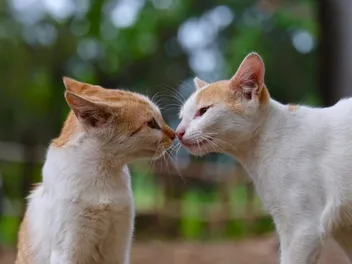
Adult cats occasionally hiss or yowl in the direction of other cats when scared. They often touch noses or link tails with those they're happy to see and feel comfortable around.
Do Cats Imitate Their Humans?
There's some evidence that cats’ behavior is affected by their owners, and they can have personality traits that mirror those of their favorite people. Cats attempt to bond with their favorite people by showing interest in activities requiring humans to focus intensely, and cats likely interpret the activities as necessary to their companions.
There's some evidence that cats can also imitate human behavior. In one study, a cat learned to accurately mirror human actions; if the human in the experiment touched a box with her hand, the cat would do the same with her paw.
Do Cats Have Good Hearing?
Cats have fantastic hearing. They rely on it heavily when hunting in the wild, particularly when there's not much light out. They can also hear sounds entirely undetectable by humans, particularly high-pitched ones like those made by squeaking mice.
Cats' outer ears can move toward sounds, which boosts their hearing abilities. Because they have such fantastic hearing, loud, sudden sounds (like sneezes) can make them scared.
Are There Cats That Typically Meow More Than Others?
Yes. Siamese, Sphynx, Tonkinese, and Bengal cats are known for being quick to let out a meow or two. Unspayed female cats meow frequently when they're in heat, and unneutered males often do so when seeking mates. Kittens are a bit more inclined to meow than adult cats.
Conclusion
Cats have all sorts of adorable ways of interacting and engaging with humans, and it's relatively common for them to meow when people sneeze. They do so for all sorts of reasons, from being startled to simply acknowledging their humans, likely as a learned behavior.
While cats are generally expert communicators, adults don't generally meow to communicate with each other; it's primarily a way of getting information across to humans. Body language and scent are the primary ways cats exchange information with each other.
Featured Image Credit: Cat Box, Shutterstock
Expert cat care, straight to your inbox
News, insights, and useful advice, delivered to you.

No spam — unsubscribe anytime.
By signing up, you agree to our Terms & Conditions and Privacy & Cookies Policy.
How useful was this post?
Click a star to rate. You can leave written feedback afterwards. (We read all feedback.)
Lorre Luther is a writer who is firmly convinced that cats are smarter than humans. She left her law career in the United States and moved to the Netherlands to follow her dream of becoming a writer. Lorre currently lives in Rotterdam, she enjoys traveling and greatly appreciates the beauty of nature. Lorre has a spot for animals and admires the intelligence of cats.