Can a Cat Detect Bed Bugs? Vet-Reviewed Facts & FAQ



In this article
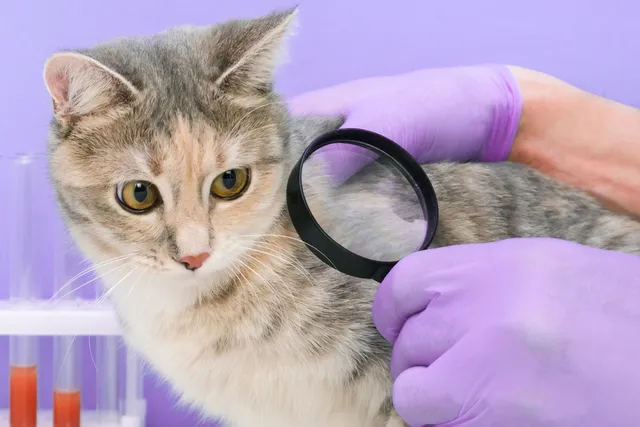
Cats have extraordinary eyesight and sense of smell and are well-known to excel at hunting. Many cat owners have also witnessed their cat catching a fly in midair! But if cats are such great hunters, including tracking down tiny spiders, can they also detect bed bugs?
There is a chance that cats can indeed spot bed bugs, but as you probably know, it’s difficult to get cats to do anything that they don’t want to do, so you won’t be seeing any professional bed bug cat detectors any time soon.
Here, we discuss bed bugs and cats, as well as dogs (for a good reason), and whether you can train your cat to hunt these obnoxious pests!

A Little About a Cat’s Senses
Cats have excellent senses that excel our own (except for taste). When it comes to touch, sight, hearing, and smell, cats are super in tune with their environment and can often pick up on things that we can’t.
Touch
Cats use their sensitive whiskers to navigate their surroundings. Whiskers give cats the ability to sense their environment, particularly tight spaces. They can also detect subtle movements and air currents, which lets the cat know when their potential prey is nearby.

Hearing
Cats have excellent hearing and can pick up sounds beyond humans’ hearing. This includes the ability to hear in high frequency, also known as ultrasonic.
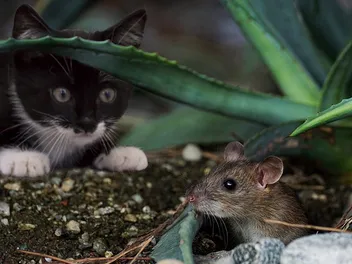
They can also swivel their ears 180 degrees independent of each other, which enables them to precisely locate where a sound is coming from, even if it’s the tiniest prey, such as a mouse scurrying across the floor (which we definitely can’t hear).
Sight
Cats are crepuscular, being most active at dusk and dawn, which has an impact on their eyesight. Cats see much better than us in low light thanks to the high number of rod cells and a reflective layer called the tapetum lucidum, so they can hunt at those times.
Cats also have excellent peripheral vision, and they can see motion in dim conditions quite well. This makes them exceptional hunters, which comes in handy because many rodent species are also only active at dusk and dawn.

Smell
A cat’s sense of smell is one of their most important senses. They have 45-80 million scent receptors in their noses, whereas humans have about 5 million. Their noses enable them to sniff out prey and give them information about where you’ve been and who you’ve met. Their noses keep them safe and are essential for their survival.
Can Cats Detect Bed Bugs?
Probably! The nature of the typical cat makes this a difficult question to answer. A cat’s senses are acute enough to detect bed bugs, and it is conceivable that cats can hear, smell, sense, and see them. It’s also possible for a cat to be curious enough to hunt them down. You’ve probably seen your cat hunting many different insects.
Bed bugs have a sweetish-musty smell that humans will only be able to smell if there’s a severe infestation (and you won’t need a cat to tell you that you have bed bugs at that point!). So, cats may be able to detect them by smell, and their subtle movements may also make them more perceivable.
Bed bugs are most active in the middle of the night, when some cats nap, while youngsters tend to play and explore, depending on their lifestyle, as feline’s nighttime activities can vary significantly.
They aren’t quite as food motivated as dogs, for one thing, and while cats can be trained to do tricks, there currently doesn’t seem to be any cats used to detect bed bugs. But if your cat seems to be uncommonly interested in your mattress, you might want to call an exterminator.
Bed Bug-Sniffing Dogs
The tricky thing about bed bugs is that it can be difficult for an exterminator to find exact locations, particularly the eggs. You might know that they are in the mattress, but in more extreme infestations, they can spread to almost anything with seams and corners.
Some exterminators have dogs specially trained to detect bed bugs in every life cycle — eggs, nymphs, and adults. It’s essential to remove all life stages or the infestation will return.
Some scent hounds have a whopping 300 million olfactory receptors in their noses. Due to their sense of smell and how well they take to training, many dogs can be quite effective at locating bed bugs.
The biggest issues are that it’s expensive to use one of these dogs and that the accuracy isn’t always there — too much depends on the dog and the trainer. That said, you can probably find bed bug detection dogs in almost every city.

Can Cats Get Bitten by Bed Bugs?
Cats won’t carry bed bugs the same way that they can carry fleas. While bed bugs are opportunistic and can feed from your cat, their main target is unfortunately us humans. They find their way into people’s homes by attaching themselves to clothing or bags. They can also find their way in through tiny crevices, like electrical outlets.
They are drawn by the carbon dioxide that we exhale, heat and movement. Once they are home, they inject their saliva which contains numbing compounds into the spot where they bite, so you don’t feel it. They will usually choose a human over an animal — our carbon dioxide emanations are just that appealing. But if a human isn’t around, the bed bugs will gravitate to any living thing, including your cat.
What Should You Do If You Find Bed Bugs?
If your cat is showing intense interest in your mattress (and not in the curling up and sleeping kind of way) or you’ve received bites, wash all your bedding in hot water and dry it at the highest heat setting. If pests are also in your pet’s bedding, wash it the same way. Wipe down any surfaces with rubbing alcohol, and vacuum surfaces well (and empty the vacuum immediately afterward).
That said, eradicating all bed bugs from your home should be left to qualified exterminators. Speak with them before they treat your house to ensure that their method is safe for your pets.

Conclusion
The jury is out if cats can detect bed bugs. They likely can, but they probably cannot be trained to do so. If your cat is suddenly interested in your mattress, it might not necessarily be bed bugs. Cats find almost anything interesting!
Hopefully, you do not have bed bugs and are just reading this out of curiosity. But if you do need to use a pet to find bed bugs, stick with a dog. Cats probably consider themselves too above this kind of work, anyway!
Related Read: Will Bed Bug Spray Hurt My Cat? What You Should Know!
Sources
Featured Image Credit: ELENA PETRUNEVA, Shutterstock
Expert cat care, straight to your inbox
News, insights, and useful advice, delivered to you.

No spam — unsubscribe anytime.
By signing up, you agree to our Terms & Conditions and Privacy & Cookies Policy.
How useful was this post?
Click a star to rate. You can leave written feedback afterwards. (We read all feedback.)
Kathryn was a librarian in a previous lifetime and is currently a pet writer. When she was a child, she hoped to work in ZOOs or with wildlife in some way, thanks to her all-consuming love for animals. Sadly, she's not strong in the sciences, so she fills her days with researching and writing about all kinds of animals and spends time playing with her adorable but very naughty tabby cat, Bella. Kathryn is hoping to add to her family in the near future – maybe another cat and a dog.