The British may be known for their staunch tradition, but they’re also pioneers of progressive breeding techniques that have produced some incredible British cats. Several of the world’s most beloved felines were developed in Great Britain, including the Cornish Rex, Scottish Fold, and British Shorthair.
Let’s take a closer look at the most recognizable British cat breeds!

The 10 British Cat Breeds
1. British Shorthair

| Lifespan: | 12 to 20 years |
| Suitable for: | Any home, with or without kids or other pets |
| Temperament: | Calm, loving, independent |
At the top of our list of British cats is the British Shorthair, probably the most recognized and oldest breed throughout Britain They were believed to have been brought over by the Romans and were used to help keep the rodent population down. However, after WWI, British Shorthair numbers fell drastically.
To revitalize the breed, they were mated with Persian cats. The breed bounced back, but that joy was short-lived. When WWII came, the population declined again, and Persian cats were needed to reinforce the gene pool. But today, they are abundant and are among the most common cats across the UK.
2. British Semi-Longhair

| Lifespan: | 15–20 years |
| Suitable for: | Indoor environments, families of all types |
| Temperament: | Calm, gentle, friendly, mild |
The British Semi-Longhair came about due to the crossbreeding between British Shorthairs and Persians during the two World Wars. The intermingling of genes between the two is vastly spread, but they are still classified as separate breeds. This means two “pure-bred” British Shorthairs can produce a British Semi-Longhair breed!
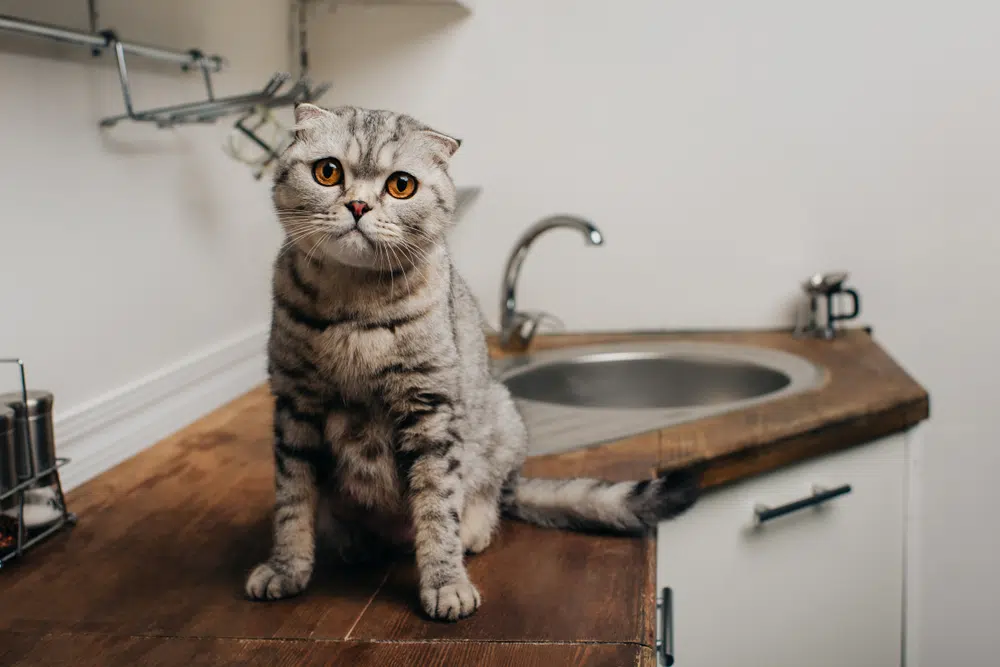
3. Scottish Fold
| Lifespan: | 11 – 15 years |
| Suitable for: | Families with children, families with dogs, apartment living |
| Temperament: | Friendly, social, and docile |
The adorable Scottish Fold is a result of a genetic mutation first discovered in 1961. On a farm near Coupar Angus, Scotland, a white kitten named Susie was born to Mr. and Mrs. McRae with unusual folded ears.
The couple thought nothing of it until a neighboring farmer and cat enthusiast pointed out the extraordinary feature. Two years later, Susie had her litter, with two of the offspring having the same folded ears. As each generation passed, more of these “lop-eared British cats” were born.
4. Scottish Straight

| Lifespan: | 11 – 15 years |
| Suitable for: | Families with children, families with dogs, apartment living |
| Temperament: | Friendly, social, and docile |
While the Scottish Fold is now a highly sought-after breed, some breeding restrictions limit their viability. Two Scottish Folds cannot mate together since the offspring will have homozygous genes leading to skeletal deformities.
Scottish Folds must be paired with one of two accepted breeds: the British Shorthair or the American Shorthair. The resulting kittens are born with upright ears; however, they’ll begin to fold over at around three to four weeks. Those kittens whose ears remain upright are known as Scottish Straights.
5. Cornish Rex

| Lifespan: | 10 – 15 years |
| Suitable for: | Active families and individuals looking for a low-shedding cat |
| Temperament: | Affectionate, loyal, friendly, intelligent, quick learners, gets along well with other pets |
In July of 1950, a tortoiseshell cat named Serena gave birth to a healthy litter of five kittens. There was nothing unusual about it except that one of the kittens had been born with an unusually short and curly coat. The cat, named Kalli, became the progenitor of the Cornish Rex breed.
6. Devon Rex

| Lifespan: | 10–17 years |
| Suitable for: | Active families or individuals who can make a lifetime commitment to a cat |
| Temperament: | Loyal, loving, mischievous, intelligent, friendly, needy |
The Cornish Rex isn’t the only British cat with a short curly coat, as you might also find the Devon Rex. In 1959—nearly ten years after the discovery of the Cornish Rex—Beryl Cox took in an old stray tom living in a nearby deserted tin mine. The tom had an unusual coat and mated with another of her rescue cats, which produced curly-haired offspring.
Shortly after, Beryl saw a photograph in the newspaper for an upcoming cat show featuring Du-Bu Lambtex, a Cornish Rex touted as the only curly-haired cat in Britain. Upon reading, Beryl immediately contacted Du-Bu’s breeder, explaining that she, too, had a similar situation.
This prompted the purchase of Kirlee (Beryl Cox’s kitten) by Mr. Brian Sterling-Webb, a contemporary who worked on the original Cornish Rex breed. As he went to cross Kirlee with other Cornish Rexes, he discovered something astonishing.
All of the offspring produced had straight hair. The curly-haired gene from both Kirlee and the other Cornish Rex kittens were different and there had been two entirely separate curly-haired breeds discovered in Britain within 10 years.
7. Chinchilla

| Lifespan: | 12 – 15 years |
| Suitable for: | Seniors, singles, families with older children |
| Temperament: | Loving, sweet, quiet, gentle, calm, smart |
The Chinchilla is one of the world’s oldest man-made breeds. They look very similar to the flat-faced Persian, but their facial features aren’t as pronounced. They’re known for their easygoing temperament and their beautiful silvery or golden-colored coats.
The breed first appeared in 1882 when a Blue Persian was mated with a stray tom, producing a smoke-colored kitten. This smoke-colored cat Persian cross was later bred with a silver tabby and produced a litter. One of the kittens from the litter later gave birth to the first Chinchilla male.
8. Burmilla

| Lifespan: | 7–15 years |
| Suitable for: | Families, apartment living, companionship for singles and seniors |
| Temperament: | Affectionate, social, easy-going |
Burmillas are a relatively new breed that only appeared on the scene in the early 1980s. They resulted from accidental breeding when a Lilac Burmese female escaped from her home and mated with a nearby Silver Chinchilla male.
The litter produced four short-haired female kittens that were all black-shaded. But it wasn’t their coats and beauty that was so intriguing. It was their calm yet playful, intelligent demeanor. In 1997, the breed was granted recognition.
9. Oriental

| Lifespan: | 12–15+ years |
| Suitable for: | Families or singles with or without pets |
| Temperament: | Playful, active, affectionate, cuddly, intelligent, vocal, attention-seeking |
The Oriental is a very peculiar cat. They were first bred in the UK in the 1950s by breeders looking to create a Siamese cat without the traditional color markings.
They have long and slender beauties and are intelligent and affectionate. Sometimes referred to as Foreign Shorthairs, Orientals were engineered using the lineages of Siamese, Abyssinians, Russian Blues, and domestic shorthairs.
10. Havana Brown

| Lifespan: | 10 – 15 years |
| Suitable for: | Attentive owners, families, and households with other pets |
| Temperament: | Alert, intelligent, friendly |
Another of Britain’s man-made breeds is the Havana Brown. They were first bred during the 1950s when a Siamese male was crossed with a black shorthair female. The resulting litter produced four kittens: three black cats and one curious brown male. This brown feline, named Elmtower Bronze Idol, went on to sire other litters and, with the help of other breeders, established the breed.

Conclusion
As you can see from the cats above, the UK has cat breeding down to an art. They’ve been able to rescue vulnerable breeds from the brink of extinction through specialized breeding, create new breeds through selective crossbreeding, and even harness spontaneous genetic mutations.
Related Read:
- Australia’s Most Popular Cat Breeds (With Pictures)
- Most Popular Cat Breeds in the UK (With Pictures)
Featured Image Credit: PHOTOCREO Michal Bednarek, Shutterstock
 The 10 British Cat Breeds